

Xinjiang Agricultural Sciences ›› 2025, Vol. 62 ›› Issue (6): 1371-1379.DOI: 10.6048/j.issn.1001-4330.2025.06.009
• Crop Genetics and Breeding·Cultivation Physiology·Physiology and Biochemistry • Previous Articles Next Articles
REN Shiheng( ), WANG Aifan, MAO Liping, ZHU Qisheng, SU Xiujuan()
Received:2024-11-13
Online:2025-06-20
Published:2025-07-29
Correspondence author:
SU Xiujuan
Supported by:
任世恒(), 王爱凡, 毛李平, 朱麒任, 苏秀娟()
通讯作者:
苏秀娟
作者简介:任世恒(1997-),男,新疆哈密人,硕士研究生,研究方向为薰衣草遗传育种,(E-mail)1463742799@qq.com
基金资助:CLC Number:
REN Shiheng, WANG Aifan, MAO Liping, ZHU Qisheng, SU Xiujuan. Effects of different reproduction modes on agronomic traits, essential oil yield and quality of lavender[J]. Xinjiang Agricultural Sciences, 2025, 62(6): 1371-1379.
任世恒, 王爱凡, 毛李平, 朱麒任, 苏秀娟. 不同繁殖方式对薰衣草农艺性状、精油产量及品质的影响[J]. 新疆农业科学, 2025, 62(6): 1371-1379.
Add to citation manager EndNote|Ris|BibTeX
URL: https://www.xjnykx.com/EN/10.6048/j.issn.1001-4330.2025.06.009
| 时期 Periods | 繁殖方式 Reproduc tionmode | 株高 Plant height (cm) | 茎粗 Stem thickness (mm) | 东西冠幅 East-west crown width (cm) | 南北冠幅 North-south crown width (cm) | 叶长 Leaf length (mm) | 叶宽 Leaf width (mm) |
|---|---|---|---|---|---|---|---|
| 返青期 Regreenning stage | 扦插 | 26.15±1.48ab | 6.01±0.73a | 32.90±5.95a | 32.70±3.99a | 47.21±5.66a | 4.91±0.56a |
| 种子 | 30.52±3.79a | 4.39±0.90b | 27.80±2.40a | 27.20±3.35b | 40.65±1.45ab | 4.49±1.08ab | |
| 分根 | 24.30±3.73b | 5.28±1.46ab | 23.20±8.85a | 23.30±7.75ab | 40.00±4.27b | 4.30±0.71b | |
| 分枝期 Branching stage | 扦插 | 29.48±3.26a | 8.54±2.96a | 55.26±10.96a | 47.94±0.25a | 51.75±2.25a | 5.50±2.25a |
| 种子 | 32.11±5.11a | 6.07±0.86b | 43.48±7.37ab | 36.99±0.67ab | 44.19±2.04ab | 4.92±2.04ab | |
| 分根 | 28.11±1.99a | 7.11±1.18ab | 32.80±10.95b | 37.30±0.69b | 44.10±4.10b | 4.69±4.10b | |
| 现蕾期 Budding stage | 扦插 | 45.80±3.86a | 10.07±3.57a | 66.60±11.14a | 58.80±11.52a | 54.21±2.34a | 5.84±0.24a |
| 种子 | 47.43±2.36a | 6.93±0.74b | 51.80±8.47a | 46.00±6.87ab | 46.57±1.92ab | 5.29±0.59ab | |
| 分根 | 46.88±4.71a | 8.12±1.59ab | 48.50±11.70a | 42.70±9.89b | 43.90±4.59b | 4.90±0.73b | |
| 盛花期 Blooming stage | 扦插 | 55.66±4.26a | 12.18±3.66a | 83.30±8.64a | 75.80±7.61a | 57.16±2.10a | 6.14±0.3a |
| 种子 | 51.11±3.31b | 8.73±1.41b | 64.30±11.78b | 59.6±10.18ab | 49.13±1.86ab | 5.63±0.62ab | |
| 分根 | 53.49±4.94ab | 10.81±1.44ab | 68.10±10.27ab | 54.80±8.77b | 47.20±5.01b | 5.20±0.72b |
Tab.1 Comparison of plant architecture and leaf traits of annual lavender with different reproduction modes at different development stages
| 时期 Periods | 繁殖方式 Reproduc tionmode | 株高 Plant height (cm) | 茎粗 Stem thickness (mm) | 东西冠幅 East-west crown width (cm) | 南北冠幅 North-south crown width (cm) | 叶长 Leaf length (mm) | 叶宽 Leaf width (mm) |
|---|---|---|---|---|---|---|---|
| 返青期 Regreenning stage | 扦插 | 26.15±1.48ab | 6.01±0.73a | 32.90±5.95a | 32.70±3.99a | 47.21±5.66a | 4.91±0.56a |
| 种子 | 30.52±3.79a | 4.39±0.90b | 27.80±2.40a | 27.20±3.35b | 40.65±1.45ab | 4.49±1.08ab | |
| 分根 | 24.30±3.73b | 5.28±1.46ab | 23.20±8.85a | 23.30±7.75ab | 40.00±4.27b | 4.30±0.71b | |
| 分枝期 Branching stage | 扦插 | 29.48±3.26a | 8.54±2.96a | 55.26±10.96a | 47.94±0.25a | 51.75±2.25a | 5.50±2.25a |
| 种子 | 32.11±5.11a | 6.07±0.86b | 43.48±7.37ab | 36.99±0.67ab | 44.19±2.04ab | 4.92±2.04ab | |
| 分根 | 28.11±1.99a | 7.11±1.18ab | 32.80±10.95b | 37.30±0.69b | 44.10±4.10b | 4.69±4.10b | |
| 现蕾期 Budding stage | 扦插 | 45.80±3.86a | 10.07±3.57a | 66.60±11.14a | 58.80±11.52a | 54.21±2.34a | 5.84±0.24a |
| 种子 | 47.43±2.36a | 6.93±0.74b | 51.80±8.47a | 46.00±6.87ab | 46.57±1.92ab | 5.29±0.59ab | |
| 分根 | 46.88±4.71a | 8.12±1.59ab | 48.50±11.70a | 42.70±9.89b | 43.90±4.59b | 4.90±0.73b | |
| 盛花期 Blooming stage | 扦插 | 55.66±4.26a | 12.18±3.66a | 83.30±8.64a | 75.80±7.61a | 57.16±2.10a | 6.14±0.3a |
| 种子 | 51.11±3.31b | 8.73±1.41b | 64.30±11.78b | 59.6±10.18ab | 49.13±1.86ab | 5.63±0.62ab | |
| 分根 | 53.49±4.94ab | 10.81±1.44ab | 68.10±10.27ab | 54.80±8.77b | 47.20±5.01b | 5.20±0.72b |

Fig.1 Comparison of plant architecture and leaf traits of annual Xinnong Xun 2 at different development stages under different reproduction modes
| 时期 Periods | 繁殖方式 Reproduc tionmode | 株高 Plant height (cm) | 茎粗 Stem thickness (mm) | 东西冠幅 East-west crown width (cm) | 南北冠幅 North-south crown width (cm) | 叶长 Leaf length (mm) | 叶宽 Leaf width (mm) |
|---|---|---|---|---|---|---|---|
| 返青期 Regreenning stage | 扦插 | 20.10±3.78a | 5.42±0.84a | 68.80±4.24a | 68.80±9.21a | 41.00±8.05a | 3.70±0.41b |
| 种子 | 15.10±3.20ab | 4.44±0.50b | 55.63±8.34b | 57.90±9.93a | 41.41±6.87a | 5.76±1.54a | |
| 分根 | 14.10±2.27b | 4.94±1.15ab | 67.73±1.48ab | 60.90±16.48a | 35.32±5.73a | 4.62±1.10ab | |
| 分枝期 Branching stage | 扦插 | 32.67±4.15a | 5.90±0.68a | 78.56±3.97a | 79.28±3.88a | 47.31±8.20a | 4.21±0.64b |
| 种子 | 27.98±4.17a | 4.97±0.63b | 64.28±10.35b | 64.37±11.25b | 47.92±6.27a | 6.32±1.58a | |
| 分根 | 29.89±5.48a | 5.15±0.98ab | 73.90±17.30ab | 69.38±15.28ab | 43.23±7.85a | 5.19±0.93ab | |
| 现蕾期 Budding stage | 扦插 | 50.04±5.74a | 6.52±0.73a | 91.28±6.64a | 88.71±6.16a | 48.99±8.33a | 4.36±0.65b |
| 种子 | 41.77±4.88b | 5.64±0.55b | 74.21±10.36b | 71.03±11.28b | 50.11±5.90a | 6.32±1.58a | |
| 分根 | 45.64±7.310ab | 5.77±0.82ab | 83.61±18.27ab | 77.04±16.30ab | 44.56±8.34a | 5.48±0.83ab | |
| 盛花期 Blooming stage | 扦插 | 69.21±4.15a | 6.85±0.70a | 103.59±7.47a | 97.57±10.55a | 50.45±8.21a | 4.52±0.65b |
| 种子 | 54.54±7.86b | 6.03±0.49b | 84.07±8.33b | 78.03±11.01b | 51.64±6.62a | 7.09±1.53a | |
| 分根 | 54.62±5.65ab | 6.23±0.87ab | 91.97±20.71ab | 88.16±16.62ab | 45.61±8.34a | 5.94±0.83ab |
Tab.2 Comparisons of plant architecture and leaf traits of biennial lavender with different reproduction modes at different development stages
| 时期 Periods | 繁殖方式 Reproduc tionmode | 株高 Plant height (cm) | 茎粗 Stem thickness (mm) | 东西冠幅 East-west crown width (cm) | 南北冠幅 North-south crown width (cm) | 叶长 Leaf length (mm) | 叶宽 Leaf width (mm) |
|---|---|---|---|---|---|---|---|
| 返青期 Regreenning stage | 扦插 | 20.10±3.78a | 5.42±0.84a | 68.80±4.24a | 68.80±9.21a | 41.00±8.05a | 3.70±0.41b |
| 种子 | 15.10±3.20ab | 4.44±0.50b | 55.63±8.34b | 57.90±9.93a | 41.41±6.87a | 5.76±1.54a | |
| 分根 | 14.10±2.27b | 4.94±1.15ab | 67.73±1.48ab | 60.90±16.48a | 35.32±5.73a | 4.62±1.10ab | |
| 分枝期 Branching stage | 扦插 | 32.67±4.15a | 5.90±0.68a | 78.56±3.97a | 79.28±3.88a | 47.31±8.20a | 4.21±0.64b |
| 种子 | 27.98±4.17a | 4.97±0.63b | 64.28±10.35b | 64.37±11.25b | 47.92±6.27a | 6.32±1.58a | |
| 分根 | 29.89±5.48a | 5.15±0.98ab | 73.90±17.30ab | 69.38±15.28ab | 43.23±7.85a | 5.19±0.93ab | |
| 现蕾期 Budding stage | 扦插 | 50.04±5.74a | 6.52±0.73a | 91.28±6.64a | 88.71±6.16a | 48.99±8.33a | 4.36±0.65b |
| 种子 | 41.77±4.88b | 5.64±0.55b | 74.21±10.36b | 71.03±11.28b | 50.11±5.90a | 6.32±1.58a | |
| 分根 | 45.64±7.310ab | 5.77±0.82ab | 83.61±18.27ab | 77.04±16.30ab | 44.56±8.34a | 5.48±0.83ab | |
| 盛花期 Blooming stage | 扦插 | 69.21±4.15a | 6.85±0.70a | 103.59±7.47a | 97.57±10.55a | 50.45±8.21a | 4.52±0.65b |
| 种子 | 54.54±7.86b | 6.03±0.49b | 84.07±8.33b | 78.03±11.01b | 51.64±6.62a | 7.09±1.53a | |
| 分根 | 54.62±5.65ab | 6.23±0.87ab | 91.97±20.71ab | 88.16±16.62ab | 45.61±8.34a | 5.94±0.83ab |

Fig.2 Comparisons of plant architecture and leaf traits of biennial Xinnong Xun 2 at different developmental stages under different reproduction modes
| 繁殖方式 Reproduction modes | 花萼长 Calyx length (mm) | 花萼宽 Calyx width (mm) | 花穗长 Tassels length (cm) | 花穗数 Number of floral cluster (个) | 花轮数 Number of floral whorl (个) | 中轮小花数 Number of small flowers in the middle floral whorls (个) | 第一二花 轮节间距 Pitch of first and second floral whorl (mm) | |
|---|---|---|---|---|---|---|---|---|
| 一年生 Annual | 扦插 | 5.67±0.47a | 2.43±0.19b | 7.82±1.16a | 80.56±15.16a | 5.22±0.44a | 14.00±2.45a | 31.58±7.92a |
| 种子 | 5.17±0.32ab | 2.63±0.14ab | 8.51±1.73a | 24.11±15.36b | 5.78±1.09a | 15.33±3.16a | 18.32±2.38b | |
| 分根 | 4.84±0.22b | 2.69±0.17a | 9.17±1.85a | 59.89±25.41ab | 5.44±0.53a | 15.56±2.60a | 29.07±5.12ab | |
| 二年生 Biennial | 扦插 | 5.4±0.13a | 2.30±0.10a | 11.65±1.23a | 572.22±60.70a | 5.44±0.53a | 13.56±2.19a | 47.81±3.32a |
| 种子 | 5.18±0.24b | 2.31±0.08a | 8.89±1.29b | 296.89±64.16b | 5.11±0.60a | 12.44±1.67a | 36.51±3.86b | |
| 分根 | 5.31±0.11ab | 2.37±0.11a | 9.53±0.83ab | 344.78±85.25ab | 5.22±0.44a | 12.89±1.76a | 37.69±3.52ab |
Tab.3 Comparisons of floral cluster traits of lavender with different reproduction modes
| 繁殖方式 Reproduction modes | 花萼长 Calyx length (mm) | 花萼宽 Calyx width (mm) | 花穗长 Tassels length (cm) | 花穗数 Number of floral cluster (个) | 花轮数 Number of floral whorl (个) | 中轮小花数 Number of small flowers in the middle floral whorls (个) | 第一二花 轮节间距 Pitch of first and second floral whorl (mm) | |
|---|---|---|---|---|---|---|---|---|
| 一年生 Annual | 扦插 | 5.67±0.47a | 2.43±0.19b | 7.82±1.16a | 80.56±15.16a | 5.22±0.44a | 14.00±2.45a | 31.58±7.92a |
| 种子 | 5.17±0.32ab | 2.63±0.14ab | 8.51±1.73a | 24.11±15.36b | 5.78±1.09a | 15.33±3.16a | 18.32±2.38b | |
| 分根 | 4.84±0.22b | 2.69±0.17a | 9.17±1.85a | 59.89±25.41ab | 5.44±0.53a | 15.56±2.60a | 29.07±5.12ab | |
| 二年生 Biennial | 扦插 | 5.4±0.13a | 2.30±0.10a | 11.65±1.23a | 572.22±60.70a | 5.44±0.53a | 13.56±2.19a | 47.81±3.32a |
| 种子 | 5.18±0.24b | 2.31±0.08a | 8.89±1.29b | 296.89±64.16b | 5.11±0.60a | 12.44±1.67a | 36.51±3.86b | |
| 分根 | 5.31±0.11ab | 2.37±0.11a | 9.53±0.83ab | 344.78±85.25ab | 5.22±0.44a | 12.89±1.76a | 37.69±3.52ab |

Fig.3 Comparisons of main agronomic traits between annual and biennial lavender floral cluster under different reproduction modes
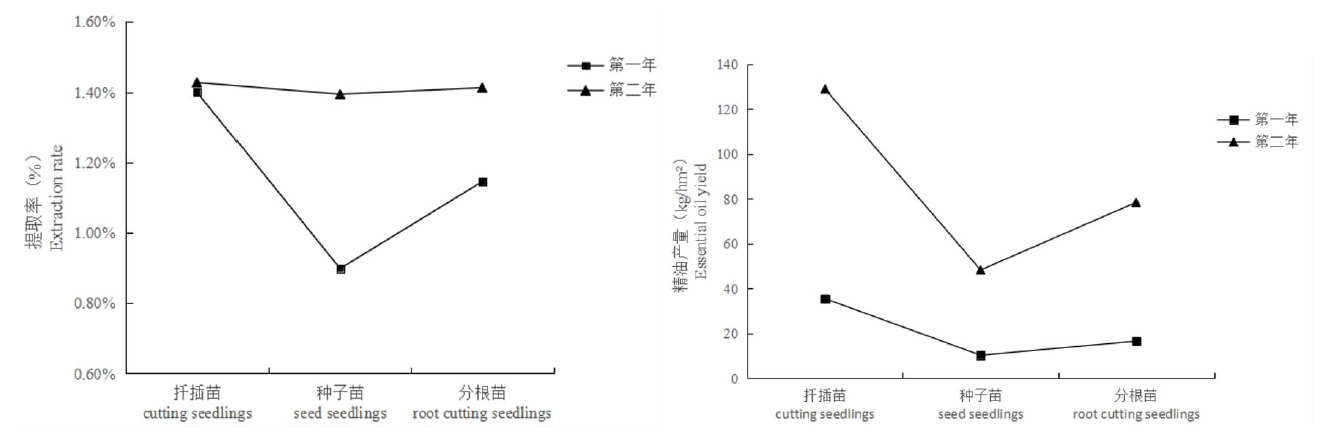
Fig.4 Comparisons of extraction rate and yield of essential oil from annual and biennial lavender under different reproduction modes
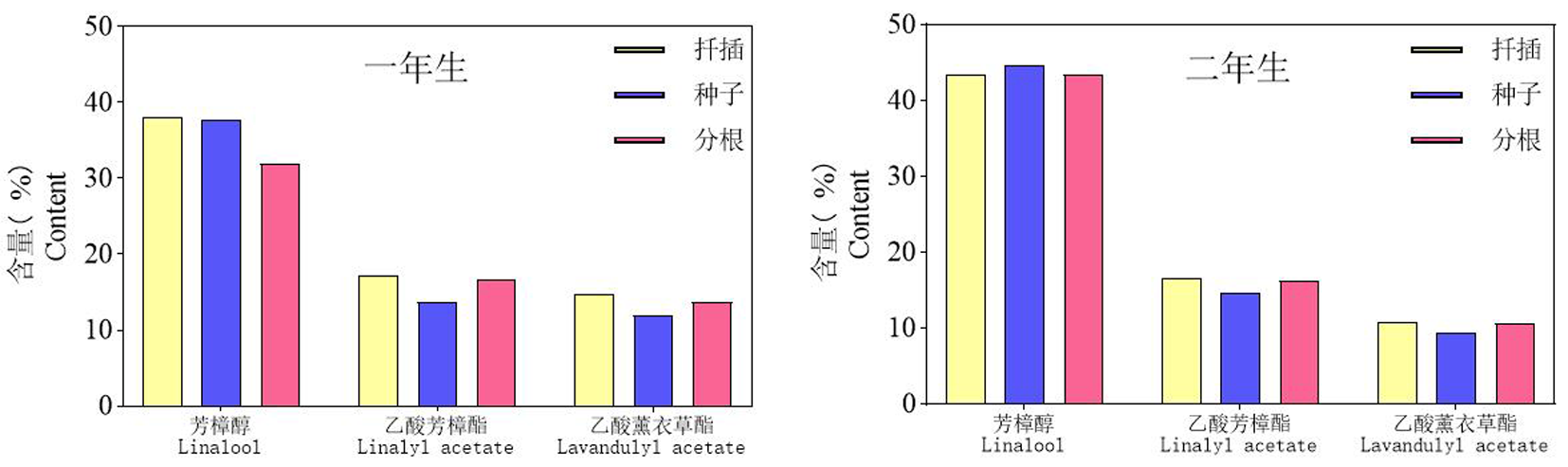
Fig.5 Changes of different reproduction modes on components of lavender essential oil
| [1] | Javed M A, Khan M A, Arshad H, et al. Pharmacological evaluation of Lavandula stoechas L. for ethanol-induced gastric mucosal ulcer[J]. RADS Journal of Pharmacy and Pharmaceutical Sciences, 2020, 8(1): 47-57. |
| [2] | Cavanagh H A, Wilkinson J M. Biological activities of lavender essential oil[J]. Phytotherapy Research, 2002, 16(4): 301-308. |
| [3] | Hajhashemi V, Ghannadi A, Sharif B. Anti-inflammatory and analgesic properties of the leaf extracts and essential oil of Lavandula angustifolia Mill[J]. Journal of Ethnopharmacology, 2003, 89(1): 67-71. |
| [4] | 周甜, 熊令辉, 韦红梅, 等. 芳香疗法在抑郁症患者康复中的研究进展[J]. 中国医学创新, 2023, 20(3): 170-175. |
| ZHOU Tian, XIONG Linghui, WEI Hongmei, et al. Research progress of aromatherapy in rehabilitation of depression patients[J]. Medical Innovation of China, 2023, 20(3): 170-175. | |
| [5] | Nasiri Lari Z, Hajimonfarednejad M, Riasatian M, et al. Efficacy of inhaled Lavandula angustifolia Mill. Essential oil on sleep quality, quality of life and metabolic control in patients with diabetes mellitus type II and insomnia[J]. Journal of Ethnopharmacology, 2020, 251: 112560. |
| [6] | Kavurmacı M, Sarıaslan A, YıldızÍ. Determination the effects of lavender oil quality of sleep and fatigue of students[J]. Perspectives in Psychiatric Care, 2022, 58(3): 1013-1020. |
| [7] | 张群, 扎灵丽. 薰衣草的研究和应用[J]. 时珍国医国药, 2008, 19(6): 1312-1314. |
| ZHANG Qun, ZHA Lingli. Research and application of lavender[J]. Lishizhen Medicine and Materia Medica Research, 2008, 19(6): 1312-1314. | |
| [8] | 王远会, 项华, 何叶, 等. 薰衣草栽培管理技术[J]. 南方农业(园林花卉版), 2009, 3(5): 24-25. |
| WANG Yuanhui, XIANG Hua, HE Ye, et al. Management techniques of lavender cultivation[J]. South China Agriculture, 2009, 3(5): 24-25. | |
| [9] | 李敏, 王自健, 路喆, 等. 不同产地薰衣草H-701精油理化性质比较[J]. 江苏农业科学, 2015, 43(2): 303-306. |
| LI Min, WANG Zijian, LU Zhe, et al. Comparison of physicochemical properties of lavender H-701 essential oil from different origins[J]. Jiangsu Agricultural Sciences, 2015, 43(2): 303-306. | |
| [10] | 谢翠苹, 倪孟羽, 胡千云, 等. 薰衣草繁殖技术研究[J]. 北方园艺, 2012,(18): 110-111. |
| XIE Cuiping, NI Mengyu, HU Qianyun, et al. Research on breeding technology of Lavandula angustifolia[J]. Northern Horticulture, 2012,(18): 110-111. | |
| [11] | 包建红, 郑惠文, 陈晓露, 等. 薰衣草扦插栽培管理技术[J]. 园艺与种苗, 2023, 43(3): 35-37, 93. |
| BAO Jianhong, Zheng Huiwen, Chen Xiaolu, et al. Cutting-planting maintenance and management techniques of Lavandula angusitifolia[J]. Horticulture & Seed, 2023, 43(3): 35-37, 93. | |
| [12] | 程云. 南京地区薰衣草栽培管理技术[J]. 现代农业科技, 2017,(20): 141-142. |
| CHENG Yun. Management technology of lavender cultivation in Nanjing area[J]. Modern Agricultural Science and Technology, 2017,(20): 141-142. | |
| [13] | 魏航, 郑言. 薰衣草栽培管理技术研究[J]. 福建农业, 2015,(5): 80. |
| WEI Hang, ZHENG Yan. Research on the management techniques of lavender cultivation[J]. FuJian Agriculture, 2015,(5): 80. | |
| [14] | 王仲, 高宇, 高洪福, 等. 不同产地薰衣草花中精油化学成分分析[J]. 北方园艺, 2017,(6): 140-143. |
| WANG Zhong, GAO Yu, GAO Hongfu, et al. Chemical composition of essential oil of lavender flower from different regions[J]. Northern Horticulture, 2017,(6): 140-143. | |
| [15] | 万梦婕, 蒋细旺. “新薰一号” 薰衣草在武汉地区高效发芽及移栽研究[J]. 安徽林业科技, 2018, 44(4): 11-15. |
| WAN Mengjie, JIANG Xiwang. Study on high-efficiency germination and transplanting of lavender cultivar Xinxun No.1 in Wuhan City[J]. Anhui Forestry Science and Technology, 2018, 44(4): 11-15. | |
| [16] | 王自健, 李敏, 路喆, 等. 薰衣草不同采收时期对其精油产量及品质的影响[J]. 黑龙江农业科学, 2016,(1): 77-79. |
| WANG Zijian, LI Min, LU Zhe, et al. Effect of different harvesting time of lavandar on the yield and quality of essential oil[J]. Heilongjiang Agricultural Sciences, 2016,(1): 77-79. | |
| [17] | 赵爱娟, 陈秀丽, 韩欣然. 薰衣草精油提取工艺的正交优化及其成分的GC/MS测定[J]. 中国食品添加剂, 2017, 28(4): 168-172. |
| ZHAO Aijuan, CHEN Xiuli, HAN Xinran. Orthogonal optimization of extraction technology of lavender essential oil and its compositionanalyzed by GC/MS[J]. China Food Additives, 2017, 28(4): 168-172. | |
| [18] | 张健, 蔡宝国, 章苏宁, 等. 薰衣草精油化学成分的GC-MS分析比较[J]. 食品工业, 2007, 28(5): 52-54. |
| ZHANG Jian, CAI Baoguo, ZHANG Suning, et al. Determination of essential oils from lavendula officinalis by GC-MS[J]. The Food Industry, 2007, 28(5): 52-54. | |
| [19] | 金建忠, 哈成勇. GC-MS法测定熏衣草精油的化学成分[J]. 食品与生物技术学报, 2005, 24(5): 68-71. |
| JIN Jianzhong, HA Chengyong. GC-MS determination of chemical components of essential oil from lavender[J]. Journal of Wuxi University of Light Industry, 2005, 24(5): 68-71. | |
| [20] | 刘钦玲, 王海涛. 薰衣草的栽培管理及园林应用[J]. 中国园艺文摘, 2012, 28(2): 132-133. |
| LIU Qinling, WANG Haitao. Cultivation management and garden application of lavender[J]. Chinese Horticulture Abstracts, 2012, 28(2): 132-133. | |
| [21] | 李红艳, 孙亚楠. 水稻雄性不育系扦插繁殖成活规律研究[J]. 种业导刊, 2018,(8): 28-30. |
| LI Hongyan, SUN Yanan. Study on the rule of cutting propagation of male sterile lines in rice[J]. Journal of Seed Industry Guide, 2018,(8): 28-30. | |
| [22] | 来端. 乐昌含笑种子育苗和扦插繁殖技术研究[J]. 林业科学研究, 2006, 19(4): 441-445. |
| LAI Duan. A study on seedling breeding and cuttage reproduction of Michelia chapensis[J]. Forest Research, 2006, 19(4): 441-445. | |
| [23] | 臧传富, 苏建荣, 张志钧. 云南红豆杉扦插苗和实生苗的生长及光合特性[J]. 林业科学研究, 2010, 23(3): 411-416. |
| ZANG Chuanfu, SU Jianrong, ZHANG Zhijun. Research of photosynthetic characteristics and the growth of seedlings and cutting stocks of Taxus yunnanensis[J]. Forest Research, 2010, 23(3): 411-416. | |
| [24] | 江海都, 柴胜丰, 熊忠臣, 等. 金花茶回归苗木的生长、光合特性和叶片形态特征[J]. 广西科学, 2023, 30(6): 1180-1189. |
| JIANG Haidu, CHAI Shengfeng, XIONG Zhongchen, et al. Growth, photosynthetic characteristics and leaf morphological characteristics of Camellia nitidissima reintroduction plants[J]. Guangxi Sciences, 2023, 30(6): 1180-1189. | |
| [25] | 赵健, 赵志国, 唐凤鸾, 等. 龙牙百合的研究进展[J]. 贵州农业科学, 2017, 45(7): 78-81. |
| ZHAO Jian, ZHAO Zhiguo, TANG Fengluan, et al. Progress in Lilium brownii var. viridulum[J]. Guizhou Agricultural Sciences, 2017, 45(7): 78-81. | |
| [26] | 伍观娣, 连辉明, 张春花, 等. 广东阴香叶精油及其主要化学成分含量变异与评价[J]. 林业与环境科学, 2020, 36(6): 88-95. |
| WU Guandi, LIAN Huiming, ZHANG Chunhua, et al. Content variation and evaluation of essential oil and its main chemical components of Cinnamomum burmannii in Guangdong Province[J]. Forestry and Environmental Science, 2020, 36(6): 88-95. | |
| [27] | 童红梅, 赵剑鸣, 宋巧, 等. 甘肃平凉地区甜叶菊引种试验初报[J]. 甘肃科技纵横, 2023, 52(11): 17-19. |
| TONG Hongmei, ZHAO Jianming, SONG Qiao, et al. Preliminary report of the introduction of stevia in Pingliang region, Gansu Province[J]. Scientific & Technical Information of Gansu, 2023, 52(11): 17-19. | |
| [28] | 王以红, 覃子海, 吴幼媚, 等. 芳樟醇型樟树选优与其无性系的含樟油性状评价[J]. 西部林业科学, 2010, 39(2): 18-21. |
| WANG Yihong, QIN Zihai, WU Youmei, et al. Plus tree selection of Cinnamomum camphora and character evaluation of camphor oil[J]. Journal of West China Forestry Science, 2010, 39(2): 18-21. | |
| [29] | 方培华, 钟展, 李兰, 等. 营造良种——岑溪软枝油茶无性繁殖种子园技术研究报告[J]. 广西林业科技, 1987, 16(2): 10-15. |
| FANG Peihua, ZHONG Zhan, LI Lan, et al. Research report of seed garden[J]. Guangxi Forestry Science, 1987, 16(2): 10-15. |
| [1] | HAO Xiyu, LIU Tingting, WANG Hui, LENG Jingwen, GONG Shihang, LIU Wei. Selection and comprehensive evaluation of nitrogen-efficient foxtail millet varieties based on principal component analysis [J]. Xinjiang Agricultural Sciences, 2025, 62(3): 619-626. |
| [2] | ZHANG Xiaole, Wueren Ahebieerdi, Entemake Bulatibai, Muguli Muhaxi, YUAN Qingqing, BAI Ru. Changes in bacterial diversity and community structure in rhizosphere soil of lavender with different continuous cropping years [J]. Xinjiang Agricultural Sciences, 2025, 62(3): 706-714. |
| [3] | LU Mingkun, LI Junhong, Nilupaier Yusufujiang, PAN Xipeng, LIU Xiaocheng, ZHANG Zhenggui, PAN Zhanlei, ZHAI Menghua, ZHANG Yaopeng, ZHAO Wenqi, WANG Lihong, WANG Zhanbiao. Effect of silic on fertiliser application on the growth and development of cotton and its yield and quality [J]. Xinjiang Agricultural Sciences, 2025, 62(2): 286-293. |
| [4] | CHEN Yong, ZHOU Lei, SUI Chun, LIN Caixia. The characteristics of 32 cultivated germplasms of Isatis tinctoria Linnaeus in Xinjiang production area [J]. Xinjiang Agricultural Sciences, 2024, 61(9): 2307-2314. |
| [5] | MIAO Yu, CHEN Cuixia, MA Yanming, XING Guofang, DONG Yusheng, CHEN Zhijun, WANG Xian, XIANG Li. Genetic diversity analysis of phenotypic traits of 276 Central Asian barley germplasm resources [J]. Xinjiang Agricultural Sciences, 2024, 61(8): 1888-1895. |
| [6] | YE Pingyi, LONG Yilei, TANG Yanping, DU Xiao, AN Mengjie, TAO Zhixin, LIANG Farui, AI Xiantao, HU Shoulin. Identification and evaluation of fruit branch angle and machine-picked agronomic traits in Gossypium hirsutum L. [J]. Xinjiang Agricultural Sciences, 2024, 61(6): 1318-1327. |
| [7] | LIU Yue, JIA Yonghong, ZHANG Jinshan, YU Yuehua, WANG Runqi, LI Dandan, SHI Shubing. Comparison of peanut varieties with different high oleic acid under drip irrigation [J]. Xinjiang Agricultural Sciences, 2024, 61(6): 1361-1367. |
| [8] | YANG Xiangbo, CHEN Liangyu, YANG Songnan, CHEN Xifeng, XING Weiming, LI Xueying, CONG Weixuan, ZANG Zhenyuan, ZANG Yuanbo, ZHANG Jun. Phenotype analysis and comprehensive evaluation of spring soybean germplasm resources from northeast China [J]. Xinjiang Agricultural Sciences, 2024, 61(12): 2921-2933. |
| [9] | LI Chunyu, TAN Zhanming, CHENG Yunxia, SHU Sheng, MA Quanhui, HE Miao, DUAN Yifan, WU Hui. Comparative analysis of agronomic traits of different processing tomato varieties [J]. Xinjiang Agricultural Sciences, 2024, 61(11): 2676-2683. |
| [10] | CUI Yujiang, GONG Zhaolong, WANG Junduo, ZHENG Juyun, SANG Zhiwei, YANG Ni, LIANG Yajun, LI Xueyuan, QU Yanying. Comprehensive evaluation of basic agronomic traits and yield components of 245 Gossypium hirsutum L. varieties [J]. Xinjiang Agricultural Sciences, 2024, 61(10): 2358-2365. |
| [11] | SHAO Jiang, ZHAO Yun, HU Xiangwei, LIU Jie, Nasirula Keremu, SHI Shubing, FENG Guojun. Effects of drought stress on foxtail millet yield and dry matter accumulation in different periods [J]. Xinjiang Agricultural Sciences, 2024, 61(10): 2388-2395. |
| [12] | WANG Ting, ZHANG Li, ZHANG Fanfan, HUANG Rongzheng, LI Xiao, ZHANG Yulin, CHEN Yongcheng, ZHAO Jiantao, MA Chunhui. Poduction performance screening and nutritional value evaluation of corn varieties suitable for silage [J]. Xinjiang Agricultural Sciences, 2023, 60(7): 1596-1605. |
| [13] | SHI Xiaolei, DING Sunlei, CONG Hua, ZHANG Jinbo, QU Kejia, WANG Xingzhou, HAN dai, YAN Yongliang. Gray correlation analysis of reast soybean yield correlation traits [J]. Xinjiang Agricultural Sciences, 2023, 60(7): 1641-1652. |
| [14] | YAN Yongliang, ZHANG Heng, QU Kejia, SHI Xiaolei, WANG Xingzhou, ZHANG Jinbo, CONG Hua. Comparative study on the agronomic traits and yields of different soybean varieties [J]. Xinjiang Agricultural Sciences, 2023, 60(7): 1653-1662. |
| [15] | HUANG Qiannan, Maerheba Aisibaier, ZOU Hui, WANG Cairong, Ailimaimaiti Kuerban, SUN Na, LEI Junjie. Genetic diversity of main agronomic traits in Xinjiang winter wheat germplasm resources [J]. Xinjiang Agricultural Sciences, 2023, 60(5): 1050-1058. |
| Viewed | ||||||
|
Full text |
|
|||||
|
Abstract |
|
|||||
