

Xinjiang Agricultural Sciences ›› 2025, Vol. 62 ›› Issue (4): 807-819.DOI: 10.6048/j.issn.1001-4330.2025.04.004
• Crop Genetics and Breeding · Cultivation Physiology · Physilolgy and Biochemistry • Previous Articles Next Articles
QIAO Di1( ), LIN Tao2(), CUI Jianping2, ZHANG Pengzhong2, ZHANG Hao1, BAO Longlong1, TANG Qiuxiang1,3()
Received:2024-08-19
Online:2025-04-20
Published:2025-06-20
Supported by:
乔迪1(), 林涛2(), 崔建平2, 张鹏忠2, 张昊1, 鲍龙龙1, 汤秋香1,3()
通讯作者:
林涛(1980-),男,新疆玛纳斯人,研究员,博士,研究方向为棉花智慧生产,(E-mail)27427732@qq.com;汤秋香(1981-),女,河南开封人,教授,博士,硕士生/博士生导师,研究方向为作物高产高效,(E-mail)790058828@qq.com
作者简介:乔迪(1998-),女,河南南阳人,硕士研究生,研究方向为作物高产高效,(Email)1628143681@qq.com
基金资助:CLC Number:
QIAO Di, LIN Tao, CUI Jianping, ZHANG Pengzhong, ZHANG Hao, BAO Longlong, TANG Qiuxiang. Effects of RZWQM2-based nitrogen fertilizer transport mode on cotton growth and yield[J]. Xinjiang Agricultural Sciences, 2025, 62(4): 807-819.
乔迪, 林涛, 崔建平, 张鹏忠, 张昊, 鲍龙龙, 汤秋香. 基于RZWQM2的氮肥运筹方式对棉花生长及产量的影响[J]. 新疆农业科学, 2025, 62(4): 807-819.
Add to citation manager EndNote|Ris|BibTeX
URL: https://www.xjnykx.com/EN/10.6048/j.issn.1001-4330.2025.04.004

Fig.1 Simulated and measured values of RZWQM2 for leaf area index of cotton under different treatments

Fig.2 Comparison of simulated and measured RZWQM2 values of aboveground biomass accumulation in cotton under different treatments
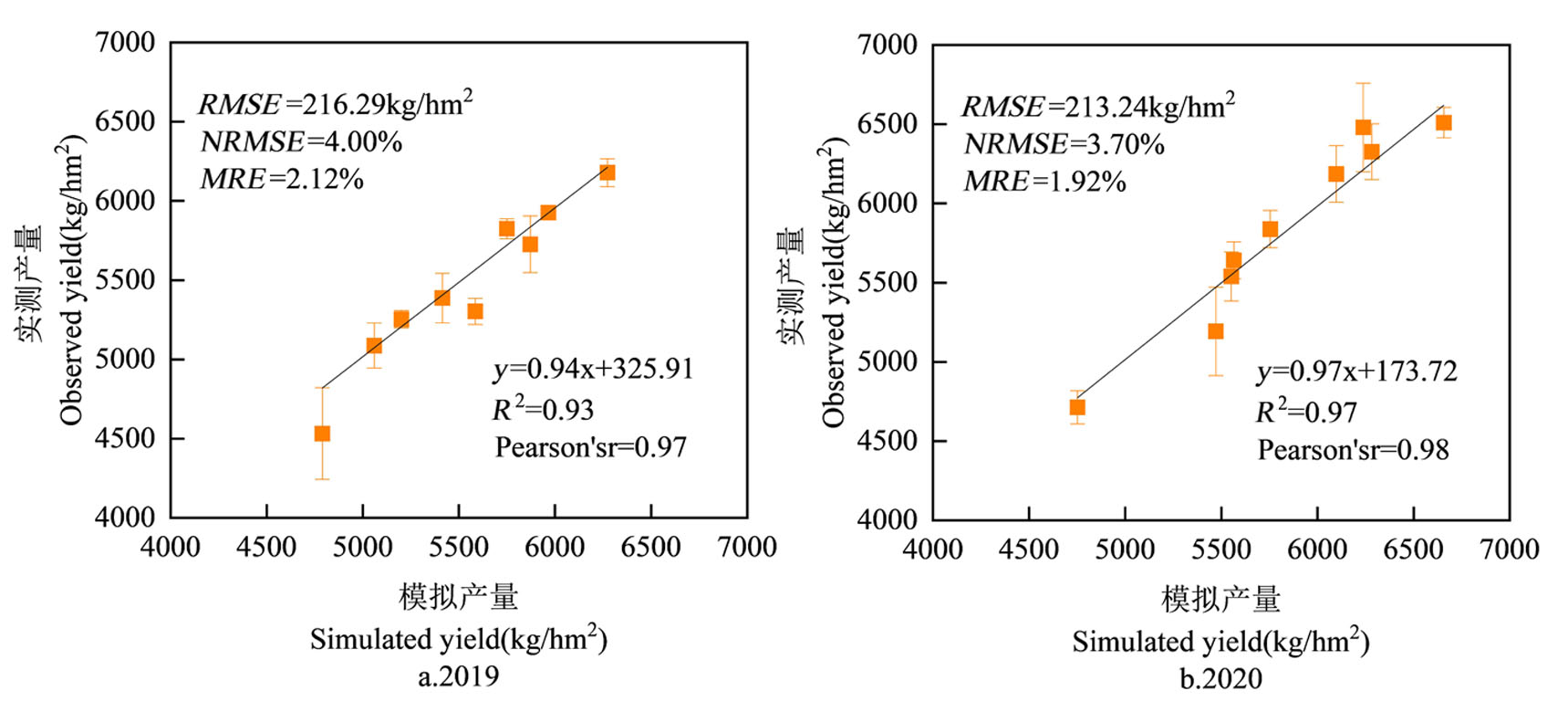
Fig.3 Comparison of simulated and measured rate determination of seed cotton yield
| 基追比例 Basal- Topdressing ratio | 生长时期 Growth period | 时间 Date (M/D) | 处理 Treat- ments | 次数 Times |
|---|---|---|---|---|
| 0∶10 | 现蕾期 | 6/18~6/25 | N190 | 9 |
| 1∶9 | 开花-盛铃期 | 7/4~8/6 | N451 | 10 |
| 2∶8 | N271 | 10 | ||
| 3∶7 | 盛铃后期 | 8/14~8/24 | N082 | 8 |
| 4∶6 | N163 | 10 |
Tab.1 N application cycle and N application rate under different treatments
| 基追比例 Basal- Topdressing ratio | 生长时期 Growth period | 时间 Date (M/D) | 处理 Treat- ments | 次数 Times |
|---|---|---|---|---|
| 0∶10 | 现蕾期 | 6/18~6/25 | N190 | 9 |
| 1∶9 | 开花-盛铃期 | 7/4~8/6 | N451 | 10 |
| 2∶8 | N271 | 10 | ||
| 3∶7 | 盛铃后期 | 8/14~8/24 | N082 | 8 |
| 4∶6 | N163 | 10 |
| 处理 Treatments | Logistic函数生长方程 Logistic function growth equation | Vm (kg/hm2/d) | GT (kg/hm2) | t0 | t1 | t2 | Δt | R2 | |
|---|---|---|---|---|---|---|---|---|---|
| d | |||||||||
| 0:10 | N190 | Y=16 761.48/(1+e(5.518-0.06t)) | 246.34 | 11 037.08 | 93.87 | 71.47 | 116.27 | 44.81 | 0.999 |
| N451 | Y=16 581.08/(1+e(5.520-0.06t)) | 243.68 | 10 918.29 | 93.89 | 71.49 | 116.30 | 44.81 | 0.999 | |
| N271 | Y=16 626.34/(1+e(5.519-0.06t)) | 244.34 | 10 948.09 | 93.89 | 71.49 | 116.29 | 44.81 | 0.999 | |
| N082 | Y=16 692.50/(1+e(5.519-0.06t)) | 245.33 | 10 991.66 | 93.88 | 71.47 | 116.28 | 44.80 | 0.999 | |
| N163 | Y=17 179.91/(1+e(5.460-0.06t)) | 248.01 | 11 312.61 | 94.53 | 71.72 | 117.33 | 45.61 | 0.998 | |
| 1:9 | N190 | Y=16 649.62/(1+e(5.519-0.06t)) | 244.63 | 10 963.42 | 93.88 | 71.48 | 116.29 | 44.82 | 0.999 |
| N451 | Y=16 693.43/(1+e(5.519-0.06t)) | 245.33 | 10 992.27 | 93.88 | 71.47 | 116.28 | 44.81 | 0.999 | |
| N271 | Y=16 738.99/(1+e(5.518-0.06t)) | 246.00 | 11 022.27 | 93.87 | 71.47 | 116.27 | 44.81 | 0.999 | |
| N082 | Y=16 806.99/(1+e(5.518-0.06t)) | 247.00 | 11 067.05 | 93.86 | 71.46 | 116.26 | 44.80 | 0.999 | |
| N163 | Y=16 877.40/(1+e(5.517-0.06t)) | 248.01 | 11 113.42 | 93.86 | 71.45 | 116.26 | 44.81 | 0.999 | |
| 2:8 | N190 | Y=16 762.61/(1+e(5.5179-0.06t)) | 246.34 | 11 037.83 | 93.87 | 71.47 | 116.27 | 44.81 | 0.999 |
| N451 | Y=16 806.95/(1+e(5.5178-0.06t)) | 247.01 | 11 067.02 | 93.86 | 71.46 | 116.26 | 44.80 | 0.999 | |
| N271 | Y=16 905.55/(1+e(5.5338-0.06t)) | 249.37 | 11 131.95 | 93.79 | 71.47 | 116.11 | 44.64 | 0.999 | |
| N082 | Y=16 922.24/(1+e(5.5168-0.06t)) | 248.69 | 11 142.94 | 93.85 | 71.45 | 116.25 | 44.81 | 0.999 | |
| N163 | Y=17 006.24/(1+e(5.518 6-0.06t)) | 249.97 | 11 198.25 | 93.86 | 71.46 | 116.26 | 44.80 | 0.999 | |
| 3:7 | N190 | Y=16 806.99/(1+e(5.519-0.06t)) | 247.01 | 11 067.05 | 93.86 | 71.46 | 116.26 | 44.80 | 0.999 |
| N451 | Y=16 851.73/(1+e(5.519-0.06t)) | 247.69 | 11 096.51 | 93.85 | 71.45 | 116.25 | 44.80 | 0.999 | |
| N271 | Y=16 900.41/(1+e(5.517-0.06t)) | 248.35 | 11 128.56 | 93.85 | 71.45 | 116.26 | 44.81 | 0.999 | |
| N082 | Y=16 983.97/(1+e(5.519-0.06t)) | 249.64 | 11 183.58 | 93.87 | 71.47 | 116.27 | 44.80 | 0.999 | |
| N163 | Y=17 302.55/(1+e(5.518-0.06t)) | 250.63 | 11 227.43 | 93.86 | 71.46 | 116.25 | 44.80 | 0.999 | |
| 4:6 | N190 | Y=16 717.01/(1+e(5.518-0.06t)) | 245.62 | 11 007.80 | 93.89 | 71.48 | 116.30 | 44.82 | 0.999 |
| N451 | Y=16 761.76/(1+e(5.518-0.06t)) | 246.28 | 11037.27 | 93.88 | 71.47 | 116.29 | 44.82 | 0.999 | |
| N271 | Y=16 807.49/(1+e(5.517-0.06t)) | 246.94 | 11 067.38 | 93.88 | 71.47 | 116.29 | 44.82 | 0.999 | |
| N082 | Y=16 879.29/(1+e(5.517-0.06t)) | 248.02 | 11 114.66 | 93.86 | 71.45 | 116.27 | 44.81 | 0.999 | |
| N163 | Y=16 961.72/(1+e(5.519-0.06t)) | 249.32 | 11 168.94 | 93.87 | 71.47 | 116.27 | 44.80 | 0.999 | |
Tab.2 Cotton photosynthetic product cumulative dynamics and logistic function growth model analysis under different nitrogen transport treatments
| 处理 Treatments | Logistic函数生长方程 Logistic function growth equation | Vm (kg/hm2/d) | GT (kg/hm2) | t0 | t1 | t2 | Δt | R2 | |
|---|---|---|---|---|---|---|---|---|---|
| d | |||||||||
| 0:10 | N190 | Y=16 761.48/(1+e(5.518-0.06t)) | 246.34 | 11 037.08 | 93.87 | 71.47 | 116.27 | 44.81 | 0.999 |
| N451 | Y=16 581.08/(1+e(5.520-0.06t)) | 243.68 | 10 918.29 | 93.89 | 71.49 | 116.30 | 44.81 | 0.999 | |
| N271 | Y=16 626.34/(1+e(5.519-0.06t)) | 244.34 | 10 948.09 | 93.89 | 71.49 | 116.29 | 44.81 | 0.999 | |
| N082 | Y=16 692.50/(1+e(5.519-0.06t)) | 245.33 | 10 991.66 | 93.88 | 71.47 | 116.28 | 44.80 | 0.999 | |
| N163 | Y=17 179.91/(1+e(5.460-0.06t)) | 248.01 | 11 312.61 | 94.53 | 71.72 | 117.33 | 45.61 | 0.998 | |
| 1:9 | N190 | Y=16 649.62/(1+e(5.519-0.06t)) | 244.63 | 10 963.42 | 93.88 | 71.48 | 116.29 | 44.82 | 0.999 |
| N451 | Y=16 693.43/(1+e(5.519-0.06t)) | 245.33 | 10 992.27 | 93.88 | 71.47 | 116.28 | 44.81 | 0.999 | |
| N271 | Y=16 738.99/(1+e(5.518-0.06t)) | 246.00 | 11 022.27 | 93.87 | 71.47 | 116.27 | 44.81 | 0.999 | |
| N082 | Y=16 806.99/(1+e(5.518-0.06t)) | 247.00 | 11 067.05 | 93.86 | 71.46 | 116.26 | 44.80 | 0.999 | |
| N163 | Y=16 877.40/(1+e(5.517-0.06t)) | 248.01 | 11 113.42 | 93.86 | 71.45 | 116.26 | 44.81 | 0.999 | |
| 2:8 | N190 | Y=16 762.61/(1+e(5.5179-0.06t)) | 246.34 | 11 037.83 | 93.87 | 71.47 | 116.27 | 44.81 | 0.999 |
| N451 | Y=16 806.95/(1+e(5.5178-0.06t)) | 247.01 | 11 067.02 | 93.86 | 71.46 | 116.26 | 44.80 | 0.999 | |
| N271 | Y=16 905.55/(1+e(5.5338-0.06t)) | 249.37 | 11 131.95 | 93.79 | 71.47 | 116.11 | 44.64 | 0.999 | |
| N082 | Y=16 922.24/(1+e(5.5168-0.06t)) | 248.69 | 11 142.94 | 93.85 | 71.45 | 116.25 | 44.81 | 0.999 | |
| N163 | Y=17 006.24/(1+e(5.518 6-0.06t)) | 249.97 | 11 198.25 | 93.86 | 71.46 | 116.26 | 44.80 | 0.999 | |
| 3:7 | N190 | Y=16 806.99/(1+e(5.519-0.06t)) | 247.01 | 11 067.05 | 93.86 | 71.46 | 116.26 | 44.80 | 0.999 |
| N451 | Y=16 851.73/(1+e(5.519-0.06t)) | 247.69 | 11 096.51 | 93.85 | 71.45 | 116.25 | 44.80 | 0.999 | |
| N271 | Y=16 900.41/(1+e(5.517-0.06t)) | 248.35 | 11 128.56 | 93.85 | 71.45 | 116.26 | 44.81 | 0.999 | |
| N082 | Y=16 983.97/(1+e(5.519-0.06t)) | 249.64 | 11 183.58 | 93.87 | 71.47 | 116.27 | 44.80 | 0.999 | |
| N163 | Y=17 302.55/(1+e(5.518-0.06t)) | 250.63 | 11 227.43 | 93.86 | 71.46 | 116.25 | 44.80 | 0.999 | |
| 4:6 | N190 | Y=16 717.01/(1+e(5.518-0.06t)) | 245.62 | 11 007.80 | 93.89 | 71.48 | 116.30 | 44.82 | 0.999 |
| N451 | Y=16 761.76/(1+e(5.518-0.06t)) | 246.28 | 11037.27 | 93.88 | 71.47 | 116.29 | 44.82 | 0.999 | |
| N271 | Y=16 807.49/(1+e(5.517-0.06t)) | 246.94 | 11 067.38 | 93.88 | 71.47 | 116.29 | 44.82 | 0.999 | |
| N082 | Y=16 879.29/(1+e(5.517-0.06t)) | 248.02 | 11 114.66 | 93.86 | 71.45 | 116.27 | 44.81 | 0.999 | |
| N163 | Y=16 961.72/(1+e(5.519-0.06t)) | 249.32 | 11 168.94 | 93.87 | 71.47 | 116.27 | 44.80 | 0.999 | |
| 器官 Organ | 处理 Treatments | K (kg/hm2) | t1 | t2 | △t | Vm |
|---|---|---|---|---|---|---|
| 营养器官生物量 Vegetative organ biomass (kg/hm2) | N190 | 5 062.27 | 61.4 | 84.78 | 23.38 | 142.6 |
| N451 | 5 048.24 | 61.26 | 84.76 | 23.51 | 141.41 | |
| N271 | 5 044.63 | 60.89 | 84.39 | 23.51 | 141.31 | |
| N082 | 5 025.01 | 61.00 | 84.56 | 23.55 | 140.49 | |
| N163 | 5 009.36 | 60.82 | 84.51 | 23.69 | 139.22 | |
| 生殖器官生物量 Reproductive organ biomass (kg/hm2) | N190 | 8 508.84 | 92.88 | 119.33 | 26.45 | 216.09 |
| N451 | 8 567.48 | 93.08 | 119.37 | 26.29 | 216.6 | |
| N271 | 8 619.98 | 93.18 | 119.34 | 26.16 | 217 | |
| N082 | 8 733.44 | 93.29 | 119.34 | 26.05 | 218.74 | |
| N163 | 8 817.32 | 93.45 | 119.38 | 25.93 | 219.52 |
| 器官 Organ | 处理 Treatments | K (kg/hm2) | t1 | t2 | △t | Vm |
|---|---|---|---|---|---|---|
| 营养器官生物量 Vegetative organ biomass (kg/hm2) | N190 | 5 062.27 | 61.4 | 84.78 | 23.38 | 142.6 |
| N451 | 5 048.24 | 61.26 | 84.76 | 23.51 | 141.41 | |
| N271 | 5 044.63 | 60.89 | 84.39 | 23.51 | 141.31 | |
| N082 | 5 025.01 | 61.00 | 84.56 | 23.55 | 140.49 | |
| N163 | 5 009.36 | 60.82 | 84.51 | 23.69 | 139.22 | |
| 生殖器官生物量 Reproductive organ biomass (kg/hm2) | N190 | 8 508.84 | 92.88 | 119.33 | 26.45 | 216.09 |
| N451 | 8 567.48 | 93.08 | 119.37 | 26.29 | 216.6 | |
| N271 | 8 619.98 | 93.18 | 119.34 | 26.16 | 217 | |
| N082 | 8 733.44 | 93.29 | 119.34 | 26.05 | 218.74 | |
| N163 | 8 817.32 | 93.45 | 119.38 | 25.93 | 219.52 |

Fig.4 Changes in the proportion of dry matter allocated to nutrient organs under the proportion of nitrogen supply

Fig.5 Correlation analysis of seed cotton yield with Vm、K and PI
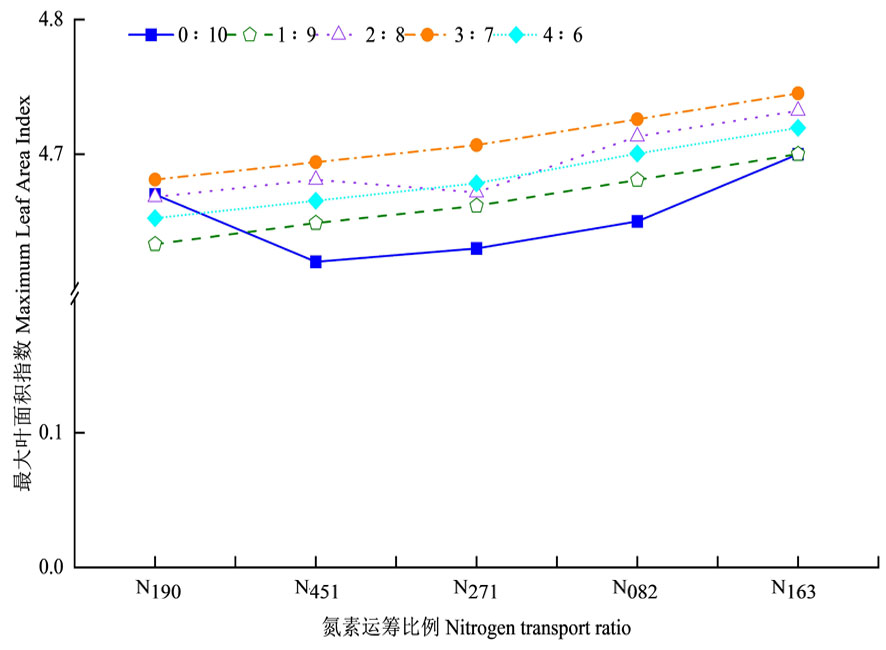
Fig.6 Changes of different nitrogen fertilizer transport modes on maximum leaf area index
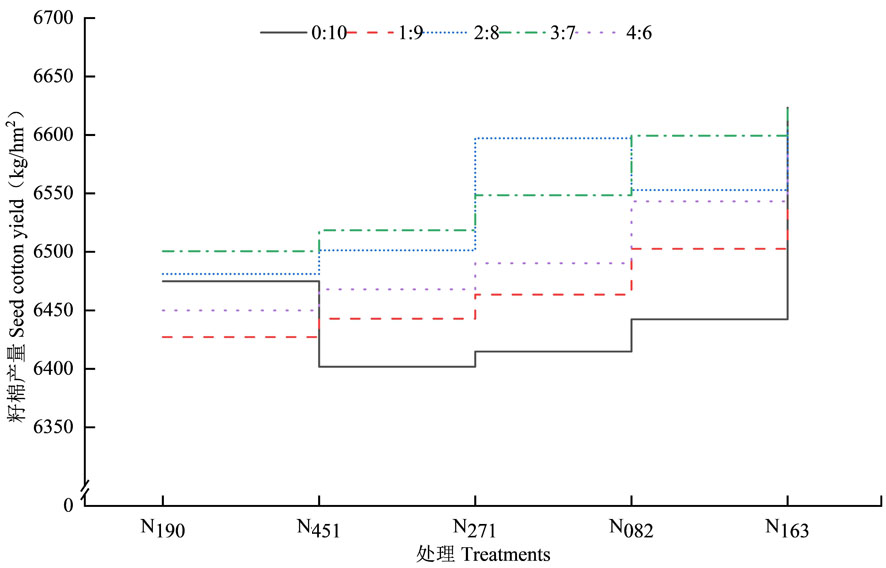
Fig.7 Changes of different nitrogen transportation methods on seed cotton yield
| [1] | Shi X J, Hao X Z, Li N N, et al. Organic liquid fertilizer coupled with single application of chemical fertilization improves growth, biomass, and yield components of cotton under mulch drip irrigation[J]. Frontiers in Plant Science, 2021, 12: 763525. |
| [2] | Shi F, Li N N, Khan A, et al. DPC can inhibit cotton apical dominance and increase seed yield by affecting apical part structure and hormone content[J]. Field Crops Research, 2022, 282: 108509. |
| [3] | Pokhrel A, Snider J L, Virk S, et al. Quantifying physiological contributions to nitrogen-induced yield variation in field-grown cotton[J]. Field Crops Research, 2023, 299: 108976. |
| [4] | 李卫国, 顾晓鹤, 王尔美, 等. 基于作物生长模型参数调整动态估测夏玉米生物量[J]. 农业工程学报, 2019, 35(7): 136-142. |
| LI Weiguo, GU Xiaohe, WANG Ermei, et al. Dynamic estimation of summer maize biomass based on parameter adjustment of crop growth model[J]. Transactions of the Chinese Society of Agricultural Engineering, 2019, 35(7): 136-142. | |
| [5] |
张宏, 曾雄, 王爱莲, 等. 不同施氮量对棉花产量、养分吸收及氮素利用的影响[J]. 新疆农业科学, 2021, 58(9): 1656-1664.
DOI |
|
ZHANG Hong, ZENG Xiong, WANG Ailian, et al. Effects of different nitrogen application rates on yield, nutrient uptake and nitrogen utilization of cotton in southern Xinjiang[J]. Xinjiang Agricultural Sciences, 2021, 58(9): 1656-1664.
DOI |
|
| [6] | Raphael J P A, Echer F R, Rosolem C A. Nitrogen fertilization can mitigate cotton yield loss by temporary shading at early flowering[J]. European Journal of Agronomy, 2022, 140: 126593. |
| [7] | Luo H H, Wang Q, Zhang J K, et al. One-time fertilization at first flowering improves lint yield and dry matter partitioning in late planted short-season cotton[J]. Journal of Integrative Agriculture, 2020, 19(2): 509-517. |
| [8] |
李春梅, 马云珍, 徐文修, 等. 不同施氮量对棉花产量和棉田土壤养分的影响[J]. 核农学报, 2022, 36(7): 1446-1455.
DOI |
|
LI Chunmei, MA Yunzhen, XU Wenxiu, et al. Effects of different nitrogen application rates on cotton yield and soil nutrients in cotton fields[J]. Journal of Nuclear Agricultural Sciences, 2022, 36(7): 1446-1455.
DOI |
|
| [9] | 赵强, 娄善伟, 姜婷婷, 等. 机采模式下氮肥不同基追比对棉花产量形成的影响[J]. 棉花科学, 2018, 40(2): 9-13. |
| ZHAO Qiang, LOU Shanwei, JIANG Tingting, et al. Effects of different ratio of base to topdressing of nitrogen fertilizer on cotton yield formation under mechanical harvest mode[J]. Cotton Sciences, 2018, 40(2): 9-13. | |
| [10] | Tian Y, Wang F Y, Shi X J, et al. Late nitrogen fertilization improves cotton yield through optimizing dry matter accumulation and partitioning[J]. Annals of Agricultural Sciences, 2023, 68(1): 75-86. |
| [11] | Li P C, Dong H L, Liu A Z, et al. Effects of nitrogen rate and split application ratio on nitrogen use and soil nitrogen balance in cotton fields[J]. Pedosphere, 2017, 27(4): 769-777. |
| [12] | Bahri H, Annabi M, Cheikh M’Hamed H, et al. Assessing the long-term impact of conservation agriculture on wheat-based systems in Tunisia using APSIM simulations under a climate change context[J]. Science of The Total Environment, 2019, 692: 1223-1233. |
| [13] | 孙琳丽, 侯琼, 马玉平, 等. WOFOST模型在内蒙古河套灌区模拟玉米生长全程的适应性[J]. 生态学杂志, 2016, 35(3): 800-807. |
| SUN Linli, HOU Qiong, MA Yuping, et al. Adaptability of WOFOST model to simulate the whole growth period of maize in Hetao irrigation region of Inner Mongolia[J]. Chinese Journal of Ecology, 2016, 35(3): 800-807. | |
| [14] | 蒋腾聪, 窦子荷, 姚宁, 等. 不同水分胁迫情境下冬小麦生长发育的RZWQM2模拟[J]. 农业机械学报, 2018, 49(7): 205-216. |
| JIANG Tengcong, DOU Zihe, YAO Ning, et al. Simulation of winter wheat growth under different scenarios of water stress with RZWQM2 model[J]. Transactions of the Chinese Society for Agricultural Machinery, 2018, 49(7): 205-216. | |
| [15] | 张红娟, 李赟, 李雅丽, 等. 北方农牧交错带裸燕麦蒸散结构与灌溉制度优化研究[J]. 节水灌溉, 2022(3): 8-14. |
| ZHANG Hongjuan, LI Yun, LI Yali, et al. Study on evapotranspiration structure and irrigation system optimization of naked oat in agro-pastoral ecotone of northern China[J]. Water Saving Irrigation, 2022(3): 8-14. | |
| [16] | Zhou S W, Hu X T, Ran H, et al. Optimization of irrigation and nitrogen fertilizer management for spring maize in northwestern China using RZWQM2[J]. Agricultural Water Management, 2020, 240: 106276. |
| [17] | 丁奠元, 赵英, 孙本华, 等. 根区水质模型在黄土高原旱区冬小麦氮肥管理中的适用性分析[J]. 农业工程学报, 2015, 31(23): 111-121. |
| DING Dianyuan, ZHAO Ying, SUN Benhua, et al. Suitability analysis of nitrogen fertilizer management on dryland of Loess Plateau based on root zone water quality model[J]. Transactions of the Chinese Society of Agricultural Engineering, 2015, 31(23): 111-121. | |
| [18] | Kuang N K, Ma Y Z, Hong S Z, et al. Simulation of soil moisture dynamics, evapotranspiration, and water drainage of summer maize in response to different depths of subsoiling with RZWQM2[J]. Agricultural Water Management, 2021, 249: 106794. |
| [19] | 周始威. 基于RZWQM2模拟的西北旱区玉米控墒补灌模式下水氮最优调控研究[D]. 杨凌: 西北农林科技大学, 2021. |
| ZHOU Shiwei. Research on the optimal regulation of water and nitrogen under the moisture control and supplemental irrigation mode of maize in the Northwest dry zone based on RZWQM2 simulation[D]. Yangling: Northwest A & F University, 2021. | |
| [20] | 黄春燕, 陶玲, 王登伟, 等. 棉花冠层光合有效辐射参数与地上部各组分鲜生物量的相关分析[J]. 新疆农业科学, 2015, 52(11): 1969-1974. |
| HUANG Chunyan, TAO Ling, WANG Dengwei, et al. Correlationship analysis between photosynthetically active radiation parameters and aboveground fresh biomass from different components of cotton canopy[J]. Xinjiang Agricultural Sciences, 2015, 52(11): 1969-1974. | |
| [21] | Mao L L, Zhang L Z, Sun X Z, et al. Use of the beta growth function to quantitatively characterize the effects of plant density and a growth regulator on growth and biomass partitioning in cotton[J]. Field Crops Research, 2018, 224: 28-36. |
| [22] | 徐家屯. 基于RZWQM2模型的关中灌区冬小麦/夏玉米灌溉施肥优化及深层土壤水氮运移特征分析[D]. 杨凌: 西北农林科技大学, 2020. |
| XU Jiatun. Optimization of winter wheat/summer maize irrigation fertilization and characterization of deep soil water and nitrogen transport in Guanzhong Irrigation District based on RZWQM2 model[D]. Yangling: Northwest A & F University, 2020. | |
| [23] | 周晋, 邓仲宁, 李文昌. 后期追施氮肥对棉花生育产量的作用[J]. 农业科学通讯, 1959,(15): 521-522. |
| ZHOU Jin, DENG Zhongning, LI Wenchang. Effect of topdressing nitrogen fertilizer on cotton growth and yield in later stage[J]. Scientia Agricultura Sinica, 1959,(15): 521-522. | |
| [24] |
龚双凤, 杨涛, 陈宝燕, 等. 机采棉模式下氮肥运筹对棉花产量和养分吸收的调控[J]. 中国农学通报, 2015, 31(12): 145-151.
DOI |
|
GONG Shuangfeng, YANG Tao, CHEN Baoyan, et al. Regulation of nitrogen fertilizer management of cotton yield and nutrient uptake under the machine pick cotton pattern[J]. Chinese Agricultural Science Bulletin, 2015, 31(12): 145-151.
DOI |
|
| [25] | 夏文, 林涛, 褚晓升, 等. RZWQM2模型模拟地膜覆盖时间对南疆棉田水分利用效率及产量的影响[J]. 农业工程学报, 2021, 37(11): 140-150. |
| XIA Wen, LIN Tao, CHU Xiaosheng, et al. Effects of mulching time on water use efficiency and yield of cotton in southern Xinjiang simulated by RZWQM2 model[J]. Transactions of the Chinese Society of Agricultural Engineering, 2021, 37(11): 140-150. | |
| [26] | 杨甜甜. 不同灌溉梯度下无膜棉生长发育模拟与产量评估[D]. 阿拉尔: 塔里木大学, 2022. |
| YANG Tiantian. Simulation of growth and development and yield assessment of filmless cotton under different irrigation gradients[D]. Ala’er: Tarim University, 2022. | |
| [27] | 李萌. 南疆膜下滴灌棉花灌溉和施肥调控效应及生长模拟研究[D]. 杨凌: 西北农林科技大学, 2020. |
| LI Meng. Irrigation and fertilization regulation effects and growth simulation of drip-irrigated cotton under membrane in South Xinjiang[D]. Yangling: Northwest A & F University, 2020. | |
| [28] | 李鹏程, 董合林, 刘爱忠, 等. 种植密度氮肥互作对棉花产量及氮素利用效率的影响[J]. 农业工程学报, 2015, 31(23): 122-130. |
| LI Pengcheng, DONG Helin, LIU Aizhong, et al. Effects of planting density and nitrogen fertilizer interaction on yield and nitrogen use efficiency of cotton[J]. Transactions of the Chinese Society of Agricultural Engineering, 2015, 31(23): 122-130. | |
| [29] | Cheng H M, Shu K X, Qi Z M, et al. Effects of residue removal and tillage on greenhouse gas emissions in continuous corn systems as simulated with RZWQM2[J]. Journal of Environmental Management, 2021, 285: 112097. |
| [30] |
姚青青, 孙绘健, 马兴旺, 等. 减量追施氮肥运筹对棉花地上部干物质积累、分配及产量的影响[J]. 新疆农业科学, 2021, 58(8): 1398-1405.
DOI |
|
YAO Qingqing, SUN Huijian, MA Xingwang, et al. Effects of reduced-amount nitrogen application on cotton aboveground dry matter accumulation, distribution and yield[J]. Xinjiang Agricultural Sciences, 2021, 58(8): 1398-1405.
DOI |
|
| [31] |
文明, 李鹏兵, 王乐, 等. 减施氮肥对北疆滴灌棉花干物质积累及产量的影响[J]. 新疆农业科学, 2019, 56(1): 120-129.
DOI |
|
WEN Ming, LI Pengbing, WANG Le, et al. Effects of reduced nitrogen application on dry matter accumulation and yield of cotton under drip irrigation in northern Xinjiang[J]. Xinjiang Agricultural Sciences, 2019, 56(1): 120-129.
DOI |
|
| [32] | 胡国智, 张炎, 李青军, 等. 氮肥运筹对棉花干物质积累、氮素吸收利用和产量的影响[J]. 植物营养与肥料学报, 2011, 17(2): 397-403. |
| HU Guozhi, ZHANG Yan, LI Qingjun, et al. Effect of nitrogen fertilizer management on the dry matter accumulation, N uptake and utilization and yield in cotton[J]. Plant Nutrition and Fertilizer Science, 2011, 17(2): 397-403. | |
| [33] | 伍维模, 郑德明, 王自强, 等. 南疆高产栽培技术模式下陆地棉干物质生产规律的研究[J]. 新疆农业科学, 2000, 37(4): 145-148. |
| WU Weimo, ZHENG Deming, WANG Ziqiang, et al. Study on the upland cotton dry matter production under the high-yielding cultivation techniques in south Xinjiang[J]. Xinjiang Agricultural Sciences, 2000, 37(4): 145-148. | |
| [34] | Grundy P R, Yeates S J, Bell K L. Cotton production during the tropical monsoon season. I-The influence of variable radiation on boll loss, compensation and yield[J]. Field Crops Research, 2020, 254: 107790. |
| [35] | Saleem M F, Shahid M, Shakoor A, et al. Removal of early fruit branches triggered regulations in senescence, boll attributes and yield of Bt cotton genotypes[J]. Annals of Applied Biology, 2018, 172(2): 224-235. |
| [36] | Zhang J, Han Y C, Li Y B, et al. Inhibition of apical dominance affects boll spatial distribution, yield and fiber quality of field-grown cotton[J]. Industrial Crops and Products, 2021, 173: 114098. |
| [37] | Zhang Z, Chattha M S, Ahmed S, et al. Nitrogen reduction in high plant density cotton is feasible due to quicker biomass accumulation[J]. Industrial Crops and Products, 2021, 172: 114070. |
| [38] | Song M Z, Fan S L, Yuan R H, et al. Genetic analysis of earliness traits in short season cotton (Gossypium hirsutum L.)[J]. Journal of Integrative Agriculture, 2012, 11(12): 1968-1975. |
| [39] | Kant S, Seneweera S, Rodin J, et al. Improving yield potential in crops under elevated CO2: Integrating the photosynthetic and nitrogen utilization efficiencies[J]. Frontiers in Plant Science, 2012, 3: 162. |
| [40] | Lin Q. Population quality indices of high yield and regulation techniques in cotton. In: The Quality of Crop Population. Shanghai Scientific &Technical Publishers, Shanghai, China, pp. 293-386. |
| [41] | Ali N. Review: nitrogen utilization features in cotton crop[J]. American Journal of Plant Sciences, 2015, 6(7): 987-1002. |
| [42] | 陈求柱. 氮肥运筹对棉花产量形成及养分吸收利用的影响研究[D]. 武汉: 华中农业大学, 2013. |
| CHEN Qiuzhu. Effects of nitrogen application on cotton yield formation and nutrient absorption and utilization[D]. Wuhan: Huazhong Agricultural University, 2013. | |
| [43] | Wang H M, Gao K, Fang S, et al. Cotton yield and defoliation efficiency in response to nitrogen and harvest aids[J]. Agronomy Journal, 2019, 111(1): 250-256. |
| [44] | Wang F Y, Han H Y, Lin H, et al. Effects of planting patterns on yield, quality, and defoliation in machine-harvested cotton[J]. Journal of Integrative Agriculture, 2019, 18(9): 2019-2028. |
| [45] | Luo Z, Hu Q Y, Tang W, et al. Effects of N fertilizer rate and planting density on short-season cotton yield, N agronomic efficiency and soil N using 15N tracing technique[J]. European Journal of Agronomy, 2022, 138: 126546. |
| [46] | Li X X, Liu H G, He X L, et al. Water-nitrogen coupling and multi-objective optimization of cotton under mulched drip irrigation in arid northwest China[J]. Agronomy, 2019, 9(12): 894. |
| [47] | Wang H D, Wu L F, Cheng M H, et al. Coupling effects of water and fertilizer on yield, water and fertilizer use efficiency of drip-fertigated cotton in northern Xinjiang, China[J]. Field Crops Research, 2018, 219: 169-179. |
| [48] | 刘翠, 张巨松, 郑慧, 等. 氮肥基追比对南疆杂交棉氮素吸收、生物量及产量的影响[J]. 中国土壤与肥料, 2016,(1): 64-71. |
| LIU Cui, ZHANG Jusong, ZHENG Hui, et al. Effects of ratios of base and topdressing nitrogen fertilizer on N uptake, biomass and yield of hybrid cotton in southern Xinjiang[J]. Soil and Fertilizer Sciences in China, 2016,(1): 64-71. | |
| [49] | 徐新霞, 雷建峰, 王立红, 等. 不同氮肥基追比对机采棉光合物质生产及产量的影响[J]. 西北农业学报, 2015, 24(6): 46-52. |
| XU Xinxia, LEI Jianfeng, WANG Lihong, et al. Effect of different ratios of base and topdressing nitrogen fertilizer on photosynthetic production and yield of machine-picked cotton[J]. Acta Agriculturae Boreali-occidentalis Sinica, 2015, 24(6): 46-52. | |
| [50] | Li H J, Liu Z Y, Chen Y, et al. A positive correlation between seed cotton yield and high-efficiency leaf area index in directly seeded short-season cotton after wheat[J]. Field Crops Research, 2022, 285: 108594. |
| [1] | XIE Xiurong, ZHANG Yongqiang, HAI Feng, LEI Junjie, LYU Xiaoqing, CHEN Chuanxin, XU Qijiang, NIE Shihui, WANG Jichuan. Effects of uniform sowing and densification on population structure and yield of late sowing winter wheat [J]. Xinjiang Agricultural Sciences, 2025, 62(1): 21-28. |
| [2] | DONG Zhenlin, WAN Sumei, XIONG Shiwu, MA Yunzhen, MAO Tingyong, YANG Beifang, LUO Lei, LIU Chaoqun, CHEN Guodong, LI Yabing. Effects of different planting densities on agronomic traits and yield of Zhongmian 113 [J]. Xinjiang Agricultural Sciences, 2024, 61(5): 1102-1111. |
| [3] | SONG Xianming, HOU Xianfei, GU Yuanguo, MIAO Haocui, LI Qiang, GUO Meili, ZENG Youling, JIA Donghia. Effects of planting density and row spacing on growth and yield of Carthamus tinctorius L. under mulch drip irrigation [J]. Xinjiang Agricultural Sciences, 2024, 61(4): 804-813. |
| [4] | ZHANG Junyao, WANG Jiayong, TANG Jianghua, LOU Shanwei, LI Wenshan, XU Wenxiu, MENG Lingyi, HE Hongtao, SANG Junmin. Effect of sowing period and density on growth and development and yield of Gossypium hirsutum L. [J]. Xinjiang Agricultural Sciences, 2024, 61(3): 547-555. |
| [5] | WANG Jiayong, LI Chunmei, XU Wenxiu, LI Pengcheng, ZHANG Na, LI Ling, MA Yunzhen, WANG Fang. Effects of planting density on canopy structure, canopy temperature and humidity and yield of 76 cm machine-picked cotton with equal row spacing [J]. Xinjiang Agricultural Sciences, 2023, 60(11): 2609-2617. |
| [6] | WANG Haitao, LIU Cunjing, TANG Liyuan, ZHANG Sujun, CAI Xiao, LI Xinghe, MA Wenna, HAN Junwei, ZHANG Xiangyun, ZHANG Jianhong. The influence of different planting densities on agronomic traits, yield and quality of machine-picked cotton varieties [J]. Xinjiang Agricultural Sciences, 2023, 60(11): 2638-2645. |
| [7] | YANG Jinyu, SUN Jiusheng, QIAO Xiaoyan, WANG Xihe, HUAI Guolong, CUI Lei. Effects of More Plants Per Hole on Maize Growth and Yield Components [J]. Xinjiang Agricultural Sciences, 2022, 59(9): 2186-2191. |
| [8] | CHEN Meng, LIANG Xueqi, LI Ling, ZHANG Li, CHEN Guodong, WU Quanzhong, ZHAI Yunlong. Effects of Planting Densities on Grain Filling and Grain Yield of Uniformly Sown Winter Wheat [J]. Xinjiang Agricultural Sciences, 2022, 59(6): 1338-1346. |
| [9] | WANG Rujia, TANG Feng, ZHANG Shuzhen, ZHANG Yongchao, LUO Jin, CHEN Yingxia, ZHANG Lei, ZHANG Bo. Effects of the Interaction between Density and Nitrogen Fertilizer on Seed Yield and Activity of Elymus Sibiricus [J]. Xinjiang Agricultural Sciences, 2022, 59(3): 533-540. |
| [10] | XU Gaoyu, LIN Tao, SHAO Yajie, ZHANG Hao, TANG Qiuxiang. Effects of Nitrogen Fertilizer and Density on Dry Matter Accumulation, Root Growth and Yield of Cotton with Equal Row Spacing [J]. Xinjiang Agricultural Sciences, 2022, 59(2): 302-309. |
| [11] | CHEN Lijun, LIN Tao, WU Fengquan, SHAO Yajie, XU Yanjun, TANG Qiuxiang. Effects of Planting Density and Irrigation Quota on Growth and Development and Yield Formation of 76 cm Equal Row Spacing Machine-Picked Cotton [J]. Xinjiang Agricultural Sciences, 2022, 59(12): 2899-2908. |
| [12] | DU Shanshan, CHEN Jinrui, LUO Jing, YAO Qingqing, SUN Huijian, HE Zhongsheng, Kurban Yasheng. Effects of Different Planting Densities on Main Agronomic Traits and Yield of Peanuts [J]. Xinjiang Agricultural Sciences, 2022, 59(11): 2637-2643. |
| [13] | WU Minhua, WU Jiaying, YU Xinhua, ZHANG Kaixuan, LU Haibo, ZHAO Haichao, LIU Zigang, HUANG Zhihong. Effects of Yuhuangjin on Microstructure and Bending Strength of Spring Maize Stem [J]. Xinjiang Agricultural Sciences, 2022, 59(10): 2402-2410. |
| [14] | Abdukadier Kurban, CHEN Yongqiang, LIU Huajun, PAN Jinghai, LI Xiaohui, LIN Ming, LU Weidan, BAI Xiaoshan, DONG Xinjiu, LI Sizhong. Effects of Subsoiling on the Characteristics of Morphological Structure and Biomass Accumulation of Sugar Beet in Long-term Leaf Cluster [J]. Xinjiang Agricultural Sciences, 2022, 59(10): 2421-2430. |
| [15] | ZHANG Yongqiang, ZHANG Heng, FANG Hui, CHEN Chuanxin, Sailihan Sai, XUE Lihua, CHEN Xingwu, LEI Junjie. Response of Winter Wheat Canopy Structure and Microclimate to Planting Density in Walnut-Wheat Intercropping Pattern [J]. Xinjiang Agricultural Sciences, 2020, 57(7): 1177-1186. |
| Viewed | ||||||
|
Full text |
|
|||||
|
Abstract |
|
|||||
