

Xinjiang Agricultural Sciences ›› 2025, Vol. 62 ›› Issue (S1): 253-260.DOI: 10.6048/j.issn.1001-4330.2025.S1.049
• Management of scientific research· Agricultural economy colume • Previous Articles
REN Yanyan1( ), TIAN Conghua1(), ZHANG Lin2
Received:2025-06-20
Online:2025-10-10
Published:2025-10-29
Correspondence author:
TIAN Conghua
Supported by:
任严岩1(), 田聪华1(), 张琳2
通讯作者:
田聪华
作者简介:任严岩(1986-),女,博士,研究方向为农业经济,(E-mail)344302745@qq.com
基金资助:CLC Number:
REN Yanyan, TIAN Conghua, ZHANG Lin. Characteristics of spatial and temporal variability of wheat production and factors affecting yield improvement in Xinjiang[J]. Xinjiang Agricultural Sciences, 2025, 62(S1): 253-260.
任严岩, 田聪华, 张琳. 新疆小麦生产的时空变迁特征及单产提升的影响因素分析[J]. 新疆农业科学, 2025, 62(S1): 253-260.
Add to citation manager EndNote|Ris|BibTeX
URL: https://www.xjnykx.com/EN/10.6048/j.issn.1001-4330.2025.S1.049
| 县(市)指标 County(city) indicators | 冬小麦Winter wheat | 复播玉米Replanting corn | ||||
|---|---|---|---|---|---|---|
| 播种面积 Sown area (万亩)(104 hm2) | 总产量 Total Production (104 t) | 单产 Yield per unit (kg/667m2) | 播种面积 Sown area (万亩)(104 hm2) | 总产量 Total Production (104 t) | 单产 Yield per unit (kg/667m2) | |
| 合计Total | 349.65(23.31) | 157.68 | 450.97 | 271.41(18.10) | 133.73 | 492.74 |
| 喀什市Kashgar City | 15.28(1.02) | 6.75 | 441.87 | 13.35(0.89) | 6.03 | 451.90 |
| 疏附县Shufu County | 32.12(2.14) | 14.48 | 450.86 | 25.00(1.67) | 12.00 | 479.87 |
| 疏勒县Shule County | 40.15(2.68) | 18.55 | 462.09 | 26.01(1.73) | 12.96 | 498.28 |
| 英吉沙县Yingjisha County | 22.90(1.53) | 10.48 | 457.71 | 18.94(1.26) | 9.21 | 486.31 |
| 泽普县Zepu County | 24.45(1.63) | 10.62 | 434.14 | 14.29(0.95) | 7.05 | 493.66 |
| 莎车县Shache County | 67.70(4.51) | 30.35 | 448.38 | 58.43(3.89) | 30.29 | 518.45 |
| 叶城县Yecheng County | 38.36(2.56) | 15.51 | 404.35 | 31.00(2.07) | 14.42 | 465.27 |
| 麦盖提县Maigaiti County | 24.32(1.62) | 11.08 | 455.46 | 17.26(1.15) | 8.59 | 497.83 |
| 岳普湖县Yuepuhu County | 19.98(1.33) | 9.30 | 465.42 | 10.60(0.71) | 5.20 | 490.64 |
| 伽师县Jiashi County | 44.19(2.95) | 20.20 | 457.04 | 38.00(2.53) | 18.71 | 492.31 |
| 巴楚县Bachu County | 26.24(1.75) | 12.27 | 467.80 | 18.08(1.21) | 9.08 | 501.99 |
| 塔什库尔干县Taxian County | 6.06(0.40) | 1.73 | 285.13 | 0.45(0.03) | 0.18 | 409.88 |
Tab.1 Statistics on winter wheat + replanted maize production in Kashgar region, 2023
| 县(市)指标 County(city) indicators | 冬小麦Winter wheat | 复播玉米Replanting corn | ||||
|---|---|---|---|---|---|---|
| 播种面积 Sown area (万亩)(104 hm2) | 总产量 Total Production (104 t) | 单产 Yield per unit (kg/667m2) | 播种面积 Sown area (万亩)(104 hm2) | 总产量 Total Production (104 t) | 单产 Yield per unit (kg/667m2) | |
| 合计Total | 349.65(23.31) | 157.68 | 450.97 | 271.41(18.10) | 133.73 | 492.74 |
| 喀什市Kashgar City | 15.28(1.02) | 6.75 | 441.87 | 13.35(0.89) | 6.03 | 451.90 |
| 疏附县Shufu County | 32.12(2.14) | 14.48 | 450.86 | 25.00(1.67) | 12.00 | 479.87 |
| 疏勒县Shule County | 40.15(2.68) | 18.55 | 462.09 | 26.01(1.73) | 12.96 | 498.28 |
| 英吉沙县Yingjisha County | 22.90(1.53) | 10.48 | 457.71 | 18.94(1.26) | 9.21 | 486.31 |
| 泽普县Zepu County | 24.45(1.63) | 10.62 | 434.14 | 14.29(0.95) | 7.05 | 493.66 |
| 莎车县Shache County | 67.70(4.51) | 30.35 | 448.38 | 58.43(3.89) | 30.29 | 518.45 |
| 叶城县Yecheng County | 38.36(2.56) | 15.51 | 404.35 | 31.00(2.07) | 14.42 | 465.27 |
| 麦盖提县Maigaiti County | 24.32(1.62) | 11.08 | 455.46 | 17.26(1.15) | 8.59 | 497.83 |
| 岳普湖县Yuepuhu County | 19.98(1.33) | 9.30 | 465.42 | 10.60(0.71) | 5.20 | 490.64 |
| 伽师县Jiashi County | 44.19(2.95) | 20.20 | 457.04 | 38.00(2.53) | 18.71 | 492.31 |
| 巴楚县Bachu County | 26.24(1.75) | 12.27 | 467.80 | 18.08(1.21) | 9.08 | 501.99 |
| 塔什库尔干县Taxian County | 6.06(0.40) | 1.73 | 285.13 | 0.45(0.03) | 0.18 | 409.88 |
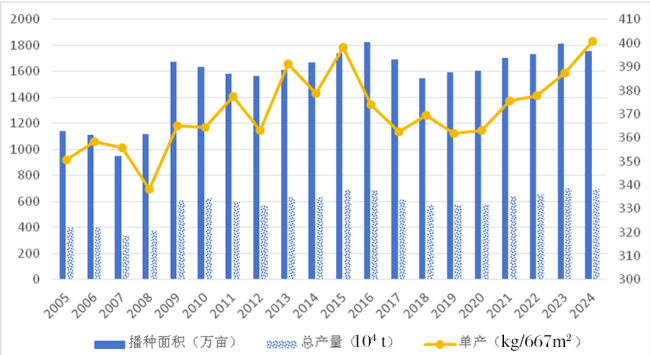
Fig.1 Wheat production in Xinjiang, 2005-2024
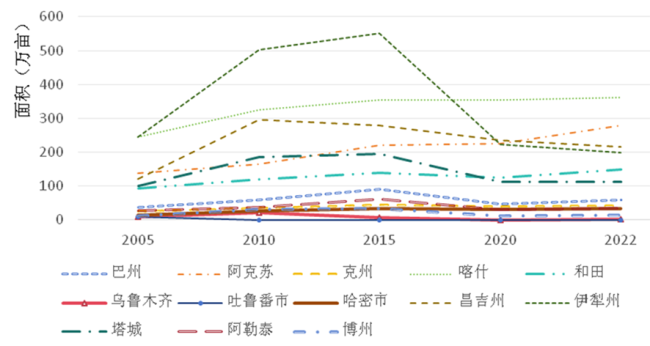
Fig. 2 Wheat planting area in Xinjiang cities and towns (except Karamay) in major years
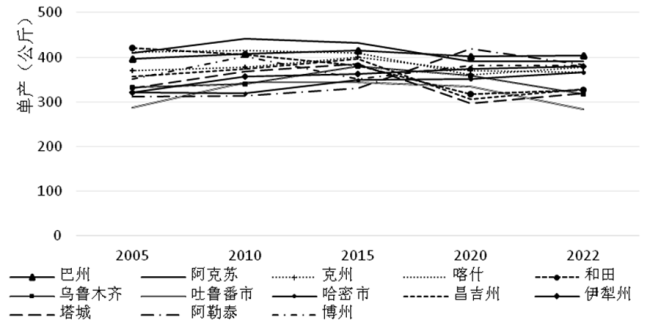
Fig.3 Wheat yield levels in major years in various cities and towns in Xinjiang (except Karamay)
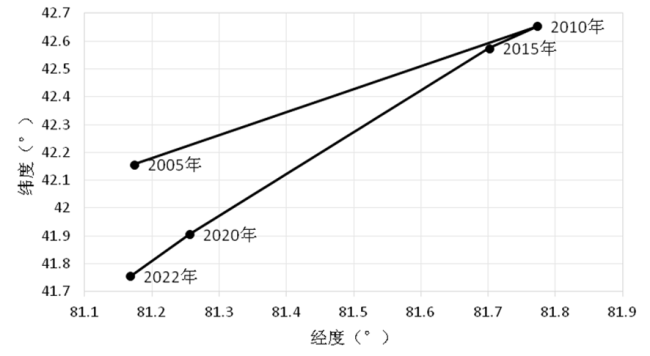
Fig.4 2005-2022 trajectory of wheat production center shift in Xinjiang
| 变量 Variable | 定义与说明 Definitions and descriptions | 预期方向 Intended direction |
|---|---|---|
| 小麦单产(Y) Wheat yields(Y) | 小麦单产(kg/667m2) | |
| 小麦生产规模(X1) Scale of wheat production(X1) | 某地州市小麦种植面积占 全区小麦买种植面积的比重 | + |
| 温度(X2) Temp(X2) | 各地州全年平均温度(℃) | +/- |
| 降雨量(X3) Quantity of rainfall(X3) | 各地州全年降雨量(mm) | +/- |
| 日照时长(X4) Sunshine duration(X4) | 各地州全年总日照时长(H) | +/- |
| 人均生产总值(X5) Per Capita GDP(X5) | 人均生产总值(元) | - |
| 机械总动力(X6) Total mechanical power | 农业机械总动力(KW) | + |
Tab. 2 Variable table of factors affecting wheat yield in Xinjiang
| 变量 Variable | 定义与说明 Definitions and descriptions | 预期方向 Intended direction |
|---|---|---|
| 小麦单产(Y) Wheat yields(Y) | 小麦单产(kg/667m2) | |
| 小麦生产规模(X1) Scale of wheat production(X1) | 某地州市小麦种植面积占 全区小麦买种植面积的比重 | + |
| 温度(X2) Temp(X2) | 各地州全年平均温度(℃) | +/- |
| 降雨量(X3) Quantity of rainfall(X3) | 各地州全年降雨量(mm) | +/- |
| 日照时长(X4) Sunshine duration(X4) | 各地州全年总日照时长(H) | +/- |
| 人均生产总值(X5) Per Capita GDP(X5) | 人均生产总值(元) | - |
| 机械总动力(X6) Total mechanical power | 农业机械总动力(KW) | + |
| 变量 Variable | 系数 Coefficient | 标准误 SE | T值 | P值 |
|---|---|---|---|---|
| 小麦生产规模(X1) Scale of wheat production(X1) | 0.021** | 0.009 | 2.33 | 0.021 |
| 温度(X2) Temp(X2) | 0.184*** | 0.042 | 4.38 | 0.000 |
| 降雨量(X3) Quantity of rainfall(X3) | 0.003* | 0.002 | 1.72 | 0.087 |
| 日照时长(X4) Sunshine duration(X4) | 0.127** | 0.051 | 2.49 | 0.014 |
| 人均生产总值(X5) Per Capita GDP(X5) | 0.012 | 0.008 | 1.50 | 0.136 |
| 机械总动力(X6) Total mechanical power(X6) | 0.038*** | 0.011 | 3.45 | 0.001 |
| 常数项Constant | 5.217*** | 0.843 | 6.19 | 0.000 |
| R2 | 0.412 | |||
| F(6,238) | 24.37 | |||
Tab.3 Changes of factors affecting the improvement of wheat yield level in Xinjiang
| 变量 Variable | 系数 Coefficient | 标准误 SE | T值 | P值 |
|---|---|---|---|---|
| 小麦生产规模(X1) Scale of wheat production(X1) | 0.021** | 0.009 | 2.33 | 0.021 |
| 温度(X2) Temp(X2) | 0.184*** | 0.042 | 4.38 | 0.000 |
| 降雨量(X3) Quantity of rainfall(X3) | 0.003* | 0.002 | 1.72 | 0.087 |
| 日照时长(X4) Sunshine duration(X4) | 0.127** | 0.051 | 2.49 | 0.014 |
| 人均生产总值(X5) Per Capita GDP(X5) | 0.012 | 0.008 | 1.50 | 0.136 |
| 机械总动力(X6) Total mechanical power(X6) | 0.038*** | 0.011 | 3.45 | 0.001 |
| 常数项Constant | 5.217*** | 0.843 | 6.19 | 0.000 |
| R2 | 0.412 | |||
| F(6,238) | 24.37 | |||
| 变量 Variable | 系统GMM估计值 (稳健标准误) SystemGMM Estimates | 剔除异常值 FE估计值 FE Estimation with Outlier Removal |
|---|---|---|
| 小麦单产(YL1.) Wheat yields(YL.1) | 0.326***(0.041) | / |
| 小麦生产规模(X1) Scale of wheat production(X1) | 0.049***(0.013) | 0.049***(0.012) |
| 温度(X2) Temp(X2) | 0.118**(0.052) | 0.121**(0.051) |
| 降雨量(X3) Quantity of rainfall(X3) | 0.034*(0.019) | 0.036*(0.019) |
| 日照时长(X4) Sunshine duration(X4) | 0.085***(0.024) | 0.088***(0.023) |
| 人均生产总值(X5) Per Capita GDP(X5) | 0.152***(0.035) | 0.154***(0.034) |
| 机械总动力(X6) Total mechanical power(X6) | 0.090***(0.028) | 0.091***(0.027) |
| R2 | 0.894 | |
| Hansen检验(P值) | 0.176 | |
| Arellano-Bond 检验(P值) | 0.000(一阶差分自相关) 0.213(二阶差分自相关) |
Tab. 4 Robustness test affecting the increase of wheat yield level in Xinjiang
| 变量 Variable | 系统GMM估计值 (稳健标准误) SystemGMM Estimates | 剔除异常值 FE估计值 FE Estimation with Outlier Removal |
|---|---|---|
| 小麦单产(YL1.) Wheat yields(YL.1) | 0.326***(0.041) | / |
| 小麦生产规模(X1) Scale of wheat production(X1) | 0.049***(0.013) | 0.049***(0.012) |
| 温度(X2) Temp(X2) | 0.118**(0.052) | 0.121**(0.051) |
| 降雨量(X3) Quantity of rainfall(X3) | 0.034*(0.019) | 0.036*(0.019) |
| 日照时长(X4) Sunshine duration(X4) | 0.085***(0.024) | 0.088***(0.023) |
| 人均生产总值(X5) Per Capita GDP(X5) | 0.152***(0.035) | 0.154***(0.034) |
| 机械总动力(X6) Total mechanical power(X6) | 0.090***(0.028) | 0.091***(0.027) |
| R2 | 0.894 | |
| Hansen检验(P值) | 0.176 | |
| Arellano-Bond 检验(P值) | 0.000(一阶差分自相关) 0.213(二阶差分自相关) |
| [1] | 姚成胜, 李政通, 易行. 中国粮食产量变化的驱动效应及其空间分异研究[J]. 中国人口·资源与环境, 2016, 26(9):72-81. |
| YAO Chengsheng, LI Zheng-tong, YI Xing. Driving effects of grain production change and its spatial differences in China[J]. China Population,Resource Sand Enviroment, 2016, 26(9):72-81. | |
| [2] | 伍山林. 中国粮食生产区域特征与成因研究—市场化改革以来的实证分析[J]. 经济研究, 2000,(10):38-45,79. |
| WU Shanlin. A Study of the Regional Characteristics of China’s Grain Production:An Empirical Analysis Since the Market-oriented Reform[J]. Economic Research Journal, 2000,(10):38-45,79. | |
| [3] | 陆文聪, 梅燕. 中国粮食生产区域格局变化及其成因实证分析—基于空间计量经济学模型[J]. 中国农业大学学报(社会科学版), 2007,(3):140-152. |
| LU Wencong, Mei Yan. Empirical Studies on the Variation and Contributing Factors of Regional Grain Production Strcuture in China-Based on Spatial Econometrics Models[J]. China Agricultural University Journal of Social Sciences Edition, 2007,(3):140-152. | |
| [4] | 张锦宗, 朱瑜馨, 赵飞, 等. 我国粮食生产格局演变及增产贡献研究[J]. 中国农业资源与区划, 2017, 38(7):10-16,35. |
| ZHANG Jinzong, ZHU Yuxin1 ZHAO Fei, et al. Spatial-Temporal Evolution of Chinese Grain Production Pattern and Arable Land Production Capacity[J]. Chinese Journal of Agricultural Resources and Regional Planning, 2017, 38(7):10-16,35. | |
| [5] | 郭延景, 孙学涛. 山东省粮食供需现状及粮食增产驱动因素分析[J]. 中国农业资源与区划, 2025-02-05. |
| GUO Yanjing, SUN Xuetao. Analysis of the Current Situation of Grain Supply and Demand in Shandong Province and Its Drivers of Grain Production Increase[J]. Chinese Journal of Agricultural Resources and Regional Planning, 2025-02-05. | |
| [6] | 林毅夫. 我国主要粮食作物单产潜力与增产前景[J]. 中国农业资源与区划, 1995,(3):4-7. |
| LIN Yinfu. Yield Potential and Prospects for Increasing Yields of China's Major Grain Crops[J]. Chinese Journal of Agricultural Resources and Regional Planning, 2017, 38(7):10-16+35. | |
| [7] | 高云, 陈伟忠, 詹慧龙, 等. 中国粮食增产潜力影响因素分析[J]. 中国农学通报, 2013, 29(35):132-138. |
|
GAOYun, CHEN Weizhong, ZHAN Huilong, et al. The Analysis of Influencing Factors on Grain Potential Yield Growth[J]. Chinese Agricultural Science Bulletin, 2013, 29(35):132-138.
DOI |
|
| [8] | 马永喜, 丁芮, 俞书傲. 技术培训对农户粮食生产韧性的影响效应与作用机制[J]. 湖南农业大学学报(社会科学版), 2024, 25(5):27-37. |
| MA Yongxi, DING Rui, YU Shuao. The impacts of technical training on farmers’ grain production resilience and its mechanism[J]. Journal of Hunan Agricultural University(Social Sciences), 2024, 25(5):27-37. | |
| [9] | 韩一军, 韩亭辉. “十四五”时期我国小麦增产潜力分析与实现路径[J]. 农业经济问题, 2021,(7):38-46. |
| HAN Yijun, HAN Tinghui. China’s Wheat Yield Increase Potential and Realization Path during the “14th Five-Year Plan”Period[J]. Issues in Agricultural Economy, 2021,(7):38-46. | |
| [10] | 荣越, 黄高彦, 马恒运. 气候变化对黄淮海地区粮食单产影响的HP滤波法分析[J]. 河南农业大学学报, 2025, 59(1):179-188. |
| RONG Yue, HUANG Gaoyan, MA Hengyun. The impact analysis of climate change on grain yield per unit area of the Huang-Huai-Hai Region by HP filter method[J]. Journal of Henan Agricultural University, 2025, 59(1):179-188. | |
| [11] | 胡瑞法, 黄季焜. 中国与三大粮食主要生产国的单产变化趋势比较研究[J]. 华南农业大学学报(社会科学版), 2024, 23(5):75-83. |
| HU Ruifa, HUANG Jikun. A Comparative Study on the Changing Yield Trends of Three Major Grains between China and Major Grain Producing Countries[J]. Journal of South China Agricultural University(Social Science Edition), 2024, 23(5):75-83. | |
| [12] | 吴芬, 徐萍, 郭海谦, 张正斌. 冬小麦产量差和资源利用效率差及调控途径研究进展[J]. 中国生态农业学报(中英文), 2020, 28(10):1551-1567. |
| WU Fen, XU Ping, GUO Haiqian, ZHANG Zhengbing. Advances in research regarding the yield gap and resource use efficiency of winter wheat cultivation and the related regulatory approaches[J]. Chinese Journal of Eco-Agriculture, 2020, 28(10): 1551-1567. | |
| [13] | 张宸熙, 商燕, 奥布力·塔力普. 基于DEA-Malmquist方法的新疆与全国小麦主产区生产效率动态比较研究[J]. 粮油食品科技, 2024, 32(4):227-234. |
| ZHANG Chenxi, SHANG Yan, AO BULI·Talipu. Comparative Study on the Dynamics of Production Efficiency Between Xinjiang and the Main Wheat-producing Areas in China Based on the DEA-Malmquist[J]. Science and Technology of Cereals,Oils and Foods, 2024, 32(4):227-234. | |
| [14] | 朱倩倩, 刘国宏, 许咏梅. 水氮对新疆南部麦后复种饲料油菜产量和品质的影响[J]. 中国生态农业学报(中英文), 2019, 27(7):1033-1041. |
| ZHU Qianqian, LIU Guohong, XU Yongmei, et al.. Effect of water and nitrogen on the yield and quality of forage rape grown after wheat in South Xinjiang[J]. Chinese Journal of Eco-Agriculture, 2019, 27(7): 1033-1041 | |
| [15] | 杨军黎, 万春, 沙勇龙. 新疆吐鲁番地区哈密瓜复种关键栽培技术[J]. 中国瓜菜, 2014, 27(S1):117-118. |
| YANG Junli, WAN Chun, SHA Yonglong, et al. Key Cultivation Techniques of Cantaloupe Replanting in Turpan Area of Xinjiang[J]. China Cucurbits and Vegetables, 2014, 27(S1):117-118. | |
| [16] | 龙桃, 熊黑钢, 左永君. 新疆耕地动态变化与可持续发展[J]. 干旱区资源与环境, 2012, 26(1):19-24. |
| LONG Tao, XIONG Heigang, ZUO Yongjun, et al. Dynamic change of cultivated land in Xinjiang and its sustainable development[J]. Journal of Arid Land Resources and Environment, 2012, 26(1):19-24. | |
| [17] | 郝晓燕, 张益, 韩一军. 中国小麦生产布局演化及影响因素研究[J]. 中国农业资源与区划, 2018, 39(8):40-48. |
| HAO Xiaoyan, ZHANG Yi, HAN Yijun. Study on Wheat Spatial Distribution Variation and Influencing Factors in China[J]. Chinese Journal of Agricultural Resources and Regional Planning, 2018, 39(8):40-48. | |
| [18] | 刘金阁, 郝帅, 王国刚. 中国饲料粮生产格局演变及影响因素研究[J]. 中国农业资源与区划, 2024, 45(8):11-20. |
| LIU Jinge, HAO Shuai, WANG Guogang et al. Changes in China’s Feed Grain Production Pattern and Its Influencing Factors[J]. Chinese Journal of Agricultural Resources and Regional Planning, 2024, 45(8):11-20. |
| [1] | WANG Lihong, SHI Jia, GAO Xin, WANG Chunsheng, HAN Junjie, WANG Yufan, ZHANG Yueqiang. Analysis of the path to increase wheat yield in changji prefecture, a mModel wheat region in northern Xinjiang [J]. Xinjiang Agricultural Sciences, 2025, 62(S1): 1-6. |
| [2] | SHEN Yuyang, YANG Hong, LI Guangkuo, GAO Haifeng. Wheat stripe rust in Xinjiang: current status and integrated management strategies [J]. Xinjiang Agricultural Sciences, 2025, 62(S1): 171-175. |
| [3] | JIA Yonghong, WEI Haipeng, ZENG Chaowu, LI Jianjiang, LIANG Xiaodong. Current status and development trends of the spring wheat industry in Xinjiang [J]. Xinjiang Agricultural Sciences, 2025, 62(S1): 7-11. |
| [4] | WANG Haobo, XIA Jianqiang, ZHANG Pengpeng, JIN Yongwei, ZHANG Yueqiang, GENG Hongwei. Screening and identification of spring wheat germplasm resources for heat resistance [J]. Xinjiang Agricultural Sciences, 2025, 62(7): 1586-1594. |
| [5] | LIN Min, SHEN Yuyang, DENG Feifei, LI Guangkuo, GAO Haifeng. Effects of Bromus japonicus on the yield traits of wheat in desert oasis regions [J]. Xinjiang Agricultural Sciences, 2025, 62(7): 1605-1611. |
| [6] | GU Meiying, GE Chunhui, CHU Min, TANG Qiyong, ZHU Jing, Ghenijan Osman, YI Yuanyang, XU Wanli, ZHANG Zhidong. Evaluation of the effect of composite bacteria on the functional diversity of microorganisms in wheat rhizosphere soils based on principal component-membership function analysis [J]. Xinjiang Agricultural Sciences, 2025, 62(7): 1612-1623. |
| [7] | DING Yingdeng, FAN Guiqiang, GAO Yonghong, HUANG Tianrong, ZHOU Anding, WU Xinyuan, FANG Hui. Effects of pre-flowering drought and gibberellin concentration on photosynthetic characteristics and yield formation in winter wheat [J]. Xinjiang Agricultural Sciences, 2025, 62(6): 1328-1336. |
| [8] | ZHU Hongxia, HU Linfeng, WANG Qiqi, ZHANG Jungao, ZHANG Shaomin, ZHOU Xiaoyun, LEI Bin, ZHANG Zhidong. Expression analysis of disease resistance-related genes in wheat induced by Streptomyces sp. HU2014 [J]. Xinjiang Agricultural Sciences, 2025, 62(6): 1337-1343. |
| [9] | LAI Hailin, LI Jin, SHEN Yuyang, DE Feifei, YANG Hong, LI Guangkuo, LI Yue, GAO Haifeng. Development of SNP molecular markers applied to genetic structure analysis of wheat stripe rust fungus [J]. Xinjiang Agricultural Sciences, 2025, 62(5): 1219-1225. |
| [10] | LIU Xuhuan, YU Shan, LIU Yue, SHI Shubing. Comprehensive evaluation of low temperature tolerance of different varieties of spring wheat seeds during germination [J]. Xinjiang Agricultural Sciences, 2025, 62(4): 820-828. |
| [11] | NIE Lingfan, ZHANG Jinshan, TIAN Wenqiang, SUN Ganggang, WANG Hongyi, ZHANG Jun, ZHANG Qiangbin, GUO Fei, WU Li, SHI Shubing. Effects of different water and nitrogen treatments on the growth, water and nitrogen use efficiency and yield of ultra-late sowing winter wheat [J]. Xinjiang Agricultural Sciences, 2025, 62(3): 584-592. |
| [12] | SUN Ganggang, GUO Fei, NIE Lingfan, TIAN Wenqiang, WANG Hongyi, SHI Yongqing, WU Li, AI Hongyu, ZHANG Jinshan, SHI Shubing. Effects of seed fertilizer separation on photosynthesis, dry matter accumulation and yield formation of winter wheat [J]. Xinjiang Agricultural Sciences, 2025, 62(3): 593-599. |
| [13] | LEI Jiacheng, ZHANG Jingjing, HAN Bo, LU Ziao. Research on virtual wheat growth simulation and visualization system based on PyOpenGL [J]. Xinjiang Agricultural Sciences, 2025, 62(3): 609-618. |
| [14] | SUN Na, MA Lin, ZOU Hui, ZHANG Zhihui, ZHANG Shengjun, HUANG Qiannan, YANG Hui, Dengsilamu Tuerxunbai, LI Zhibin, CAO Junmei, LEI Junjie. Analysis of combined application of NPK fertilizers on yield and quality of winter wheat and the fertilizer effect [J]. Xinjiang Agricultural Sciences, 2025, 62(1): 1-12. |
| [15] | CHEN Hui, ZHANG Yongqiang, BI Haiyan, TANJun , CHEN Chuanxin, XU Qijiang, NIE Shihui, YU Jianxin, LU Dong, LEI Junjie. Yield formation characteristics of different spring wheat varieties in dryland farming area of Xinjiang [J]. Xinjiang Agricultural Sciences, 2025, 62(1): 13-20. |
| Viewed | ||||||
|
Full text |
|
|||||
|
Abstract |
|
|||||
