

新疆农业科学 ›› 2025, Vol. 62 ›› Issue (S1): 253-260.DOI: 10.6048/j.issn.1001-4330.2025.S1.049
• 科研管理·农业经济专栏 • 上一篇
任严岩1( ), 田聪华1(), 张琳2
收稿日期:2025-06-20
出版日期:2025-10-10
发布日期:2025-10-29
通信作者:
田聪华(1978-),女,甘肃人,研究员,研究方向为农业经济,(E-mail)391253466@qq.com作者简介:任严岩(1986-),女,博士,研究方向为农业经济,(E-mail)344302745@qq.com
基金资助:
REN Yanyan1(), TIAN Conghua1(), ZHANG Lin2
Received:2025-06-20
Published:2025-10-10
Online:2025-10-29
Correspondence author:
TIAN Conghua (1978-), female, from Gansu, researcher, research direction: agricultural economics, (E-mail) 391253466@qq.comSupported by:摘要:
【目的】 分析新疆小麦生产的时空变迁特征及单产提升影响因素,深入把握新疆小麦生产脉络,为合理规划种植区域、优化资源配置提供科学依据。【方法】 基于新疆喀什地区的调研结果,采用重心分析法以及固定效应回归模型,分析新疆小麦生产的空间演变格局以及小麦单产的影响因素。【结果】 新疆小麦单产从2005年的350.65 kg/667m2提升至2024年的400.6 kg/667m2,技术驱动特征显著,但区域差异明显。温度、日照时长等气候因子与生产规模扩张和机械总动力是单产提升的核心驱动力。【结论】 新疆小麦增产需依托“气候适应性品种+机械化作业+高效节水灌溉”体系,重点突破新疆南疆水资源约束与北疆劳动力流失瓶颈。
中图分类号:
任严岩, 田聪华, 张琳. 新疆小麦生产的时空变迁特征及单产提升的影响因素分析[J]. 新疆农业科学, 2025, 62(S1): 253-260.
REN Yanyan, TIAN Conghua, ZHANG Lin. Characteristics of spatial and temporal variability of wheat production and factors affecting yield improvement in Xinjiang[J]. Xinjiang Agricultural Sciences, 2025, 62(S1): 253-260.
| 县(市)指标 County(city) indicators | 冬小麦Winter wheat | 复播玉米Replanting corn | ||||
|---|---|---|---|---|---|---|
| 播种面积 Sown area (万亩)(104 hm2) | 总产量 Total Production (104 t) | 单产 Yield per unit (kg/667m2) | 播种面积 Sown area (万亩)(104 hm2) | 总产量 Total Production (104 t) | 单产 Yield per unit (kg/667m2) | |
| 合计Total | 349.65(23.31) | 157.68 | 450.97 | 271.41(18.10) | 133.73 | 492.74 |
| 喀什市Kashgar City | 15.28(1.02) | 6.75 | 441.87 | 13.35(0.89) | 6.03 | 451.90 |
| 疏附县Shufu County | 32.12(2.14) | 14.48 | 450.86 | 25.00(1.67) | 12.00 | 479.87 |
| 疏勒县Shule County | 40.15(2.68) | 18.55 | 462.09 | 26.01(1.73) | 12.96 | 498.28 |
| 英吉沙县Yingjisha County | 22.90(1.53) | 10.48 | 457.71 | 18.94(1.26) | 9.21 | 486.31 |
| 泽普县Zepu County | 24.45(1.63) | 10.62 | 434.14 | 14.29(0.95) | 7.05 | 493.66 |
| 莎车县Shache County | 67.70(4.51) | 30.35 | 448.38 | 58.43(3.89) | 30.29 | 518.45 |
| 叶城县Yecheng County | 38.36(2.56) | 15.51 | 404.35 | 31.00(2.07) | 14.42 | 465.27 |
| 麦盖提县Maigaiti County | 24.32(1.62) | 11.08 | 455.46 | 17.26(1.15) | 8.59 | 497.83 |
| 岳普湖县Yuepuhu County | 19.98(1.33) | 9.30 | 465.42 | 10.60(0.71) | 5.20 | 490.64 |
| 伽师县Jiashi County | 44.19(2.95) | 20.20 | 457.04 | 38.00(2.53) | 18.71 | 492.31 |
| 巴楚县Bachu County | 26.24(1.75) | 12.27 | 467.80 | 18.08(1.21) | 9.08 | 501.99 |
| 塔什库尔干县Taxian County | 6.06(0.40) | 1.73 | 285.13 | 0.45(0.03) | 0.18 | 409.88 |
表1 2023年喀什地区冬小麦+复播玉米生产情况统计
Tab.1 Statistics on winter wheat + replanted maize production in Kashgar region, 2023
| 县(市)指标 County(city) indicators | 冬小麦Winter wheat | 复播玉米Replanting corn | ||||
|---|---|---|---|---|---|---|
| 播种面积 Sown area (万亩)(104 hm2) | 总产量 Total Production (104 t) | 单产 Yield per unit (kg/667m2) | 播种面积 Sown area (万亩)(104 hm2) | 总产量 Total Production (104 t) | 单产 Yield per unit (kg/667m2) | |
| 合计Total | 349.65(23.31) | 157.68 | 450.97 | 271.41(18.10) | 133.73 | 492.74 |
| 喀什市Kashgar City | 15.28(1.02) | 6.75 | 441.87 | 13.35(0.89) | 6.03 | 451.90 |
| 疏附县Shufu County | 32.12(2.14) | 14.48 | 450.86 | 25.00(1.67) | 12.00 | 479.87 |
| 疏勒县Shule County | 40.15(2.68) | 18.55 | 462.09 | 26.01(1.73) | 12.96 | 498.28 |
| 英吉沙县Yingjisha County | 22.90(1.53) | 10.48 | 457.71 | 18.94(1.26) | 9.21 | 486.31 |
| 泽普县Zepu County | 24.45(1.63) | 10.62 | 434.14 | 14.29(0.95) | 7.05 | 493.66 |
| 莎车县Shache County | 67.70(4.51) | 30.35 | 448.38 | 58.43(3.89) | 30.29 | 518.45 |
| 叶城县Yecheng County | 38.36(2.56) | 15.51 | 404.35 | 31.00(2.07) | 14.42 | 465.27 |
| 麦盖提县Maigaiti County | 24.32(1.62) | 11.08 | 455.46 | 17.26(1.15) | 8.59 | 497.83 |
| 岳普湖县Yuepuhu County | 19.98(1.33) | 9.30 | 465.42 | 10.60(0.71) | 5.20 | 490.64 |
| 伽师县Jiashi County | 44.19(2.95) | 20.20 | 457.04 | 38.00(2.53) | 18.71 | 492.31 |
| 巴楚县Bachu County | 26.24(1.75) | 12.27 | 467.80 | 18.08(1.21) | 9.08 | 501.99 |
| 塔什库尔干县Taxian County | 6.06(0.40) | 1.73 | 285.13 | 0.45(0.03) | 0.18 | 409.88 |
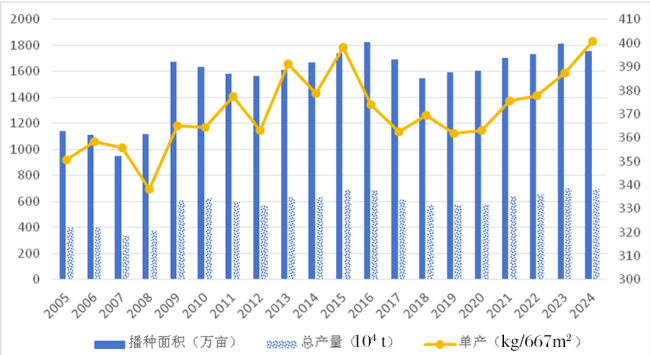
图1 2005~2024年新疆小麦生产情况
Fig.1 Wheat production in Xinjiang, 2005-2024
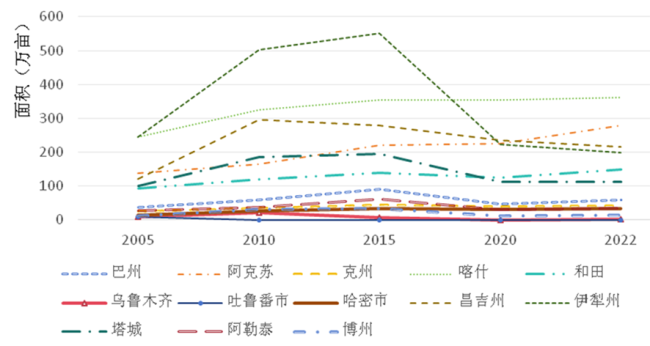
图2 新疆各地州市(克拉玛依除外)主要年份小麦种植面积
Fig. 2 Wheat planting area in Xinjiang cities and towns (except Karamay) in major years
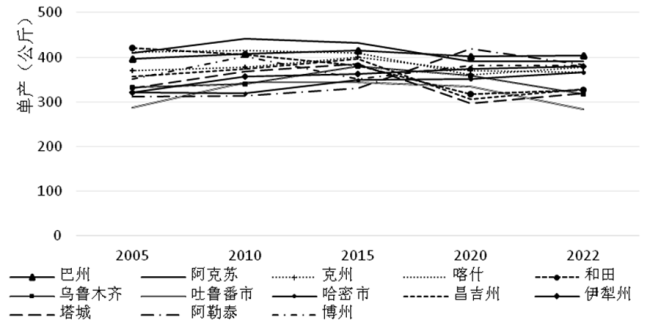
图3 新疆各地州市(克拉玛依除外)主要年份小麦单产水平
Fig.3 Wheat yield levels in major years in various cities and towns in Xinjiang (except Karamay)
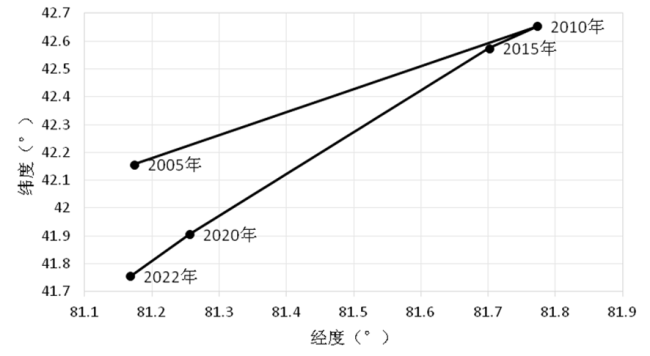
图4 2005~2022年新疆小麦生产重心变化轨迹
Fig.4 2005-2022 trajectory of wheat production center shift in Xinjiang
| 变量 Variable | 定义与说明 Definitions and descriptions | 预期方向 Intended direction |
|---|---|---|
| 小麦单产(Y) Wheat yields(Y) | 小麦单产(kg/667m2) | |
| 小麦生产规模(X1) Scale of wheat production(X1) | 某地州市小麦种植面积占 全区小麦买种植面积的比重 | + |
| 温度(X2) Temp(X2) | 各地州全年平均温度(℃) | +/- |
| 降雨量(X3) Quantity of rainfall(X3) | 各地州全年降雨量(mm) | +/- |
| 日照时长(X4) Sunshine duration(X4) | 各地州全年总日照时长(H) | +/- |
| 人均生产总值(X5) Per Capita GDP(X5) | 人均生产总值(元) | - |
| 机械总动力(X6) Total mechanical power | 农业机械总动力(KW) | + |
表2 新疆小麦单产影响因素变量
Tab. 2 Variable table of factors affecting wheat yield in Xinjiang
| 变量 Variable | 定义与说明 Definitions and descriptions | 预期方向 Intended direction |
|---|---|---|
| 小麦单产(Y) Wheat yields(Y) | 小麦单产(kg/667m2) | |
| 小麦生产规模(X1) Scale of wheat production(X1) | 某地州市小麦种植面积占 全区小麦买种植面积的比重 | + |
| 温度(X2) Temp(X2) | 各地州全年平均温度(℃) | +/- |
| 降雨量(X3) Quantity of rainfall(X3) | 各地州全年降雨量(mm) | +/- |
| 日照时长(X4) Sunshine duration(X4) | 各地州全年总日照时长(H) | +/- |
| 人均生产总值(X5) Per Capita GDP(X5) | 人均生产总值(元) | - |
| 机械总动力(X6) Total mechanical power | 农业机械总动力(KW) | + |
| 变量 Variable | 系数 Coefficient | 标准误 SE | T值 | P值 |
|---|---|---|---|---|
| 小麦生产规模(X1) Scale of wheat production(X1) | 0.021** | 0.009 | 2.33 | 0.021 |
| 温度(X2) Temp(X2) | 0.184*** | 0.042 | 4.38 | 0.000 |
| 降雨量(X3) Quantity of rainfall(X3) | 0.003* | 0.002 | 1.72 | 0.087 |
| 日照时长(X4) Sunshine duration(X4) | 0.127** | 0.051 | 2.49 | 0.014 |
| 人均生产总值(X5) Per Capita GDP(X5) | 0.012 | 0.008 | 1.50 | 0.136 |
| 机械总动力(X6) Total mechanical power(X6) | 0.038*** | 0.011 | 3.45 | 0.001 |
| 常数项Constant | 5.217*** | 0.843 | 6.19 | 0.000 |
| R2 | 0.412 | |||
| F(6,238) | 24.37 | |||
表3 影响新疆小麦单产水平提升的因素变化
Tab.3 Changes of factors affecting the improvement of wheat yield level in Xinjiang
| 变量 Variable | 系数 Coefficient | 标准误 SE | T值 | P值 |
|---|---|---|---|---|
| 小麦生产规模(X1) Scale of wheat production(X1) | 0.021** | 0.009 | 2.33 | 0.021 |
| 温度(X2) Temp(X2) | 0.184*** | 0.042 | 4.38 | 0.000 |
| 降雨量(X3) Quantity of rainfall(X3) | 0.003* | 0.002 | 1.72 | 0.087 |
| 日照时长(X4) Sunshine duration(X4) | 0.127** | 0.051 | 2.49 | 0.014 |
| 人均生产总值(X5) Per Capita GDP(X5) | 0.012 | 0.008 | 1.50 | 0.136 |
| 机械总动力(X6) Total mechanical power(X6) | 0.038*** | 0.011 | 3.45 | 0.001 |
| 常数项Constant | 5.217*** | 0.843 | 6.19 | 0.000 |
| R2 | 0.412 | |||
| F(6,238) | 24.37 | |||
| 变量 Variable | 系统GMM估计值 (稳健标准误) SystemGMM Estimates | 剔除异常值 FE估计值 FE Estimation with Outlier Removal |
|---|---|---|
| 小麦单产(YL1.) Wheat yields(YL.1) | 0.326***(0.041) | / |
| 小麦生产规模(X1) Scale of wheat production(X1) | 0.049***(0.013) | 0.049***(0.012) |
| 温度(X2) Temp(X2) | 0.118**(0.052) | 0.121**(0.051) |
| 降雨量(X3) Quantity of rainfall(X3) | 0.034*(0.019) | 0.036*(0.019) |
| 日照时长(X4) Sunshine duration(X4) | 0.085***(0.024) | 0.088***(0.023) |
| 人均生产总值(X5) Per Capita GDP(X5) | 0.152***(0.035) | 0.154***(0.034) |
| 机械总动力(X6) Total mechanical power(X6) | 0.090***(0.028) | 0.091***(0.027) |
| R2 | 0.894 | |
| Hansen检验(P值) | 0.176 | |
| Arellano-Bond 检验(P值) | 0.000(一阶差分自相关) 0.213(二阶差分自相关) |
表4 影响新疆小麦单产水平提升的稳健性检验
Tab. 4 Robustness test affecting the increase of wheat yield level in Xinjiang
| 变量 Variable | 系统GMM估计值 (稳健标准误) SystemGMM Estimates | 剔除异常值 FE估计值 FE Estimation with Outlier Removal |
|---|---|---|
| 小麦单产(YL1.) Wheat yields(YL.1) | 0.326***(0.041) | / |
| 小麦生产规模(X1) Scale of wheat production(X1) | 0.049***(0.013) | 0.049***(0.012) |
| 温度(X2) Temp(X2) | 0.118**(0.052) | 0.121**(0.051) |
| 降雨量(X3) Quantity of rainfall(X3) | 0.034*(0.019) | 0.036*(0.019) |
| 日照时长(X4) Sunshine duration(X4) | 0.085***(0.024) | 0.088***(0.023) |
| 人均生产总值(X5) Per Capita GDP(X5) | 0.152***(0.035) | 0.154***(0.034) |
| 机械总动力(X6) Total mechanical power(X6) | 0.090***(0.028) | 0.091***(0.027) |
| R2 | 0.894 | |
| Hansen检验(P值) | 0.176 | |
| Arellano-Bond 检验(P值) | 0.000(一阶差分自相关) 0.213(二阶差分自相关) |
| [1] | 姚成胜, 李政通, 易行. 中国粮食产量变化的驱动效应及其空间分异研究[J]. 中国人口·资源与环境, 2016, 26(9):72-81. |
| YAO Chengsheng, LI Zheng-tong, YI Xing. Driving effects of grain production change and its spatial differences in China[J]. China Population,Resource Sand Enviroment, 2016, 26(9):72-81. | |
| [2] | 伍山林. 中国粮食生产区域特征与成因研究—市场化改革以来的实证分析[J]. 经济研究, 2000,(10):38-45,79. |
| WU Shanlin. A Study of the Regional Characteristics of China’s Grain Production:An Empirical Analysis Since the Market-oriented Reform[J]. Economic Research Journal, 2000,(10):38-45,79. | |
| [3] | 陆文聪, 梅燕. 中国粮食生产区域格局变化及其成因实证分析—基于空间计量经济学模型[J]. 中国农业大学学报(社会科学版), 2007,(3):140-152. |
| LU Wencong, Mei Yan. Empirical Studies on the Variation and Contributing Factors of Regional Grain Production Strcuture in China-Based on Spatial Econometrics Models[J]. China Agricultural University Journal of Social Sciences Edition, 2007,(3):140-152. | |
| [4] | 张锦宗, 朱瑜馨, 赵飞, 等. 我国粮食生产格局演变及增产贡献研究[J]. 中国农业资源与区划, 2017, 38(7):10-16,35. |
| ZHANG Jinzong, ZHU Yuxin1 ZHAO Fei, et al. Spatial-Temporal Evolution of Chinese Grain Production Pattern and Arable Land Production Capacity[J]. Chinese Journal of Agricultural Resources and Regional Planning, 2017, 38(7):10-16,35. | |
| [5] | 郭延景, 孙学涛. 山东省粮食供需现状及粮食增产驱动因素分析[J]. 中国农业资源与区划, 2025-02-05. |
| GUO Yanjing, SUN Xuetao. Analysis of the Current Situation of Grain Supply and Demand in Shandong Province and Its Drivers of Grain Production Increase[J]. Chinese Journal of Agricultural Resources and Regional Planning, 2025-02-05. | |
| [6] | 林毅夫. 我国主要粮食作物单产潜力与增产前景[J]. 中国农业资源与区划, 1995,(3):4-7. |
| LIN Yinfu. Yield Potential and Prospects for Increasing Yields of China's Major Grain Crops[J]. Chinese Journal of Agricultural Resources and Regional Planning, 2017, 38(7):10-16+35. | |
| [7] | 高云, 陈伟忠, 詹慧龙, 等. 中国粮食增产潜力影响因素分析[J]. 中国农学通报, 2013, 29(35):132-138. |
|
GAOYun, CHEN Weizhong, ZHAN Huilong, et al. The Analysis of Influencing Factors on Grain Potential Yield Growth[J]. Chinese Agricultural Science Bulletin, 2013, 29(35):132-138.
DOI |
|
| [8] | 马永喜, 丁芮, 俞书傲. 技术培训对农户粮食生产韧性的影响效应与作用机制[J]. 湖南农业大学学报(社会科学版), 2024, 25(5):27-37. |
| MA Yongxi, DING Rui, YU Shuao. The impacts of technical training on farmers’ grain production resilience and its mechanism[J]. Journal of Hunan Agricultural University(Social Sciences), 2024, 25(5):27-37. | |
| [9] | 韩一军, 韩亭辉. “十四五”时期我国小麦增产潜力分析与实现路径[J]. 农业经济问题, 2021,(7):38-46. |
| HAN Yijun, HAN Tinghui. China’s Wheat Yield Increase Potential and Realization Path during the “14th Five-Year Plan”Period[J]. Issues in Agricultural Economy, 2021,(7):38-46. | |
| [10] | 荣越, 黄高彦, 马恒运. 气候变化对黄淮海地区粮食单产影响的HP滤波法分析[J]. 河南农业大学学报, 2025, 59(1):179-188. |
| RONG Yue, HUANG Gaoyan, MA Hengyun. The impact analysis of climate change on grain yield per unit area of the Huang-Huai-Hai Region by HP filter method[J]. Journal of Henan Agricultural University, 2025, 59(1):179-188. | |
| [11] | 胡瑞法, 黄季焜. 中国与三大粮食主要生产国的单产变化趋势比较研究[J]. 华南农业大学学报(社会科学版), 2024, 23(5):75-83. |
| HU Ruifa, HUANG Jikun. A Comparative Study on the Changing Yield Trends of Three Major Grains between China and Major Grain Producing Countries[J]. Journal of South China Agricultural University(Social Science Edition), 2024, 23(5):75-83. | |
| [12] | 吴芬, 徐萍, 郭海谦, 张正斌. 冬小麦产量差和资源利用效率差及调控途径研究进展[J]. 中国生态农业学报(中英文), 2020, 28(10):1551-1567. |
| WU Fen, XU Ping, GUO Haiqian, ZHANG Zhengbing. Advances in research regarding the yield gap and resource use efficiency of winter wheat cultivation and the related regulatory approaches[J]. Chinese Journal of Eco-Agriculture, 2020, 28(10): 1551-1567. | |
| [13] | 张宸熙, 商燕, 奥布力·塔力普. 基于DEA-Malmquist方法的新疆与全国小麦主产区生产效率动态比较研究[J]. 粮油食品科技, 2024, 32(4):227-234. |
| ZHANG Chenxi, SHANG Yan, AO BULI·Talipu. Comparative Study on the Dynamics of Production Efficiency Between Xinjiang and the Main Wheat-producing Areas in China Based on the DEA-Malmquist[J]. Science and Technology of Cereals,Oils and Foods, 2024, 32(4):227-234. | |
| [14] | 朱倩倩, 刘国宏, 许咏梅. 水氮对新疆南部麦后复种饲料油菜产量和品质的影响[J]. 中国生态农业学报(中英文), 2019, 27(7):1033-1041. |
| ZHU Qianqian, LIU Guohong, XU Yongmei, et al.. Effect of water and nitrogen on the yield and quality of forage rape grown after wheat in South Xinjiang[J]. Chinese Journal of Eco-Agriculture, 2019, 27(7): 1033-1041 | |
| [15] | 杨军黎, 万春, 沙勇龙. 新疆吐鲁番地区哈密瓜复种关键栽培技术[J]. 中国瓜菜, 2014, 27(S1):117-118. |
| YANG Junli, WAN Chun, SHA Yonglong, et al. Key Cultivation Techniques of Cantaloupe Replanting in Turpan Area of Xinjiang[J]. China Cucurbits and Vegetables, 2014, 27(S1):117-118. | |
| [16] | 龙桃, 熊黑钢, 左永君. 新疆耕地动态变化与可持续发展[J]. 干旱区资源与环境, 2012, 26(1):19-24. |
| LONG Tao, XIONG Heigang, ZUO Yongjun, et al. Dynamic change of cultivated land in Xinjiang and its sustainable development[J]. Journal of Arid Land Resources and Environment, 2012, 26(1):19-24. | |
| [17] | 郝晓燕, 张益, 韩一军. 中国小麦生产布局演化及影响因素研究[J]. 中国农业资源与区划, 2018, 39(8):40-48. |
| HAO Xiaoyan, ZHANG Yi, HAN Yijun. Study on Wheat Spatial Distribution Variation and Influencing Factors in China[J]. Chinese Journal of Agricultural Resources and Regional Planning, 2018, 39(8):40-48. | |
| [18] | 刘金阁, 郝帅, 王国刚. 中国饲料粮生产格局演变及影响因素研究[J]. 中国农业资源与区划, 2024, 45(8):11-20. |
| LIU Jinge, HAO Shuai, WANG Guogang et al. Changes in China’s Feed Grain Production Pattern and Its Influencing Factors[J]. Chinese Journal of Agricultural Resources and Regional Planning, 2024, 45(8):11-20. |
| [1] | 王立红, 时佳, 高新, 王春生, 韩俊杰, 王宇凡, 张跃强. 新疆北疆小麦单产提升路径分析[J]. 新疆农业科学, 2025, 62(S1): 1-6. |
| [2] | 沈煜洋, 杨红, 李广阔, 高海峰. 新疆小麦条锈病发生现状及综合防控对策[J]. 新疆农业科学, 2025, 62(S1): 171-175. |
| [3] | 贾永红, 魏海鹏, 曾潮武, 李建疆, 梁晓东. 新疆春小麦产业发展现状及趋势[J]. 新疆农业科学, 2025, 62(S1): 7-11. |
| [4] | 王昊博, 夏建强, 张鹏鹏, 金永伟, 张跃强, 耿洪伟. 春小麦种质资源耐热性筛选及鉴定[J]. 新疆农业科学, 2025, 62(7): 1586-1594. |
| [5] | 顾美英, 葛春辉, 楚敏, 唐琦勇, 朱静, 艾尼江·尔斯满, 易鸳鸯, 徐万里, 张志东. 基于主成分-隶属函数分析法评价复合菌对小麦根际土壤微生物功能多样性的影响[J]. 新疆农业科学, 2025, 62(7): 1612-1623. |
| [6] | 丁银灯, 范贵强, 高永红, 黄天荣, 周安定, 吴新元, 方辉. 花前干旱和矮壮素浓度对冬小麦光合特性及产量形成的影响[J]. 新疆农业科学, 2025, 62(6): 1328-1336. |
| [7] | 朱红霞, 胡林峰, 王琦琦, 张军高, 张少民, 周小云, 雷斌, 张志东. 链霉菌HU2014诱导小麦抗性基因的表达[J]. 新疆农业科学, 2025, 62(6): 1337-1343. |
| [8] | 来汉林, 李进, 沈煜洋, 邓菲菲, 杨红, 李广阔, 李月, 高海峰. 小麦条锈菌SNP分子标记的开发与应用[J]. 新疆农业科学, 2025, 62(5): 1219-1225. |
| [9] | 刘旭欢, 于姗, 刘跃, 石书兵. 不同品种春小麦种子萌发期耐低温性综合评价[J]. 新疆农业科学, 2025, 62(4): 820-828. |
| [10] | 孙刚刚, 郭飞, 聂凌帆, 田文强, 王泓懿, 史永清, 吴利, 艾红玉, 张金汕, 石书兵. 种肥分离对冬小麦光合特性、干物质积累和产量形成的影响[J]. 新疆农业科学, 2025, 62(3): 593-599. |
| [11] | 雷嘉诚, 张婧婧, 韩博, 鲁子翱. 基于PyOpenGL的虚拟小麦生长模拟及可视化系统[J]. 新疆农业科学, 2025, 62(3): 609-618. |
| [12] | 孙娜, 马林, 邹辉, 张志辉, 张胜军, 黄倩楠, 杨蕙, 登斯拉木·吐尔逊拜, 李志彬, 曹俊梅, 雷钧杰. 氮磷钾配施对冬小麦产量和品质的影响及其肥效分析[J]. 新疆农业科学, 2025, 62(1): 1-12. |
| [13] | 陈慧, 张永强, 毕海燕, 谭军, 陈传信, 徐其江, 聂石辉, 于建新, 陆东, 雷钧杰. 不同春小麦品种在新疆旱作区产量形成的特征分析[J]. 新疆农业科学, 2025, 62(1): 13-20. |
| [14] | 谢秀荣, 张永强, 海峰, 雷钧杰, 吕晓庆, 陈传信, 徐其江, 聂石辉, 王冀川. 匀播增密对适期晚播冬小麦群体结构及产量的影响[J]. 新疆农业科学, 2025, 62(1): 21-28. |
| [15] | 张妍婷, 张永强, 雷钧杰, 陈慧, 陈传信, 徐其江, 聂石辉, 徐文修. 不同施磷方式对干播湿出冬小麦光合生理特性及产量的影响[J]. 新疆农业科学, 2025, 62(1): 29-36. |
| 阅读次数 | ||||||
|
全文 |
|
|||||
|
摘要 |
|
|||||
