

Xinjiang Agricultural Sciences ›› 2025, Vol. 62 ›› Issue (5): 1041-1050.DOI: 10.6048/j.issn.1001-4330.2025.05.001
• Crop Genetics and Breeding·Cultivation Physiology·Physiology and Biochemistry • Previous Articles Next Articles
FANG Wancheng1( ), LIN Tao2,3(), CUI Jianping2, JIA Tao1, BAO Longlong1, WANG Liang2, FAN Shiyu1, HU Zhengdong1, SHAO Yajie1, TANG Qiuxiang1()
Received:2024-10-13
Online:2025-05-20
Published:2025-07-09
Correspondence author:
LIN Tao, TANG Qiuxiang
Supported by:
方万成1(), 林涛2,3(), 崔建平2, 贾涛1, 鲍龙龙1, 王亮2, 樊世语1, 胡正东1, 邵亚杰1, 汤秋香1()
通讯作者:
林涛,汤秋香
作者简介:方万成(1996-),男,甘肃酒泉人,硕士研究生,研究方向为农业遥感与养分诊断,(E-mail)2947283158@qq.com
基金资助:CLC Number:
FANG Wancheng, LIN Tao, CUI Jianping, JIA Tao, BAO Longlong, WANG Liang, FAN Shiyu, HU Zhengdong, SHAO Yajie, TANG Qiuxiang. Prediction of SPAD value of cotton based on UAV multispectral remote sensing and machine learning[J]. Xinjiang Agricultural Sciences, 2025, 62(5): 1041-1050.
方万成, 林涛, 崔建平, 贾涛, 鲍龙龙, 王亮, 樊世语, 胡正东, 邵亚杰, 汤秋香. 基于无人机多光谱遥感和机器学习的棉花SPAD值预测[J]. 新疆农业科学, 2025, 62(5): 1041-1050.
Add to citation manager EndNote|Ris|BibTeX
URL: https://www.xjnykx.com/EN/10.6048/j.issn.1001-4330.2025.05.001
| 植被指数 Spectral | 全称 Full name | 计算公式 Formula | 文献来源 Reference |
|---|---|---|---|
| DVI | 差值植被指数 | DVI=RNIR-RRed | [ |
| NDVI | 归一化植被指数 | NDVI=(RNIR-RRed)/(RNIR+RRed) | [ |
| GNDVI | 绿色归一化差值植被指数 | GNDVI=(RNIR-RGreen)/(RNIR+RGreen) | [ |
| RDVI | 重归一化植被指数 | RDVI=(RNIR-RRed)/√(RNIR+RRed) | [ |
| RVI | 比值植被指数 | RVI=RNIR/RRed | [ |
| SAVI | 土壤调节植被指数 | SAVI=(RNIR-RRed)/1.5(RNIR+RRed+0.5) | [ |
| OSAVI | 优化土壤调节植被指数 | OSAVI=(RNIR-RRed)/(RNIR+RRed+0.16) | [ |
| NLI | 非线性植被指数 | NLI=(R2NIR-RRed)/(R2NIR+RRed) | [ |
| MNLI | 改进非线性植被指数 | MNLI=(1.5(R2NIR-1.5RGreen)/(R2NIR+RRed+0.5) | [ |
| MSR | 改进简单比值植被指数 | MSR=(RNIR/RRed-1)/(√RNIR/RRed+1) | [ |
| GRVI | 红绿植被指数 | GRVI=(RGreen-RRed)/(RGreen+RRed) | [ |
| NDRE | 红边植被指数 | NDRE=(RNIR-RRE)/(RNIR+RRE) | [ |
Tab.1 Vegetation Index and Its Calculation Formula
| 植被指数 Spectral | 全称 Full name | 计算公式 Formula | 文献来源 Reference |
|---|---|---|---|
| DVI | 差值植被指数 | DVI=RNIR-RRed | [ |
| NDVI | 归一化植被指数 | NDVI=(RNIR-RRed)/(RNIR+RRed) | [ |
| GNDVI | 绿色归一化差值植被指数 | GNDVI=(RNIR-RGreen)/(RNIR+RGreen) | [ |
| RDVI | 重归一化植被指数 | RDVI=(RNIR-RRed)/√(RNIR+RRed) | [ |
| RVI | 比值植被指数 | RVI=RNIR/RRed | [ |
| SAVI | 土壤调节植被指数 | SAVI=(RNIR-RRed)/1.5(RNIR+RRed+0.5) | [ |
| OSAVI | 优化土壤调节植被指数 | OSAVI=(RNIR-RRed)/(RNIR+RRed+0.16) | [ |
| NLI | 非线性植被指数 | NLI=(R2NIR-RRed)/(R2NIR+RRed) | [ |
| MNLI | 改进非线性植被指数 | MNLI=(1.5(R2NIR-1.5RGreen)/(R2NIR+RRed+0.5) | [ |
| MSR | 改进简单比值植被指数 | MSR=(RNIR/RRed-1)/(√RNIR/RRed+1) | [ |
| GRVI | 红绿植被指数 | GRVI=(RGreen-RRed)/(RGreen+RRed) | [ |
| NDRE | 红边植被指数 | NDRE=(RNIR-RRE)/(RNIR+RRE) | [ |

Fig.1 Changes in SPAD value of cotton leaves under different irrigation quotas and fertilization levels
| 植被指数 Vegetation Indexes | 蕾期 Bud stage | 花期 Flower season | 花铃期 Flower and boll stage | 吐絮期 Boll opening stage |
|---|---|---|---|---|
| NIR | -0.561 | 0.165 | -0.346 | -0.269 |
| RED | 0.337 | -0.292 | 0.260 | 0.274 |
| RE | -0.178 | -0.443 | -0.702 | -0.461 |
| GREEN | 0.203 | -0.517 | -0.306 | 0.286 |
| BLUE | 0.379 | -0.308 | 0.353 | 0.263 |
| DVI | -0.500 | 0.190 | -0.361 | -0.305 |
| NDVI | -0.422 | 0.259 | -0.382 | -0.309 |
| GNDVI | -0.372 | 0.439 | -0.201 | -0.326 |
| RDVI | -0.464 | 0.215 | -0.384 | -0.309 |
| RVI | -0.426 | 0.251 | -0.258 | -0.298 |
| SAVI | -0.527 | 0.171 | -0.343 | -0.299 |
| OSAVI | -0.443 | 0.238 | -0.395 | -0.310 |
| NLI | -0.468 | 0.243 | -0.403 | -0.306 |
| MNLI | -0.476 | 0.257 | -0.317 | -0.318 |
| MSR | -0.426 | 0.255 | -0.294 | -0.302 |
| GRVI | -0.445 | -0.098 | -0.455 | -0.133 |
| NDRE | -0.193 | 0.462 | 0.390 | 0.087 |
Tab.2 Pearson correlation analysis between multispectral index and cotton SPAD value(Experiment 1)
| 植被指数 Vegetation Indexes | 蕾期 Bud stage | 花期 Flower season | 花铃期 Flower and boll stage | 吐絮期 Boll opening stage |
|---|---|---|---|---|
| NIR | -0.561 | 0.165 | -0.346 | -0.269 |
| RED | 0.337 | -0.292 | 0.260 | 0.274 |
| RE | -0.178 | -0.443 | -0.702 | -0.461 |
| GREEN | 0.203 | -0.517 | -0.306 | 0.286 |
| BLUE | 0.379 | -0.308 | 0.353 | 0.263 |
| DVI | -0.500 | 0.190 | -0.361 | -0.305 |
| NDVI | -0.422 | 0.259 | -0.382 | -0.309 |
| GNDVI | -0.372 | 0.439 | -0.201 | -0.326 |
| RDVI | -0.464 | 0.215 | -0.384 | -0.309 |
| RVI | -0.426 | 0.251 | -0.258 | -0.298 |
| SAVI | -0.527 | 0.171 | -0.343 | -0.299 |
| OSAVI | -0.443 | 0.238 | -0.395 | -0.310 |
| NLI | -0.468 | 0.243 | -0.403 | -0.306 |
| MNLI | -0.476 | 0.257 | -0.317 | -0.318 |
| MSR | -0.426 | 0.255 | -0.294 | -0.302 |
| GRVI | -0.445 | -0.098 | -0.455 | -0.133 |
| NDRE | -0.193 | 0.462 | 0.390 | 0.087 |
| 植被指数 Vegetation Indexes | 蕾期 Bud stage | 花期 Flower season | 花铃期 Flower and boll stage | 吐絮期 Boll opening stage |
|---|---|---|---|---|
| NIR | -0.124 | -0.078 | -0.349 | -0.203 |
| RED | 0.063 | 0.085 | -0.044 | 0.032 |
| RE | 0.055 | -0.515 | -0.804 | -0.481 |
| GREEN | -0.086 | -0.322 | -0.289 | -0.020 |
| BLUE | 0.016 | 0.210 | 0.078 | 0.043 |
| DVI | -0.105 | -0.082 | -0.309 | -0.150 |
| NDVI | -0.056 | -0.097 | -0.157 | -0.110 |
| GNDVI | 0.026 | 0.095 | -0.069 | -0.092 |
| RDVI | -0.082 | -0.088 | -0.271 | -0.132 |
| RVI | -0.126 | -0.087 | -0.133 | -0.103 |
| SAVI | -0.126 | -0.077 | -0.324 | -0.162 |
| OSAVI | -0.068 | -0.093 | -0.239 | -0.124 |
| NLI | -0.066 | -0.096 | -0.237 | -0.141 |
| MNLI | -0.081 | -0.024 | -0.282 | -0.120 |
| MSR | -0.105 | -0.091 | -0.143 | -0.106 |
| GRVI | -0.183 | -0.323 | -0.222 | -0.130 |
| NDRE | -0.121 | 0.283 | 0.504 | 0.091 |
Tab.3 Pearson correlation analysis between multispectral index and cotton SPAD value(Experiment 2)
| 植被指数 Vegetation Indexes | 蕾期 Bud stage | 花期 Flower season | 花铃期 Flower and boll stage | 吐絮期 Boll opening stage |
|---|---|---|---|---|
| NIR | -0.124 | -0.078 | -0.349 | -0.203 |
| RED | 0.063 | 0.085 | -0.044 | 0.032 |
| RE | 0.055 | -0.515 | -0.804 | -0.481 |
| GREEN | -0.086 | -0.322 | -0.289 | -0.020 |
| BLUE | 0.016 | 0.210 | 0.078 | 0.043 |
| DVI | -0.105 | -0.082 | -0.309 | -0.150 |
| NDVI | -0.056 | -0.097 | -0.157 | -0.110 |
| GNDVI | 0.026 | 0.095 | -0.069 | -0.092 |
| RDVI | -0.082 | -0.088 | -0.271 | -0.132 |
| RVI | -0.126 | -0.087 | -0.133 | -0.103 |
| SAVI | -0.126 | -0.077 | -0.324 | -0.162 |
| OSAVI | -0.068 | -0.093 | -0.239 | -0.124 |
| NLI | -0.066 | -0.096 | -0.237 | -0.141 |
| MNLI | -0.081 | -0.024 | -0.282 | -0.120 |
| MSR | -0.105 | -0.091 | -0.143 | -0.106 |
| GRVI | -0.183 | -0.323 | -0.222 | -0.130 |
| NDRE | -0.121 | 0.283 | 0.504 | 0.091 |
| 试验 Experiments | 模型 Model | 建模集Modeling set | 验证集Validation set | ||||
|---|---|---|---|---|---|---|---|
| R2 | RMSE | RE | R2 | RMSE | RE | ||
| 试验1 Experiments 1 | PLSR | 0.210 | 3.222 | 0.059 | 0.299 | 3.087 | 0.056 |
| SVR | 0.470 | 2.621 | 0.048 | 0.449 | 2.819 | 0.052 | |
| RF | 0.720 | 1.947 | 0.028 | 0.360 | 2.737 | 0.038 | |
| BPN | 0.486 | 2.596 | 0.039 | 0.472 | 2.713 | 0.039 | |
| 试验2 Experiments 2 | PLSR | 0.230 | 3.234 | 0.059 | 0.226 | 3.031 | 0.055 |
| SVR | 0.439 | 2.694 | 0.049 | 0.513 | 2.668 | 0.049 | |
| RF | 0.679 | 2.023 | 0.029 | 0.585 | 2.519 | 0.036 | |
| BPN | 0.468 | 2.641 | 0.039 | 0.399 | 2.893 | 0.043 | |
Tab.4 Estimation accuracy of different models for SPAD value of cotton leaves throughout the entire growth period (n=324)
| 试验 Experiments | 模型 Model | 建模集Modeling set | 验证集Validation set | ||||
|---|---|---|---|---|---|---|---|
| R2 | RMSE | RE | R2 | RMSE | RE | ||
| 试验1 Experiments 1 | PLSR | 0.210 | 3.222 | 0.059 | 0.299 | 3.087 | 0.056 |
| SVR | 0.470 | 2.621 | 0.048 | 0.449 | 2.819 | 0.052 | |
| RF | 0.720 | 1.947 | 0.028 | 0.360 | 2.737 | 0.038 | |
| BPN | 0.486 | 2.596 | 0.039 | 0.472 | 2.713 | 0.039 | |
| 试验2 Experiments 2 | PLSR | 0.230 | 3.234 | 0.059 | 0.226 | 3.031 | 0.055 |
| SVR | 0.439 | 2.694 | 0.049 | 0.513 | 2.668 | 0.049 | |
| RF | 0.679 | 2.023 | 0.029 | 0.585 | 2.519 | 0.036 | |
| BPN | 0.468 | 2.641 | 0.039 | 0.399 | 2.893 | 0.043 | |
| 试验 Experiments | 生育期 Growth stage | 建模集Modeling set | 验证集Validation set | ||||
|---|---|---|---|---|---|---|---|
| R2 | RMSE | RE | R2 | RMSE | RE | ||
| 试验1 Experiments 1 | 蕾期 | 0.641 | 1.520 | 0.108 | 0.452 | 1.842 | 0.206 |
| 花期 | 0.521 | 1.965 | 0.167 | 0.335 | 2.848 | 0.249 | |
| 花铃期 | 0.743 | 2.843 | 0.152 | 0.617 | 3.863 | 0.204 | |
| 吐絮期 | 0.586 | 3.046 | 0.138 | 0.402 | 3.922 | 0.225 | |
| 试验2 Experiments 2 | 蕾期 | 0.407 | 1.689 | 0.146 | 0.237 | 1.995 | 0.212 |
| 花期 | 0.560 | 1.735 | 0.137 | 0.227 | 1.934 | 0.269 | |
| 花铃期 | 0.819 | 1.984 | 0.100 | 0.631 | 2.598 | 0.193 | |
| 吐絮期 | 0.584 | 2.438 | 0.150 | 0.344 | 2.846 | 0.199 | |
Tab.5 Estimation accuracy of SPAD values for cotton leaves at different growth stages based on the optimal model (n=81)
| 试验 Experiments | 生育期 Growth stage | 建模集Modeling set | 验证集Validation set | ||||
|---|---|---|---|---|---|---|---|
| R2 | RMSE | RE | R2 | RMSE | RE | ||
| 试验1 Experiments 1 | 蕾期 | 0.641 | 1.520 | 0.108 | 0.452 | 1.842 | 0.206 |
| 花期 | 0.521 | 1.965 | 0.167 | 0.335 | 2.848 | 0.249 | |
| 花铃期 | 0.743 | 2.843 | 0.152 | 0.617 | 3.863 | 0.204 | |
| 吐絮期 | 0.586 | 3.046 | 0.138 | 0.402 | 3.922 | 0.225 | |
| 试验2 Experiments 2 | 蕾期 | 0.407 | 1.689 | 0.146 | 0.237 | 1.995 | 0.212 |
| 花期 | 0.560 | 1.735 | 0.137 | 0.227 | 1.934 | 0.269 | |
| 花铃期 | 0.819 | 1.984 | 0.100 | 0.631 | 2.598 | 0.193 | |
| 吐絮期 | 0.584 | 2.438 | 0.150 | 0.344 | 2.846 | 0.199 | |
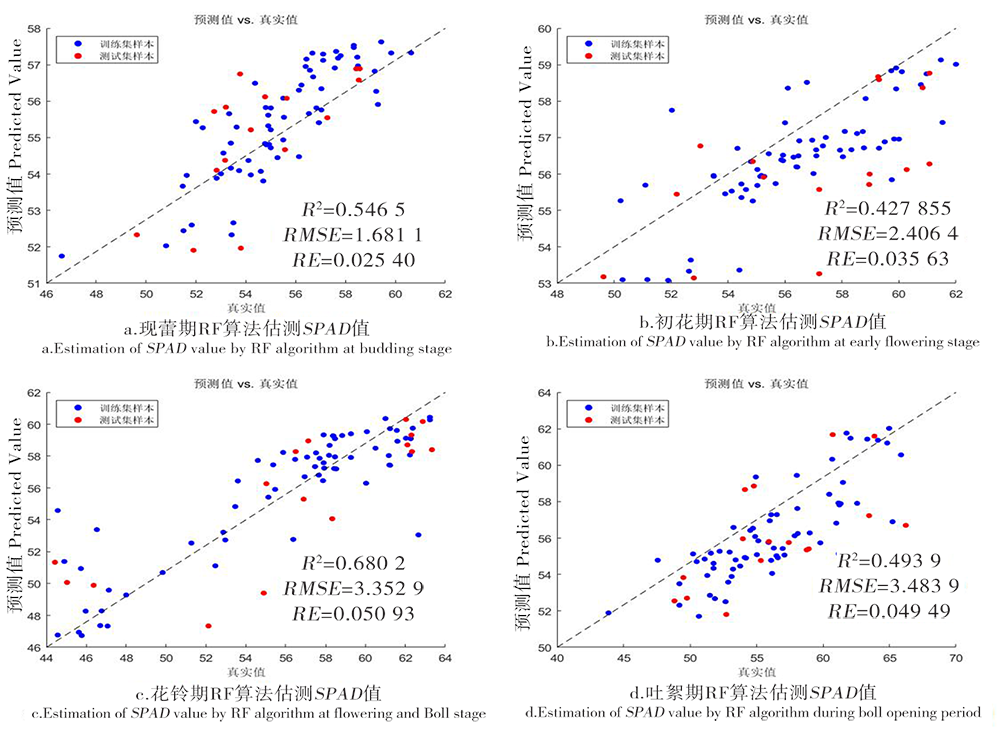
Fig.2 Estimation results of SPAD value of cotton leaves at different growth stages by RF model(Experiment 1)

Fig.3 Estimation results of SPAD value of cotton leaves at different growth stages by RF model(Experiment 2)

Fig.4 Estimation results of SPAD value of cotton leaves at different growth stages by RF model
| [1] | 周敏姑, 邵国敏, 张立元, 等. 无人机多光谱遥感反演冬小麦SPAD值[J]. 农业工程学报, 2020, 36(20): 125-133. |
| ZHOU Mingu, SHAO Guomin, ZHANG Liyuan, et al. Inversion of SPAD value of winter wheat by multispectral remote sensing of unmanned aerial vehicles[J]. Transactions of the Chinese Society of Agricultural Engineering, 2020, 36(20): 125-133. | |
| [2] | 闫成川, 曲延英, 陈全家, 等. 基于无人机多光谱影像的棉花SPAD值及叶片含水量估测[J]. 农业工程学报, 2023, 39(2): 61-67. |
| YAN Chengchuan, QU Yanying, CHEN Quanjia, et al. Estimation of cotton SPAD value and leaf water content based on UAV multispectral images[J]. Transactions of the Chinese Society of Agricultural Engineering, 2023, 39(2): 61-67. | |
| [3] | 毛智慧, 邓磊, 孙杰, 等. 无人机多光谱遥感在玉米冠层叶绿素预测中的应用研究[J]. 光谱学与光谱分析, 2018, 38(9): 2923. |
| MAO Zhihui, DENG Lei, SUN Jie, et al. Research on the application of UAV multispectral remote sensing in the maize chlorophyll prediction[J]. Spectroscopy and Spectral Analysis, 2018, 38(9): 2923. | |
| [4] | 鲍士旦. 土壤农化分析[M]. 3版. 北京: 中国农业出版社, 2000. |
| BAO Shidan. Soil and agricultural chemistry analysis[M]. 3rd ed. Beijing: China Agriculture Press, 2000. | |
| [5] | 李振海, 王纪华, 贺鹏, 等. 基于Dualex氮平衡指数测量仪的作物叶绿素含量估算模型[J]. 农业工程学报, 2015, 31(21): 191-197. |
| LI Zhenhai, WANG Jihua, HE Peng, et al. Modelling of crop chlorophyll content based on dualex[J]. Transactions of the Chinese Society of Agricultural Engineering, 2015, 31(21): 191-197. | |
| [6] | 邵亚杰, 汤秋香, 崔建平, 等. 融合无人机光谱信息与纹理特征的棉花叶面积指数估测[J]. 农业机械学报, 2023, 54(6): 186-196. |
| SHAO Yajie, TANG Qiuxiang, CUI Jianping, et al. Cotton leaf area index estimation combining UAV spectral and textural features[J]. Transactions of the Chinese Society for Agricultural Machinery, 2023, 54(6): 186-196. | |
| [7] | Daughtry C S T, Walthall C L, Kim M S, et al. Estimating corn leaf chlorophyll concentration from leaf and canopy reflectance[J]. Remote Sensing of Environment, 2000, 74(2): 229-239. |
| [8] | Navarro G, Caballero I, Silva G, et al. Evaluation of forest fire on Madeira Island using Sentinel-2A MSI imagery[J]. International Journal of Applied Earth Observation and Geoinformation, 2017, 58: 97-106. |
| [9] | Fieuzal R, Marais Sicre C, Baup F. Estimation of corn yield using multi-temporal optical and radar satellite data and artificial neural networks[J]. International Journal of Applied Earth Observation and Geoinformation, 2017, 57: 14-23. |
| [10] |
谭昌伟, 杜颖, 童璐, 等. 基于开花期卫星遥感数据的大田小麦估产方法比较[J]. 中国农业科学, 2017, 50(16): 3101-3109.
DOI |
|
TAN Changwei, DU Ying, TONG Lu, et al. Comparison of the methods for predicting wheat yield based on satellite remote sensing data at anthesis[J]. Scientia Agricultura Sinica, 2017, 50(16): 3101-3109.
DOI |
|
| [11] | 魏鹏飞, 徐新刚, 李中元, 等. 基于无人机多光谱影像的夏玉米叶片氮含量遥感估测[J]. 农业工程学报, 2019, 35(8): 126-133, 335. |
| WEI Pengfei, XU Xingang, LI Zhongyuan, et al. Remote sensing estimation of nitrogen content in summer maize leaves based on multispectral images of UAV[J]. Transactions of the Chinese Society of Agricultural Engineering, 2019, 35(8): 126-133, 335. | |
| [12] | Zhen Z J, Chen S B, Yin T G, et al. Using the negative soil adjustment factor of soil adjusted vegetation index (SAVI) to resist saturation effects and estimate leaf area index (LAI) in dense vegetation areas[J]. Sensors, 2021, 21(6): 2115. |
| [13] |
李鑫川, 徐新刚, 鲍艳松, 等. 基于分段方式选择敏感植被指数的冬小麦叶面积指数遥感反演[J]. 中国农业科学, 2012, 45(17): 3486-3496.
DOI |
|
LI Xinchuan, XU Xingang, BAO Yansong, et al. Retrieving LAI of winter wheat based on sensitive vegetation index by the segmentation method[J]. Scientia Agricultura Sinica, 2012, 45(17): 3486-3496.
DOI |
|
| [14] | Gong P, Pu R L, Biging G S, et al. Estimation of forest leaf area index using vegetation indices derived from Hyperion hyperspectral data[J]. IEEE Transactions on Geoscience and Remote Sensing, 2003, 41(6): 1355-1362. |
| [15] | Chen J M. Evaluation of vegetation indices and a modified simple ratio for boreal applications[J]. Canadian Journal of Remote Sensing, 1996, 22(3): 229-242. |
| [16] | Roujean J L, Breon F M. Estimating PAR absorbed by vegetation from bidirectional reflectance measurements[J]. Remote Sensing of Environment, 1995, 51(3): 375-384. |
| [17] | 刘帅兵, 杨贵军, 景海涛, 等. 基于无人机数码影像的冬小麦氮含量反演[J]. 农业工程学报, 2019, 35(11): 75-85. |
| LIU Shuaibing, YANG Guijun, JING Haitao, et al. Retrieval of winter wheat nitrogen content based on UAV digital image[J]. Transactions of the Chinese Society of Agricultural Engineering, 2019, 35(11): 75-85. | |
| [18] | Gitelson A A, Kaufman Y J, Merzlyak M N. Use of a green channel in remote sensing of global vegetation from EOS-MODIS[J]. Remote Sensing of Environment, 1996, 58(3): 289-298. |
| [19] | 李国君. 棉花叶片叶绿素和氮含量与产量的相关性研究[J]. 新疆农垦科技, 2018, 41(11): 37-38. |
| LI Guojun. Study on the correlation between chlorophyll and nitrogen content in cotton leaves and yield[J]. Xinjiang Farm Research of Science and Technology, 2018, 41(11): 37-38. | |
| [20] |
Xiong D L, Chen J, Yu T T, et al. SPAD-based leaf nitrogen estimation is impacted by environmental factors and crop leaf characteristics[J]. Scientific Reports, 2015, 5: 13389.
DOI PMID |
| [21] |
Cao Y F, Xu H L, Song J, et al. Applying spectral fractal dimension index to predict the SPAD value of rice leaves under bacterial blight disease stress[J]. Plant Methods, 2022, 18(1): 67.
DOI PMID |
| [22] | 李宗新, 董树亭, 王空军, 等. 不同肥料运筹对夏玉米田间土壤氮素淋溶与挥发影响的原位研究[J]. 植物营养与肥料学报, 2007, 13(6): 998-1005. |
| LI Zongxin, DONG Shuting, WANG Kongjun, et al. In situ study on influence of different fertilization strategies for summer maize on soil nitrogen leaching and volatilization[J]. Plant Nutrition and Fertilizer Science, 2007, 13(6): 998-1005. | |
| [23] | Xiao W. Interactive effects of irrigation and nitrogen fertilizer on nitrogen fertilizer recovery and nitrate-N movement across soil profile in a winter wheat field[J/OL]. Acta Ecologica Sinica, 2008. |
| [24] | Sudu B, Rong G Z, Guga S R, et al. Retrieving SPAD values of summer maize using UAV hyperspectral data based on multiple machine learning algorithm[J]. Remote Sensing, 2022, 14(21): 5407. |
| [25] | Yuan X T, Zhang X, Zhang N N, et al. Hyperspectral estimation of SPAD value of cotton leaves under Verticillium wilt stress based on GWO-ELM[J]. Agriculture, 2023, 13(9): 1779. |
| [26] | 刘一博, 裴杰, 方华军, 等. 利用无人机影像反演水稻SPAD值的最优空间窗口确定[J]. 农业工程学报, 2023, 39(19): 165-174. |
| LIU Yibo, PEI Jie, FANG Huajun, et al. Optimizing spatial window selection for rice SPAD value retrieval using multispectral UAV images[J]. Transactions of the Chinese Society of Agricultural Engineering, 2023, 39(19): 165-174. | |
| [27] | Zhang L Y, Han W T, Niu Y X, et al. Evaluating the sensitivity of water stressed maize chlorophyll and structure based on UAV derived vegetation indices[J]. Computers and Electronics in Agriculture, 2021, 185: 106174. |
| [28] | Jiang J, Atkinson P M, Zhang J Y, et al. Combining fixed-wing UAV multispectral imagery and machine learning to diagnose winter wheat nitrogen status at the farm scale[J]. European Journal of Agronomy, 2022, 138: 126537. |
| [29] | 田明璐, 班松涛, 常庆瑞, 等. 基于无人机成像光谱仪数据的棉花叶绿素含量反演[J]. 农业机械学报, 2016, 47(11): 285-293. |
| TIAN Minglu, BAN Songtao, CHANG Qingrui, et al. Estimation of SPAD value of cotton leaf using hyperspectral images from UAV-based imaging spectroradiometer[J]. Transactions of the Chinese Society for Agricultural Machinery, 2016, 47(11): 285-293. | |
| [30] | 刘江凡, 赵泽艺, 李朝阳, 等. 基于无人机多光谱遥感的苹果树冠层SPAD反演[J]. 排灌机械工程学报, 2024, 42(5): 525-531. |
| LIU Jiangfan, ZHAO Zeyi, LI Zhaoyang, et al. Estimation of apple tree canopy SPAD based on UAV multispectral remote sensing[J]. Journal of Drainage and Irrigation Machinery Engineering, 2024, 42(5): 525-531. | |
| [31] | 陈兆中, 段少坤, 岳云开, 等. 基于无人机航拍图像的水稻叶片SPAD值反演[J]. 杂交水稻, 2024, 39(2): 14-22. |
| CHEN Zhaozhong, DUAN Shaokun, YUE Yunkai, et al. Inversion of SPAD values of rice canopy based on aerial images taken by unmanned aerial vehicle[J]. Hybrid Rice, 2024, 39(2): 14-22. | |
| [32] | 刘芸, 石楠, 胡文瑞, 等. 不同棉花品种SPAD值光谱估测模型及产量估测[J]. 农业研究与应用, 2023, 36(4): 1-8. |
| LIU Yun, SHI Nan, HU Wenrui, et al. Spectral estimation models for SPAD values and yield estimation of different cotton varieties[J]. Agricultural Research and Application, 2023, 36(4): 1-8. | |
| [33] | 霍飞超. 南疆1膜3行模式密度与缩节胺对棉花生长及产量的影响[D]. 阿拉尔: 塔里木大学, 2020. |
| HUO Feichao. Effects of pattern density of 1 film and 3 rows of plastic film in South Xinjiang and thalidomide on growth and yield of cotton[D]. Aral: Tarim University, 2020. |
| [1] | LIAO Xingyang, WANG Fangyong, FU Jihai, CHEN Weiming, HAN Huanyong. Effects of different amounts of drip irrigation water and DPC on population structure, yield, quality and production cost of machine-picked cotton in Xinjiang [J]. Xinjiang Agricultural Sciences, 2025, 62(5): 1051-1063. |
| [2] | ZHANG Mengke, LIN Li, LIN Hao, HUI Ruihan, YANG Kepan. The effect of different irrigation frequencies on the growth indicators and yield of upland cotton [J]. Xinjiang Agricultural Sciences, 2025, 62(5): 1064-1074. |
| [3] | MU Guangrong, LI Jie, Gulnaz Jurat, LOU Shanwei, Parhat Mamat, MA Tengfei, ZHANG Pengzhong, WU Xianglin, ZHANG Lizhen, Batur Bake. Effects of potassium fertilizer rationing and dosage on the growth, development and yield of cotton under membrane drip irrigation [J]. Xinjiang Agricultural Sciences, 2025, 62(5): 1075-1083. |
| [4] | CHEN Chuangzhou, ZHANG Yan, Halihash Yibati, SHE Lingyi, FAN Linxin, ZHANG You. Effects of different nitrogen application rates on growth, development and yield composition of cotton [J]. Xinjiang Agricultural Sciences, 2025, 62(5): 1092-1101. |
| [5] | BAO Yanli, WANG Xiaowei, LI Qiongshi, ZHANG Lizhao, CHEN Yulan. Analysis of the high Quality development level and differences of cotton in major cotton regions of Xinjiang [J]. Xinjiang Agricultural Sciences, 2025, 62(4): 1032-1040. |
| [6] | ZHAO Yuhang, YAN An, MA Mengqian, XIAO Shuting, SUN Zhe, LI Jingyan. Estimation of cotton LAI and SPAD under water-nitrogen coupling based on multi-spectral imaging of unmanned aerial vehicle [J]. Xinjiang Agricultural Sciences, 2025, 62(4): 781-790. |
| [7] | LI Ke, YIN Caixia, CHEN Maoguang, CUI Hanyu, WANG Ke, LIU Liyang, TANG Qiuxiang. Research on cotton SPAD estimation based on UAV multispectral images combined with machine learning [J]. Xinjiang Agricultural Sciences, 2025, 62(4): 791-799. |
| [8] | LI Huqing, SHAO Dongnan, ZHANG Yi, LIU Feng, ZHANG Xinyu, LI Yanjun, SUN Jie, YANG Yonglin, XUE Fei. Bioinformatics analysis and functional verification of GHSHA1 gene in Gossypium hirsutum L. [J]. Xinjiang Agricultural Sciences, 2025, 62(4): 800-806. |
| [9] | QIAO Di, LIN Tao, CUI Jianping, ZHANG Pengzhong, ZHANG Hao, BAO Longlong, TANG Qiuxiang. Effects of RZWQM2-based nitrogen fertilizer transport mode on cotton growth and yield [J]. Xinjiang Agricultural Sciences, 2025, 62(4): 807-819. |
| [10] | ZHANG Lingjian, ZHANG Kai, ZHANG Hui, GUO Xiaomeng, CHEN Guoyue, WANG Yiding, JIA Qingyu. Study on the relationship between plant water content and morphological characteristics of top stem and leaf during the whole growth period of cotton [J]. Xinjiang Agricultural Sciences, 2025, 62(3): 531-538. |
| [11] | ZHANG Lian, CHEN Xiangyao, WANG Tangang, MA Xiaomei, CHENG Bin, WANG Gang, DUAN Zhenyu. Effects of high-strength mulch on soil temperature, humidity and cotton growth [J]. Xinjiang Agricultural Sciences, 2025, 62(3): 539-545. |
| [12] | XU Shouzhen, MA Qi, NING Xinzhu, LI Jilian, SU Junji, HAN Huanyong, WANG Fangyong, LIN Hai. Effects of different row spacing and defoliant on cotton defoliation [J]. Xinjiang Agricultural Sciences, 2025, 62(3): 546-555. |
| [13] | ZHAO Yupeng, CHEN Bolang, WANG Zhiguo, FU Yanbo, BIAN Qingyong. Effects of different carbon source inputs on the characteristics of compacted clay and the growth of cotton seedlings [J]. Xinjiang Agricultural Sciences, 2025, 62(3): 556-571. |
| [14] | WANG Yongpan, MA Jun, LI Chenyu, YAO Mengyao, WANG Zixuan, HUANG Lingzhi, ZHU Haiyan, LIU Wanrong, LI Bo, YANG Yang, GAO Wenwei. Salt tolerance in germination period of cotton seeds based on convolutional neural network and synthetic dataset [J]. Xinjiang Agricultural Sciences, 2025, 62(2): 261-269. |
| [15] | HU Shasha, SHAO Liping, CHEN Lihua, SONG Weiping, ZHAO Hai, ZHANG Xinyu, SUN Jie. Effect of defoliant on boll development and fiber quality of machine-picked cotton [J]. Xinjiang Agricultural Sciences, 2025, 62(2): 270-277. |
| Viewed | ||||||
|
Full text |
|
|||||
|
Abstract |
|
|||||
