

新疆农业科学 ›› 2025, Vol. 62 ›› Issue (7): 1765-1773.DOI: 10.6048/j.issn.1001-4330.2025.07.021
范志新1,2( ), 张宽1,2, 马鑫芸1,2, 石林媛1,2, 拜合提亚尔·穆合塔尔1, 张国儒1, 唐亚萍1, 杨生保1()
收稿日期:2024-12-15
出版日期:2025-07-20
发布日期:2025-09-05
通信作者:
杨生保(1980-),男,甘肃平凉人,研究员,博士,硕士生导师,研究方向为蔬菜遗传育种,(E-mail)ysb.jack@163.com作者简介:范志新(1999-),男,河北承德人,硕士研究生,研究方向为蔬菜遗传育种,(E-mail)2695772693@qq.com
基金资助:
FAN Zhixin1,2(), ZHANG Kuan1,2, MA Xinyun1,2, SHI Linyuan1,2, Baihetiar Muhetal1, ZHANG Guoru1, TANG Yaping1, YANG Shengbao1()
Received:2024-12-15
Published:2025-07-20
Online:2025-09-05
Supported by:摘要:
【目的】利用F2代临时自交系的辣椒果实分析辣椒素和辣椒色素的遗传规律,探究F2代性状分离比,为培育高辣椒素、高辣椒色素含量的辣椒以及种质资源的创制提供理论依据。【方法】通过亲本杂交产生F1代群体,及F1代单株自交,构建F2代世代群体。分析F2代群体的辣椒素、辣椒色素性状,研究辣椒素、辣椒色素性状遗传规律。【结果】辣椒果实中辣椒素类物质变异系数均在60%以上,辣椒色素的变异系数为28.45%。F2代群体中以母本作参照辣椒果实中辣椒素的分离比为26∶1,辣椒色素的分离比为1∶1,辣椒素的分离比为35∶13∶5∶2∶1。【结论】可以利用种间杂交创制种质资源以及培育高辣椒素和高辣椒色素品种,影响辣椒果实中的辣椒素和辣椒色素的基因位点并不止一个。
中图分类号:
范志新, 张宽, 马鑫芸, 石林媛, 拜合提亚尔·穆合塔尔, 张国儒, 唐亚萍, 杨生保. 基于种间杂交F2代自交系群体辣椒果实中辣椒素和辣椒色价的遗传规律分析[J]. 新疆农业科学, 2025, 62(7): 1765-1773.
FAN Zhixin, ZHANG Kuan, MA Xinyun, SHI Linyuan, Baihetiar Muhetal, ZHANG Guoru, TANG Yaping, YANG Shengbao. Analysis of the genetic patterns of capsaicin and pungency index in fruits of F2 intergeneric hybrid populations of chili peppers[J]. Xinjiang Agricultural Sciences, 2025, 62(7): 1765-1773.
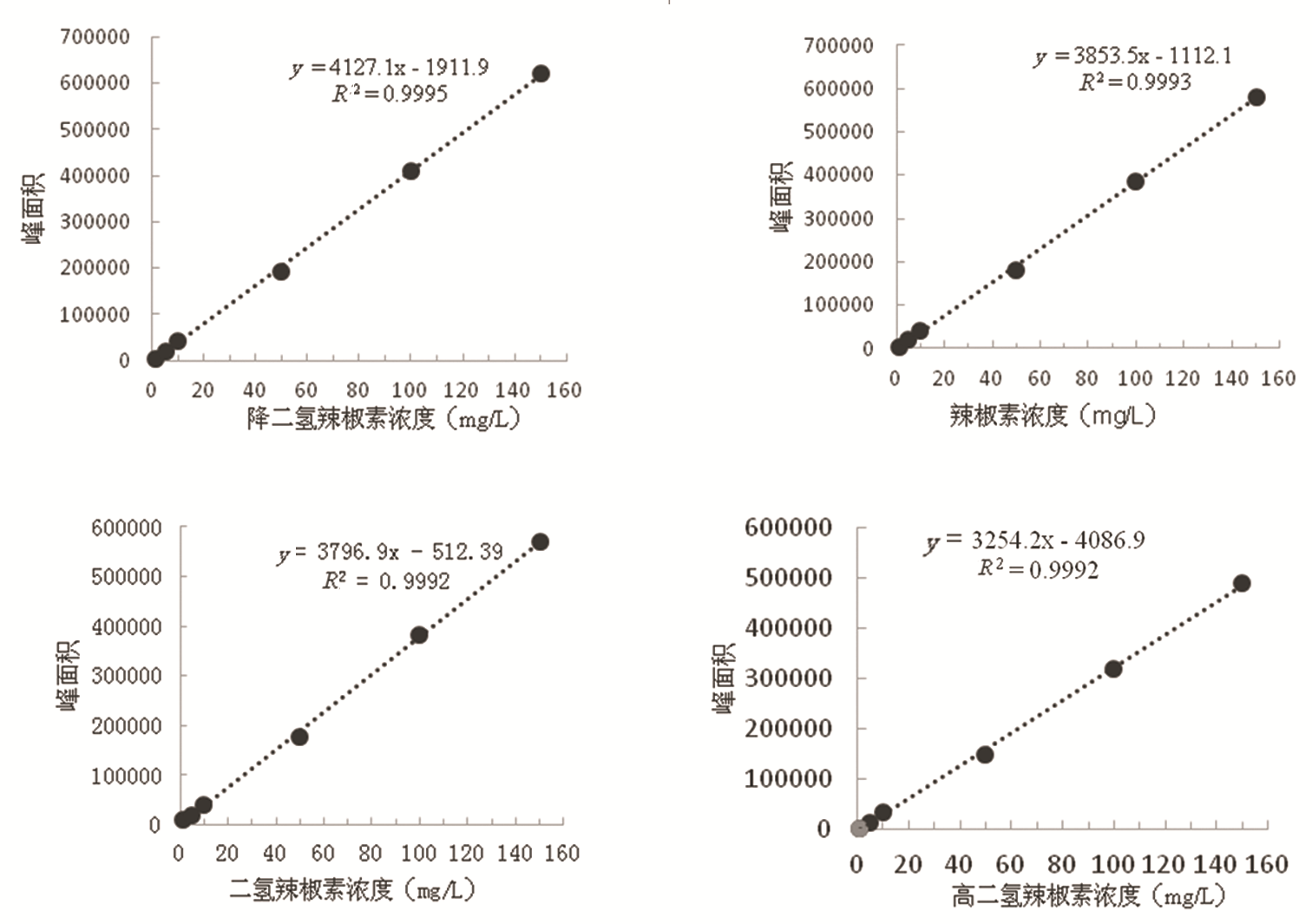
图1 各辣椒素组分标准曲线
Fig.1 Standard curve of each capsaicin component
| 国际标准值 International Standard Value/SHU | 辣度感官级别 Spiciness sensory level |
|---|---|
| 0~500 | 一级 |
| 0~500 | 二级 |
| 1 000~1 500 | 三级 |
| 1 500~2 500 | 四级 |
| 2 500~5 000 | 五级 |
| 5 000~15 000 | 六级 |
| 15 000~30 000 | 七级 |
| 30 000~50 000 | 八级 |
| 50 000~100 000 | 九级 |
| >100 000 | 十级 |
表1 辣度感官级别(十级)与国际标准值范围
Tab.1 Sensory grade of spicy degree (Grade 10) and range of international standard va
| 国际标准值 International Standard Value/SHU | 辣度感官级别 Spiciness sensory level |
|---|---|
| 0~500 | 一级 |
| 0~500 | 二级 |
| 1 000~1 500 | 三级 |
| 1 500~2 500 | 四级 |
| 2 500~5 000 | 五级 |
| 5 000~15 000 | 六级 |
| 15 000~30 000 | 七级 |
| 30 000~50 000 | 八级 |
| 50 000~100 000 | 九级 |
| >100 000 | 十级 |
| 编号 Number | 降二氢辣椒素 Dihydrocapsaicin (g/kg) | 辣椒素 Capsaicin (g/kg) | 二氢辣椒素 Dihydrocapsaicin (g/kg) | 高二氢辣椒素 High dihydrocapsaicin (g/kg) | 总辣椒素类物质 Total capsaicinoids (g/kg) | 色价 Color price |
|---|---|---|---|---|---|---|
| 线椒 GB-45 | 0.01±0.00 | 1.28±0.01 | 0.38±0.01 | 0.03±0.02 | 1.85±0.01 | 12.35±0.44 |
| 魔鬼椒 MGJ | 0.29±0.01 | 41.26±0.14 | 11.01±0.02 | 0.19±0.01 | 83.53±0.45 | 4.60±0.12 |
表2 父母本的的色价值和辣椒素类物质含量
Tab.2 Color value and capsaicin content of parents
| 编号 Number | 降二氢辣椒素 Dihydrocapsaicin (g/kg) | 辣椒素 Capsaicin (g/kg) | 二氢辣椒素 Dihydrocapsaicin (g/kg) | 高二氢辣椒素 High dihydrocapsaicin (g/kg) | 总辣椒素类物质 Total capsaicinoids (g/kg) | 色价 Color price |
|---|---|---|---|---|---|---|
| 线椒 GB-45 | 0.01±0.00 | 1.28±0.01 | 0.38±0.01 | 0.03±0.02 | 1.85±0.01 | 12.35±0.44 |
| 魔鬼椒 MGJ | 0.29±0.01 | 41.26±0.14 | 11.01±0.02 | 0.19±0.01 | 83.53±0.45 | 4.60±0.12 |
| 指标 Indexes | 最大值 Max. | 最小值 Min. | 均值 Mean | 标准差 SD | 变异幅度 Variation range | 变异系数 CV(%) | 偏度 Skewness | 峰度 Kurtosis |
|---|---|---|---|---|---|---|---|---|
| 降二氢辣椒素 Dihydrocapsaicin (g/kg) | 0.55 | 0.00 | 0.06 | 0.08 | 0.55 | 129.58 | 3.10 | 12.11 |
| 辣椒素 Capsaicin(g/kg) | 18.21 | 0.46 | 5.14 | 3.14 | 17.75 | 61.05 | 1.01 | 1.41 |
| 二氢辣椒素 Dihydrocapsaicin (g/kg) | 10.88 | 0.21 | 3.01 | 2.00 | 10.67 | 66.52 | 1.05 | 0.89 |
| 高二氢辣椒素 High dihydrocapsaicin (g/kg) | 0.72 | 0.00 | 0.09 | 0.10 | 0.72 | 119.49 | 2.98 | 12.89 |
| 总辣椒素类物质 Total capsaicinoids (g/kg) | 29.54 | 0.78 | 9.06 | 5.49 | 28.76 | 60.62 | 0.85 | 0.51 |
| 辣度 Pungency degree | 455 528.90 | 12 022.15 | 139 704.33 | 84 691.73 | 443 506.75 | 60.62 | 0.85 | 0.51 |
| 色价 Color price | 25.94 | 5.08 | 12.40 | 3.53 | 20.86 | 28.45 | 0.87 | 1.20 |
表3 F2代辣椒果实中的辣椒素类物质和辣椒色素的变异
Tab.3 Variation of capsaicin substances and capsane pigments in F2 generation pepper fruits
| 指标 Indexes | 最大值 Max. | 最小值 Min. | 均值 Mean | 标准差 SD | 变异幅度 Variation range | 变异系数 CV(%) | 偏度 Skewness | 峰度 Kurtosis |
|---|---|---|---|---|---|---|---|---|
| 降二氢辣椒素 Dihydrocapsaicin (g/kg) | 0.55 | 0.00 | 0.06 | 0.08 | 0.55 | 129.58 | 3.10 | 12.11 |
| 辣椒素 Capsaicin(g/kg) | 18.21 | 0.46 | 5.14 | 3.14 | 17.75 | 61.05 | 1.01 | 1.41 |
| 二氢辣椒素 Dihydrocapsaicin (g/kg) | 10.88 | 0.21 | 3.01 | 2.00 | 10.67 | 66.52 | 1.05 | 0.89 |
| 高二氢辣椒素 High dihydrocapsaicin (g/kg) | 0.72 | 0.00 | 0.09 | 0.10 | 0.72 | 119.49 | 2.98 | 12.89 |
| 总辣椒素类物质 Total capsaicinoids (g/kg) | 29.54 | 0.78 | 9.06 | 5.49 | 28.76 | 60.62 | 0.85 | 0.51 |
| 辣度 Pungency degree | 455 528.90 | 12 022.15 | 139 704.33 | 84 691.73 | 443 506.75 | 60.62 | 0.85 | 0.51 |
| 色价 Color price | 25.94 | 5.08 | 12.40 | 3.53 | 20.86 | 28.45 | 0.87 | 1.20 |
| 果实性状 Fruit traits | 小于母本 Smaller than the parent parent | 大于母本 Larger than the parent parent | 分离比例 Separation ratio | 渐进显著性(双侧) Progressive significance (bilateral) |
|---|---|---|---|---|
| 总辣椒素类物质Total capsaicinoids | 7 | 184 | 26∶1 | 0.00 |
| 色价Color price | 104 | 91 | 1∶1 | 0.00 |
表4 F2群体代果实性状调查结果
Tab.4 Survey results of fruit traits in F2 population
| 果实性状 Fruit traits | 小于母本 Smaller than the parent parent | 大于母本 Larger than the parent parent | 分离比例 Separation ratio | 渐进显著性(双侧) Progressive significance (bilateral) |
|---|---|---|---|---|
| 总辣椒素类物质Total capsaicinoids | 7 | 184 | 26∶1 | 0.00 |
| 色价Color price | 104 | 91 | 1∶1 | 0.00 |
| 果实性状 Fruit traits | 十级 Level 10 | 九级 Level 9 | 八级 Level 8 | 七级 Level 7 | 六级 Level 6 | 分离比例 Separation ratio | 渐进显著性(双侧) Progressive significance (bilateral) |
|---|---|---|---|---|---|---|---|
| 总辣椒素类物质 Total capsaicinoids | 138 | 52 | 18 | 8 | 4 | 35∶13∶5∶2∶1 | 0.00 |
表5 F2代群体果实总辣素性状调查结果
Tab.5 Survey results of total capsaicin traits in F2 generation population
| 果实性状 Fruit traits | 十级 Level 10 | 九级 Level 9 | 八级 Level 8 | 七级 Level 7 | 六级 Level 6 | 分离比例 Separation ratio | 渐进显著性(双侧) Progressive significance (bilateral) |
|---|---|---|---|---|---|---|---|
| 总辣椒素类物质 Total capsaicinoids | 138 | 52 | 18 | 8 | 4 | 35∶13∶5∶2∶1 | 0.00 |

图2 F2代色价和总辣椒素类物质频率分布
Fig.2 F2 color valence and frequency distribution of total capsaicinoids
| [1] |
邹学校, 朱凡. 辣椒的起源、进化与栽培历史[J]. 园艺学报, 2022, 49(6): 1371-1381.
DOI |
|
ZOU Xuexiao, ZHU Fan. Origin, evolution and cultivation history of the pepper[J]. Acta Horticulturae Sinica, 2022, 49(6): 1371-1381.
DOI |
|
| [2] | 甘增鹏, 蒋立文, 吴章华, 等. 剁辣椒加工的研究进展[J]. 食品安全质量检测学报, 2019, 10(13): 4278-4283. |
| GAN Zengpeng, JIANG Liwen, WU Zhanghua, et al. Research progress on the chopped chilli processing[J]. Journal of Food Safety & Quality, 2019, 10(13): 4278-4283. | |
| [3] | 何秋林, 吴青怡, 胡海燕, 等. 辣椒素类膳食组分抗氧化活性的研究进展[C]// 中国食品科学技术学会第十九届年会论文摘要集. 线上会议, 2022: 453-454. |
| HE Qiulin, WU Qingyi, HU Haiyan, et al. Advances in the Research of Antioxidant Activity of Capsaicinoid Dietary Components[C]// Chinese Society of Food Science and Technology. Abstracts of the 19th Annual Meeting of the Chinese Society of Food Science and Technology. Online Meeting, 2022: 453-454. | |
| [4] |
邹学校, 胡博文, 熊程, 等. 中国辣椒育种60年回顾与展望[J]. 园艺学报, 2022, 49(10): 2099-2118.
DOI |
|
ZOU Xuexiao, HU Bowen, XIONG Cheng, et al. Review and prospects of pepper breeding for the past 60 years in China[J]. Acta Horticulturae Sinica, 2022, 49(10): 2099-2118.
DOI |
|
| [5] | 付浩, 张小明, 田浩. 辣椒产业发展现状分析及建议——基于贵州辣椒产业高质量发展分析研究[J]. 耕作与栽培, 2024, 44(2): 146-150. |
| FU Hao, ZHANG Xiaoming, TIAN Hao. Analysis and suggestions of the chili industry’s current development situation based on the high-quality development of the chili industry in Guizhou Province[J]. Tillage and Cultivation, 2024, 44(2): 146-150. | |
| [6] | 王立浩, 马艳青, 张宝玺. 我国辣椒品种市场需求与育种趋势[J]. 中国蔬菜, 2019, (8): 1-4. |
| WANG Lihao, MA Yanqing, ZHANG Baoxi. Market demand and breeding trend of pepper varieties in China[J]. China Vegetables, 2019, (8): 1-4. | |
| [7] | 屠海燕, 程杨阳. 新疆发展辣椒产业的优势和建议进行浅析[C]// 2024新疆标准化论文集. 乌鲁木齐市, 2024: 187-189. |
| TU Haiyan, CHENG Yangyang. A Preliminary Analysis of the Advantages and Suggestions for Developing the Chili Industry in Xinjiang[C]// Proceedings of the 2024 Xinjiang Standardization Conference. Urumqi, 2024: 187-189. | |
| [8] | 葛菊芬, 颜彤, 欧阳炜, 等. 新疆辣椒产业现状及发展对策建议[J]. 辣椒杂志, 2010, 8(2): 8-10, 16. |
| GE Jufen, YAN Tong, OUYANG Wei, et al. Present situation and development countermeasures of pepper industry in Xinjiang[J]. Journal of China Capsicum, 2010, 8(2): 8-10, 16. | |
| [9] | 崔巍平, 陈俊科, 李欣. 新疆辣椒产业发展现状及对策[J]. 现代农业科技, 2022, (13): 195-197, 201. |
| CUI Weiping, CHEN Junke, LI Xin. Development status of pepper industry in Xinjiang and its countermeasures[J]. Modern Agricultural Science and Technology, 2022, (13): 195-197, 201. | |
| [10] | 宋文胜, 袁丰年, 张新贵. 新疆制干加工辣椒产业概况及发展趋势[J]. 辣椒杂志, 2010, 8(3): 5-8. |
| SONG Wensheng, YUAN Fengnian, ZHANG Xingui. The status quo and development trend of dried-fruit-processing hot pepper industry in Xinjiang[J]. Journal of China Capsicum, 2010, 8(3): 5-8. | |
| [11] |
Naccarato A, Furia E, Sindona G, et al. Multivariate class modeling techniques applied to multielement analysis for the verification of the geographical origin of chili pepper[J]. Food Chemistry, 2016, 206: 217-222.
DOI PMID |
| [12] | 孟庆林, 欧勇, 孙鑫. 中国加工型红辣椒产业发展现状[J]. 园艺与种苗, 2022, 42(7): 40-42. |
| MENG Qinglin, OU Yong, SUN Xin. Development status of processing red pepper industry in China[J]. Horticulture & Seed, 2022, 42(7): 40-42. | |
| [13] | 章毅颖, 褚云霞, 邓珊, 等. 我国辣椒新品种保护及DUS测试现状[J]. 上海农业学报, 2019, 35(5): 101-105. |
| ZHANG Yiying, CHU Yunxia, DENG Shan, et al. New varieties protection and DUS testing of Capsicum spp. in China[J]. Acta Agriculturae Shanghai, 2019, 35(5): 101-105. | |
| [14] | Buchanan M. Some like it hot[J]. Nature Physics, 2020, 16(1): 112. |
| [15] | Milde R, Schnabel A, Ditfe T, et al. Chemical synthesis of trans 8-methyl-6-nonenoyl-CoA and functional expression unravel capsaicin synthase activity encoded by the Pun1 locus[J]. Molecules, 2022, 27(20): 6878. |
| [16] |
Han K, Jang S, Lee J H, et al. A MYB transcription factor is a candidate to control pungency in Capsicum annuum[J]. Theoretical and Applied Genetics, 2019, 132(4): 1235-1246.
DOI PMID |
| [17] |
张正海, 曹亚从, 于海龙, 等. 辣椒果实主要品质性状遗传和代谢物组成研究进展[J]. 园艺学报, 2019, 46(9): 1825-1841.
DOI |
|
ZHANG Zhenghai, CAO Yacong, YU Hailong, et al. Genetic control and metabolite composition of fruit quality in Capsicum[J]. Acta Horticulturae Sinica, 2019, 46(9): 1825-1841.
DOI |
|
| [18] | 樊慧. 新疆辣椒产业发展现状及对策——以安集海辣椒为例[J]. 现代园艺, 2023, (6): 48-50. |
| FAN Hui. Present situation and countermeasures of pepper industry development in Xinjiang—taking anjihai pepper as an example[J]. Contemporary Horticulture, 2023, (6): 48-50. | |
| [19] |
蔡芸菲, 祝玮, 蔡煜铧, 等. 浙江省蔬菜种业发展现状及建议对策[J]. 浙江农业科学, 2022, 63(5): 883-886.
DOI |
| CAI Yunfei, ZHU Wei, CAI Yuhua, et al. Development status and suggestions for vegetable seed industry in Zhejiang Province[J]. Journal of Zhejiang Agricultural Sciences, 2022, 63(5): 883-886. | |
| [20] | 石娜, 胡春华. 现阶段我国辣椒栽培现状和育种趋势[J]. 安徽农学通报, 2017, 23(22): 61-62, 115. |
| SHI Na, HU Chunhua. Current situation and breeding trend of pepper cultivation in China[J]. Anhui Agricultural Science Bulletin, 2017, 23(22): 61-62, 115. | |
| [21] | 陈楠. 辣椒10个性状的主基因+多基因遗传分析[D]. 杨凌: 西北农林科技大学, 2022. |
| CHEN Nan. Main Gene + Polygenic Genetic Analysis of 10 Traits in Chili[D]. Yangling: Northwest A & F University, 2022. | |
| [22] | 王燕, 夏延斌, 夏菠, 等. 高效液相色谱法测定辣椒素及辣度计算[J]. 辣椒杂志, 2006, 4(1): 37-41. |
| WANG Yan, XIA Yanbin, XIA Bo, et al. Determination of capsaicinoid content by HPLC and calculation of pungency degree in Capsicum[J]. Journal of China Capsicum, 2006, 4(1): 37-41. | |
| [23] |
Aza-González C, Nú ez-Palenius H G, Ochoa-Alejo N. Molecular biology of capsaicinoid biosynthesis in chili pepper (Capsicum spp.)[J]. Plant Cell Reports, 2011, 30(5): 695-706.
DOI PMID |
| [24] |
Blum E, Liu K D, Mazourek M, et al. Molecular mapping of the C locus for presence of pungency in Capsicum[J]. Genome, 2002, 45(4): 702-705.
PMID |
| [25] | 刘熠, 刘峰, 邹学校. 辣椒素类物质生物合成及相关调控基因研究进展[J]. 湖南农业科学, 2020, (9): 109-111. |
| LIU Yi, LIU Feng, ZOU Xuexiao. Research progress of capsaicinoids biosynthesis and related regulatory genes[J]. Hunan Agricultural Sciences, 2020, (9): 109-111. | |
| [26] | Venkatesh J, Lee S Y, Back S, et al. Update on the genetic and molecular regulation of the biosynthetic pathways underlying pepper fruit color and pungency[J]. Current Plant Biology, 2023, 35: 100303. |
| [27] | 袁雷, 杨涛, 张国儒, 等. 辣椒果实中辣椒素的研究进展[J]. 中国瓜菜, 2021, 34(11): 1-9. |
| YUAN Lei, YANG Tao, ZHANG Guoru, et al. Research progress of capsaicin in pepper fruit[J]. China Cucurbits and Vegetables, 2021, 34(11): 1-9. | |
| [28] | 袁雷. 辣椒果实色素极端材料的筛选及色素相关QTL初定位[D]. 石河子: 石河子大学, 2023. |
| YUAN Lei. Screening of extreme materials of pigment in pepper fruit and preliminary mapping of pigment-related QTL[D]. Shihezi: Shihezi University, 2023. | |
| [29] | Kumar P, Lal S, Thakur P, et al. Inheritance of Mature Fruit Colour in Capsicum[J]. Indian Journal of Plant Genetic Resources, 2009, 22(1):36-40. |
| [1] | 王珊珊, 王晨瑜, 杨超沙, 蔡晓艺, 尹伟平, 尹庆珍. 优质多抗樱桃番茄亲本资源筛选[J]. 新疆农业科学, 2025, 62(5): 1139-1150. |
| [2] | 宋梅, 布卡·欧尔娜, 李国萍, 凌益章. 苹果杂种后代抗寒性遗传规律分析[J]. 新疆农业科学, 2024, 61(7): 1689-1695. |
| [3] | 张国儒, 唐亚萍, 石林媛, 袁雷, 张勇, 杨生保. 辣椒种间杂交遗传特性[J]. 新疆农业科学, 2024, 61(3): 632-641. |
| [4] | 王震鲁, 白涛, 李东亚, 戴硕, 陈珍. 基于改进YOLOv5的绿辣椒目标检测方法[J]. 新疆农业科学, 2024, 61(12): 3032-3041. |
| [5] | 蒋荣伟, 杨生保, 袁雷, 肖红星. 辣椒果实中辣椒色素的研究进展[J]. 新疆农业科学, 2024, 61(11): 2648-2657. |
| [6] | 马思洁, 朱天生, 何璐, 杨叔青. 辣椒小G蛋白CaROP的生物信息学分析[J]. 新疆农业科学, 2024, 61(1): 165-175. |
| [7] | 陈艳, 黄璐瑶, 邓昌蓉, 张彦君, 侯全刚, 邵登魁. 冷害对多茸毛型线辣椒幼苗生理水平的影响[J]. 新疆农业科学, 2023, 60(6): 1492-1498. |
| [8] | 袁雷, 唐亚萍, 张国儒, 吉雪花, 杨生保. 基于辣椒种间杂交F2群体的遗传连锁图谱构建及主要果实性状QTL定位[J]. 新疆农业科学, 2023, 60(5): 1150-1161. |
| [9] | 刘衍晨, 刘志刚, 白新慧, 乔鹏, 徐诚, 白慧敏, 张娟. 蛭石复混基质对辣椒育苗的影响[J]. 新疆农业科学, 2023, 60(5): 1190-1199. |
| [10] | 裴红霞, 李生梅, 武旭霞, 耿世伟, 赖黎丽, 高晶霞, 董心久. 辣椒核雄性不育系pby-1形态学及生理生化特性分析[J]. 新疆农业科学, 2023, 60(3): 624-632. |
| [11] | 陈丽, 马静, 朱志明, 刘炜, 孙建昌. 基于水稻RIL群体的加工品质性状QTL分析[J]. 新疆农业科学, 2023, 60(10): 2419-2425. |
| [12] | 肖中林, 闫会转, 高杰, 王思逸, 张旭旭, 艾力西热·尼加提. 不同浓度NaCl和NaHCO3胁迫对制干辣椒光合特性日变化的影响[J]. 新疆农业科学, 2023, 60(1): 140-149. |
| [13] | 彭宇, 闫会转, 肖中林, 贾凯, 燕存尧, 王妍欣. 不同施肥处理对盆栽辣椒土壤酶活性及土壤微生物含量的影响[J]. 新疆农业科学, 2022, 59(9): 2200-2208. |
| [14] | 袁雷, 吉雪花, 张国儒, 石林媛, 郭河瑶, 唐亚萍, 杨涛, 杨生保. 52份辣椒主要果实性状的遗传多样性及聚类分析[J]. 新疆农业科学, 2022, 59(8): 1935-1944. |
| [15] | 张卢慧, 赵志强, 郭庆元. 辣椒细菌性果实条斑病病原鉴定[J]. 新疆农业科学, 2022, 59(7): 1726-1733. |
| 阅读次数 | ||||||
|
全文 |
|
|||||
|
摘要 |
|
|||||
