

0 引言
【研究意义】棉花是新疆的主要经济作物之一,随着“矮、密、早、膜、滴”植棉技术的推广应用,2022年新疆棉花总产量为539.1×10⁴ t,占全国棉花总产量的90.2%[1]。但是,在棉花播种季节中常常遭遇阴雨、寒潮、倒春寒等低温气象灾害,致使地表温度远低于棉花种子萌发和幼苗生长温度的最低点,甚至降低到0℃以下,影响棉花种子萌发,导致每年有不同程度的烂种、烂芽、烂根甚至死苗现象发生,棉花播种后出苗难,一播全苗更难,严重的会导致田间缺苗断垄甚至毁种重播,即使及时补种或移苗补栽,由于生育期不一致,先出苗的长势比补种的长势好,补种的苗往往跟不上群体的发育速度,造成补种的植株弱小生长发育缓慢,即使中后期加强管理也难以弥补前期生长不良造成的损失,小苗无法获得足够的养分,会出现空棵或晚熟,影响棉花产量和品质。因此,播种季节中低温气象灾害对棉花生产影响较大。而种子包衣技术是在浸种和拌种的基础上发展起来的一项植保技术,具有综合防治、低毒高效、省种省药的特点,随着种子萌发、出苗和生长过程,种衣剂里有效成分逐渐被植株根系吸收并传导到幼苗植株各部位后对种子及幼苗根系起到保护作用,对其周围附近病菌及地下、地上害虫起到防治作用。采用种衣剂包衣棉种可有效地解决早春棉花出苗的问题。但是,在低温冷胁迫危害较重情况下,仍然难以确保田间较高保苗率,需要研究提高棉花苗期适应冷胁迫能力的新产品来获得均匀的田间出苗和较高出苗率,保苗率达到计划种植密度。【前人研究进展】萎锈灵(carboxin)和拌种灵(amicarthiazol)两者均是羧基酰胺类杀菌剂,其活性结构相似,均具有丁烯酰胺类结构,两者区别在于萎锈灵的分子结构中含有噁噻因环,而拌种灵的分子结构中含有噻唑基团。由于丁烯酰胺类化合物的脂溶性较高,易于穿透病菌细胞壁进入体内到达作用靶标,因此丁烯酰胺结构在对担子菌真菌具有高效内吸活性方面起着重要的作用[2,3]。另外,与不同病原菌琥珀酸脱氢酶铁-硫蛋白的S3中心的空间构象有关,活性结构结合部位与其中心的氨基酸残基共价结合,导致酶活性中心的构象发生改变,阻止电子从琥珀酸向辅酶Q的传递,进一步阻止其中心的氧化作用,抑制细胞的呼吸作用,致使病原菌的生长受到抑制作用[4,5]。萎锈灵和拌种灵两者在植株体内均具有良好的内吸传导性,对棉花立枯病有较好防治作用[6,7]。但是,萎锈灵包衣棉种不仅能促进棉花生长并具有抗氧化防御机制,还能增强棉苗适应冷胁迫的能力[8,9]。【本研究切入点】萎锈灵和拌种灵均是一种具有内吸作用的杀菌剂,可用于防治麦类锈病、棉花立枯病等,且防效较好,持效性长。但是萎锈灵和拌种灵包衣对棉幼苗冷胁迫生理生化特征的比较研究未见相关报道。需研究比较具有活性结构相似的2种杀菌剂萎锈灵和拌种灵包衣棉种提高棉种适应冷胁迫能力功效。【拟解决的关键问题】比较具有生物活性结构相似的拌种灵与萎锈灵2种杀菌剂包衣诱导棉苗适应冷胁迫的功效,分析2种杀菌剂包衣提高棉花适应冷胁迫的能力差异,研究其生理作用机制,为开发棉花适应冷胁迫环境的包衣剂新产品提供理论依据。
1 材料与方法
1.1 材料
选用棉花品种为新陆早50号(新疆农业科学院经济作物研究所提供)。
1.2 方法
1.2.1 试验设计
挑选籽粒饱满的棉花种子,经1%次氯酸钠消毒后灭菌蒸馏水冲洗干净并晾干。以基础种衣剂包衣处理为对照,将药剂分别添加到基础种衣剂中,制成以上不同的种衣剂,试验共设2个包衣处理:拌种灵种衣剂包衣处理和萎锈灵种衣剂包衣处理;分别按药种重量比1∶100进行包衣为对照,依次记为CK、T1、T2。将包衣的棉花种子放在通风干燥处阴干,进行种子萌发和幼苗培养。
1.2.2 测定指标
1.2.2.1 种子萌发及冷胁迫处理
细砂经水洗后干热灭菌晾至室温,添加13%的灭菌水混匀,装入发芽盒中构建发芽床。每个发芽盒沙床上等距离摆放不同处理的30粒种子;参照李海明等[11]方法在室内人工智能气候箱(4℃/16℃,12 h/12 h)模拟冷胁迫处理环境进行种子萌发。试验过程中,从第4 d开始每48 h观察记录种子萌发情况,第14 d结束萌发,采集生长一致的子叶用于测定相关生理生化指标,从各处理中均随机选出10株棉苗洗净后,经杀青后烘干至质量恒定,电子分析天平称量发芽前种子干重、发芽后的种皮和种壳干重以及幼苗鲜/干质量。并将冷胁迫处理后25℃环境进行恢复生长7 d后,对不同伤害程度的棉花幼苗叶片冷胁迫症状进行调查。
1.2.2.2 计算
参照王学奎等[14]编写的《生理生化实验原理和技术》测定棉苗相关生理生化指标,包括相对电导率(Relative conductivity,REC)、丙二醛(Malondialdehyde,MDA)含量、可溶性蛋白(Soluble protein,SP)含量、可溶性糖(Soluble sugar,SS)含量、超氧化物歧化酶(Superoxide dismutase,SOD)活性、过氧化物酶(Peroxidase,POD)活性和过氧化氢酶(Catalase,CAT)活性。
参照王俊娟等[15]方法计算棉苗的冷胁迫指数(Chilling injury index,CI)。
1.3 数据处理
采用Microsoft Excel进行数据分析,采用GraphPad Prism进行绘图。
2 结果与分析
2.1 各处理对冷胁迫下棉花种子萌发活性影响
研究表明,与对照比较,拌种灵和萎锈灵包衣处理的发芽势分别增加5.33%和9.67%,且差异显著;发芽率分别增加5.14%和10.29%,且差异显著;发芽指数分别增加6.00%和12.00%,且差异显著;活力指数分别增加6.67%和13.33%,且差异显著。拌种灵和萎锈灵包衣的棉种萌发活性指标均增加,冷胁迫条件下,拌种灵和萎锈灵包衣后均能提高种子活性,从而提高棉种发芽率。图1
图1
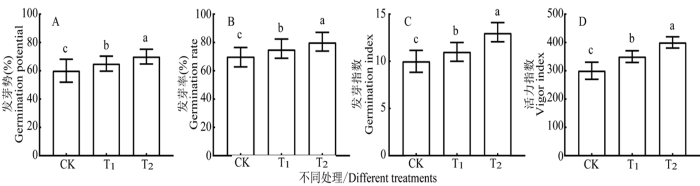
图1
冷胁迫下各包衣处理棉种萌发活性相关指标的比较
注:CK:对照,T1:拌种灵包衣,T2:萎锈灵包衣,图中小写字母表示各处理在P<0.05水平上的差异显著性,下同
Fig.1
Comparison of relevant indicators of germination activity of cotton seeds under cold stress
Note:CK:coated with inert component only,T1:seed coated with amicarthiazol,T2:seed coated with carboxin. The small letters in the figure indicate the significance of the difference between the treatments at the level of P< 0.05,the same as below
2.2 各处理对冷胁迫下棉种干物质转移的影响
研究表明,与对照比较,拌种灵和萎锈灵包衣处理的鲜重分别增加3.33%和4.33%,且差异不显著;干重分别增加4.00%和8.00%,仅萎锈灵包衣处理差异显著;干物质转移率分别增加4.00%和9.00%,仅萎锈灵包衣处理差异显著;呼吸消耗量分别增加-6.25%和-7.50%,且差异不显著。拌种灵和萎锈灵包衣的棉种干物质转移指标均增加,萎锈灵包衣处理的增加较大,冷胁迫条件下,两药剂包衣处理均能增强种子活性,提高种子干物质转化效率,增加棉花幼苗干物质积累,更有利于幼苗生长发育和适应冷胁迫环境。图2
图2
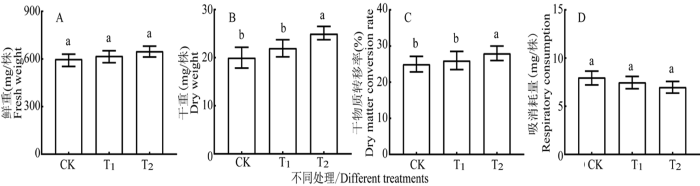
图2
冷胁迫下各包衣处理棉种干物质转移相关指标的比较
Fig.2
Comparison of dry matter transfer related indicators of cotton seeds under cold stress
2.3 各处理对冷胁迫下棉花幼苗细胞膜系统的影响
研究表明,与对照比较,拌种灵和萎锈灵包衣处理的REC分别增加-3.75%和-12.5%,仅萎锈灵的差异显著;MDA含量分别增加-3.33%和-11.11%,仅萎锈灵包衣处理差异显著。2处理REC和MDA含量均有下降,萎锈灵包衣处理的下降较大,萎锈灵处理较拌种灵处理更有助于避免冷胁迫对棉花幼苗造成的生物膜损伤,对棉花幼苗细胞膜起到保护作用。图3
图3
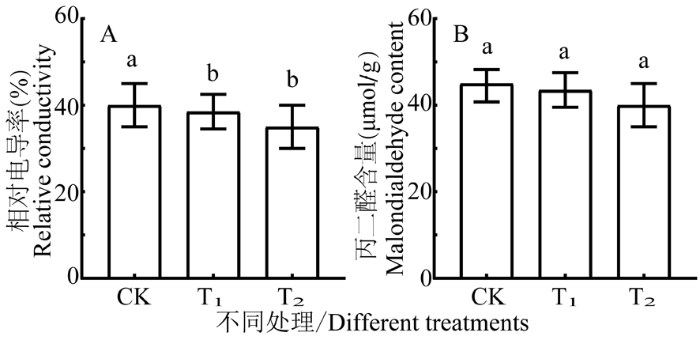
图3
冷胁迫下各包衣处理棉花幼苗细胞膜系统指标的比较
Fig. 3
Comparison of cell membrane system indexes of cotton seedlings under cold stress
2.4 各处理对冷胁迫下棉花幼苗渗透调节系统的影响
研究表明,与对照比较,拌种灵和萎锈灵包衣处理的SP含量分别增加6.00%和11.00%,且差异显著;SS含量分别增加3.33%和4.33%,且差异不显著。两药剂处理的SP含量均有所提高,但萎锈灵包衣处理提高幅度较大,萎锈灵更能诱导可溶性蛋白的积累,增强其细胞冷胁迫下的渗透调节能力。图4
图4
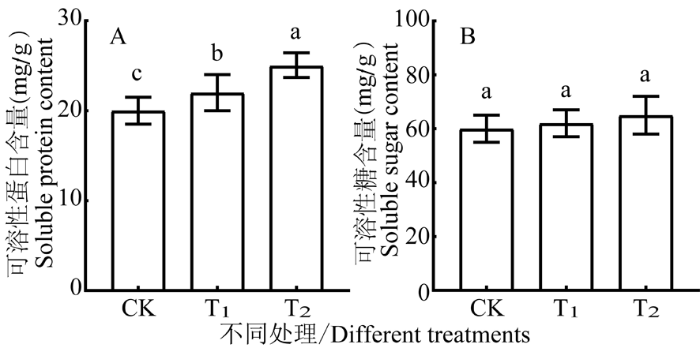
图4
冷胁迫下各包衣处理棉花幼苗渗透调节物质含量的比较
Fig. 4
Comparison of osmotic adjustment substance content of cotton seedlings under cold stress
2.5 各处理对冷胁迫下棉花幼苗抗氧化酶系统的影响
研究表明,与对照比较,拌种灵和萎锈灵包衣处理的SOD活性分别增加6.67%和10.67%,且差异显著;POD和CAT活性分别增加1.50%、1.60%、-3.33%和3.33%,且差异不显著。两药剂处理均能不同程度提高SOD酶活性,萎锈灵包衣处理提高幅度较大,更能提高棉花幼苗叶片抗氧化酶活性,以清除植物体内活性氧的积累,消除活性氧对细胞膜系统的伤害,增强对细胞的保护作用。图5(A-C)
图5
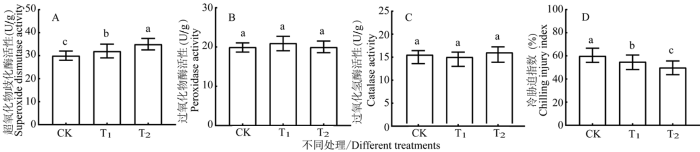
图5
冷胁迫下各包衣处理棉花幼苗抗氧化酶活性和CI的比较
Fig. 5
Comparison of antioxidant enzyme activity and CI of cotton seedlings under cold stress
2.6 各处理对冷胁迫下棉苗CI的影响
研究表明,与对照比较,拌种灵种衣剂和萎锈灵种衣剂包衣处理CI分别降低-5.33%和-10.67%,且差异显著。萎锈灵种衣剂包衣处理的CI降幅较大,该处理增强棉花幼苗适应冷胁迫的能力,受冷胁迫程度较轻。图5(D)
2.7 各处理的冷胁迫下棉花幼苗CI与其生理生化指标的相关性
研究表明,拌种灵和萎锈灵包衣处理的棉花幼苗CI与其REC、SP和SOD均显著正相关(P<0.05),相关系数分别为0.91、0.75、0.91和0.89、0.71、0.90;基础种衣剂(对照)包衣处理的棉花幼苗CI与其指标均无显著相关。两药剂包衣处理的棉苗CI与REC、SP、SOD等指标有一定相关性,两药剂处理包衣处理能增强棉花幼苗适应冷胁迫的能力。表1
表1 各处理冷胁迫下棉花幼苗CI与其生理生化指标的相关性
Tab.1
| 处理 Treatment | 生理生化指标 Physiological and biochemical indexes | ||||||
|---|---|---|---|---|---|---|---|
| REC | MDA | SP | SS | SOD | POD | CAT | |
| CK | 0.67 | 0.60 | 0.78 | 0.68 | 0.75 | 0.71 | 0.60 |
| T1 | 0.91* | 0.64 | 0.75* | 0.65 | 0.91* | 0.79 | 0.65 |
| T2 | 0.89* | 0.61 | 0.71* | 0.75 | 0.90* | 0.76 | 0.68 |
注:*表示各处理在P<0.05水平上的差异显著性
Note:* represents the significant difference between the treatments at the level of P<0.05
2.8 各处理的冷胁迫下棉花幼苗相关指标的主成分
研究表明,系统默认方差大于1的为主成分,得到第一、第二和第三主成分,其综合评值为F=4.18F1+3.45F2+1.03F3。根据第一、第二和第三主成分与客观权重之积,得到各处理的冷胁迫下棉花幼苗生长的综合影响评判结果。CK、T1和T2处理对棉花幼苗生长影响的综合评价分别为-1.69、2.12和3.69,T1和T2得分均大于1,并且其综合评分分别排在第2位和第1位。萎锈灵包衣处理提高棉花幼苗生长能力的综合影响最佳,拌种灵次之。表2
表2 各处理冷胁迫下棉花生长的综合评价
Tab.2
| 处理 Treatment | 因子Factor | F | 排序 Sort | |||||
|---|---|---|---|---|---|---|---|---|
| F1 | F2 | F3 | ||||||
| CK | -0.97 | 0.94 | -0.85 | -1.69 | 3 | |||
| T1 | 1.11 | -0.98 | 0.84 | 2.12 | 2 | |||
| T2 | 1.31 | -0.79 | 0.91 | 3.69 | 1 | |||
3 讨论
3.1 棉花苗期冷害是制约棉花生产及诱导病害发生的主要因素之一,在萌发过程中种子淀粉酶等酶活性被抑制,细胞内分解转化为能量供细胞生长的物质减少,种子活力减弱,种子萌发延迟,从而抑制种子幼芽和幼根的伸长和生长,造成出苗缓慢,苗瘦苗弱,棉苗无法自然出土;棉花幼苗活性氧代谢失调,自由基积累,细胞膜脂过氧化作用加强,细胞膜结构的完整性遭到破坏、功能丧失、透性增加,而致使细胞液外渗,细胞膜结构的破坏导致叶片坏死,叶绿素含量降低和光合作用效率降低,抗逆性减弱,缺苗断垄甚至毁种重播,最后表现为棉苗植株矮小,生长发育缓慢,对棉花产量品质形成影响非常大。植物耐冷性与植株形态、细胞结构、生理生化以及代谢等方面的抗逆指标相关[16]。大多通过外源植物生长调节物质诱导其耐冷性,如用油菜素内脂处理或脱落酸来提高植物对低温环境下的耐受能力[17,18],也有通过种子包衣技术提高棉花、玉米等在冷胁迫下种子发芽及幼苗的生长能力[19⇓-21]。但是采用杀菌剂提高作物抗冷能力研究报道很少。研究通过琥珀酸脱氢酶抑制剂类杀菌剂制成种衣剂包衣处理,主成分分析表明,萎锈灵处理对增强棉苗耐冷能力的效果优于拌种灵处理。尚需在此理论基础上,进一步通过田间试验考察萎锈灵和拌种灵包衣提高棉苗实际适应冷胁迫的能力。
3.2 在逆境环境中,植物体通过增加保护酶活性及时清除活性氧以及调控相关代谢渗透调节剂物质来降低或缓解逆境胁迫带来的伤害[22]。研究表明,2种药剂包衣处理棉苗在处理时间内的保护酶活性存在显著差异,与对照比较,两药剂包衣处理棉花幼苗在冷胁迫下的过氧化物歧化酶活性呈现增高的趋势,丙二醛及可溶性蛋白含量呈现上升的趋势,棉苗通过调节过氧化物歧化酶活性和丙二醛含量、可溶性蛋白含量来降低活性氧伤害,维持细胞内渗透平衡,以避免或降低逆境胁迫对棉苗细胞和组织的伤害,使棉苗耐冷性能力增强,提高适应冷胁迫的调节能力。该结果与前人的抗冷指标变化结论一致[23]。另外,研究结果还表明,棉苗冷胁迫指数与相对电导率、可溶性蛋白和过氧化物歧化酶活性等相关生理生化指标有一定相关性,两药剂包衣处理能增强棉花幼苗适应冷胁迫的能力。有关外源物质包衣处理增强棉花耐冷的能力,是一个复杂的的调控过程,还有待进一步在细胞、分子水平上进行深入研究。
4 结论
7.2%萎锈灵和40%拌种灵包衣处理均对棉花种子萌发和幼苗的生理特征有一定影响,能促进萌发期种子内营养物质的转化与合成,提高种子活性,从而提高种子的发芽率,通过诱导棉花幼苗细胞内部酶的活性增强,清除幼苗体内活性氧自由基,加快MDA含量的积累,保护幼苗细胞膜结构稳定性,从而提高棉苗适应冷胁迫的能力。两种药剂中,萎锈灵种衣剂诱导棉苗耐冷效果优于拌种灵。
参考文献
Mode of action of oxathiin systemic fungicides. Structure-activity relations
[J].
Fungitoxicity and structure-activity relationships of some oxathiin and thiazole derivatives
[J].
Mode of action of oxathiin systemic fungicides V. Effect on electron transport system of Ustilago maydis and Saccharomyces cerevisiae
[J].
The systemic fungicide carboxin (5,6-dihydro-2-methyl-1,4-oxathiin-3-carboxanilide) at 100 mum inhibited succinate cytochrome c reductase in mitochondria from Ustilago maydis and Saccharomyces cerevisiae. It did not have any effect on reduced nicotinamide adenine dinucleotide (NADH) cytochrome c reductase. Succinate coenzyme Q reductase was also inhibited, but NADH coenzyme Q reductase was not. When dichlorophenolindophenol (DCIP) was used as the terminal acceptor of electrons from the oxidation of succinate, carboxin was very effective in inhibiting succinate-DCIP reductase. Carboxin was inhibitory to succinic dehydrogenase assayed with phenazine methosulfate plus DCIP when intact mitochondria were used as the enzyme source but not when solubilized enzyme was used. The main site of action of carboxin, therefore, appears to lie between succinate and coenzyme Q. The dioxide analogue of carboxin was also effective in inhibiting succinate-cytochrome c reductase, succinate-coenzyme Q reductase, or succinate-DCIP reductase, whereas the monoxide analogue was less effective in inhibiting these enzymes.
Succinate dehydrogenase and fumarate reductase from Escherichia coli
[J].
萎锈灵原药的毒性研究
[J].
Study on the toxicity of carboxin technical drug
[J].
Rhizoctonia seedling disease of hemp and its control
[J].
萎锈灵包衣对低温胁迫下棉种萌发特性的影响
[J].
Effects of the Carboxin from Seed Coating Formulation on the Cotton Seed Germination Characteristics under Low Temperature Stressc
[J].
萎锈灵杀菌剂对提高棉花耐低温冷害胁迫能力的影响
[J].【目的】研究冷胁迫条件下萎锈灵杀菌剂对棉花种子发芽率、保苗率及幼苗耐低温冷害胁迫能力的影响,为萎锈灵杀菌剂应用于棉花生产提供依据。【方法】在室内制备5种不同浓度(4.2%、5.7%、7.2%,8.7%和10.2%)的萎锈灵,以裸种子不包衣处理作为空白对照,以基础杀菌剂包衣处理作为参比对照,按药种比1∶100进行种子包衣处理,测定在冷胁迫条件下萎锈灵杀菌剂对棉种的发芽率、出苗率、保苗率、棉苗株高、叶片数、干鲜重和光合参数,并采用主成分分析法,综合评价萎锈灵对棉花耐低温胁迫的影响。【结果】8.7%萎锈灵处理的种子发芽率较空白对照分别增加7.0%(25℃)、12.0%(18℃)、18.0%(15℃)和20.5%(12℃),较参比对照分别增加5.0%(25℃)、9.0%(18℃)、12.0%(15℃)和16.4%(12℃)。7.2%萎锈灵处理的出苗率较空白对照增加10.1%,较参比对照增加13.0%、8.7%萎锈灵处理的保苗率较空白对照增加9.1%,较参比对照增加13.2%。7.2%萎锈灵处理的幼苗株高、茎粗、鲜重和干重分别较空白对照增加8.9%、9.7%、7.4%和25.4%,较参比对照分别增加10.8%、10.7%、8.3%和27.5%。7.2%萎锈灵处理提高了在冷胁迫条件下的棉花幼苗叶片净光合速率、气孔导度、胞间CO<sub>2</sub>浓度指标,较空白对照分别增加11.0%、17.0%和9.0%,较参比对照分别增加6.0%、6.0%和5.0%,这些指标差异均达显著水平。7.2%萎锈灵杀菌剂处理增强棉花耐低温冷害胁迫能力的作用效果最好,其次为8.7%萎锈灵杀菌剂。【结论】萎锈灵杀菌剂处理能够增强棉花种子活力,提高了发芽率、出苗率和保苗效果,提高了棉苗耐低温冷害胁迫能力,可促进棉苗光合作用和生长。
Effects of the carboxin fungicide on the chilling stress of cotton seedlings
[J].【Objective】 To study the effect of carhoxin Fungicide on the germination and seedling of cotton under chilling stress, the Optimum concentration to improve the germination rate, seedling preservation rate and seedling chilling tolerance were explored in the hope of providing theoretical basis and technical support for the application of seed film coating carhoxin Fungicide in cotton production.【Methods】 Five kinds of seed coating agents with different concentrations (4.2%, 5.7%, 7.2%, 8.7% and 10.2%) of carhoxin were prepared in the laboratory. The naked seeds as control and the basic seed coating as control reference, and the seed coating treatment was carried out according to the drug/seed ratio of 1:100; Under the chilling stress, the germination rate and other characters were investigated and the synthetic effects were evaluated by principal component analysis through the data of the germination rate, etc.【Results】 Compared with the control, the germination rate of seeds treated with 8.7% carhoxin increased by 7.0% (25℃), 12.0% (18℃), 18.0% (15℃), 20.5% (12℃), respectively. Compared with the control reference, the germination rate of seeds treated with 7.2% carhoxin increased by 5.0% (25℃), 9.0% (18℃), 12.0% (15℃), 16.4% (12℃), respectively. The seedling rate of seeds treated with 7.2% carhoxin increased by 10.1% compared with the control, 13.0% compared with the reference. The seedling rate of seeds treated with 8.7% carhoxin increased by 9.1% compared with the control, 13.2% compared with the control reference. Compared with the control, the seedling height, stem diameter, fresh weight and dry weight of seeds treated with 7.2% carhoxin increased by 8.9%, 9.7%, 7.4% and 25.4%, respectively. Compared with the control reference, these indicators increased by 10.8%, 10.7%, 8.3% and 7.5%, respectively. Compared with the control, the indexes of net photosynthetic rate, stomatal conductance and intercellular CO<sub>2</sub> concentration of cotton seedling leaves of seeds treated with 7.2% carhoxin under chilling stress increased by 11.0%, 17.0% and 9.0%, respectively. Compared with the control reference, these indicators increased by 6.0%, 6.0% and 5.0%, respectively. Comprehensive analysis showed that seed treated with 7.2% carhoxin had the optimum effect on enhancing the ability of cotton to resist chilling stress, followed by 8.7% carhoxin.【Conclusion】 The carhoxin fungicide can enhance the vigor of cotton seed, increase the germination rate, emergence rate and seedling protection effect, improve the ability of cotton seedling to withstand chilling stress, and promote the photosynthesis and growth of cotton seedling.
内吸杀菌剂拌种灵防治棉苗立枯病、炭疽病的研究
[J].
Study on the Control of Cotton Seedling Wilt and Anthrax with Internal Absorbing Fungicide amicarthiazol
[J].
Association Analysis of Drought Tolerance and Associated Traits in Upland Cotton at the Seedling Stage
[J].(1) Background: Upland cotton (Gossypium hirsutum L.) is the most important natural fiber worldwide, and it is extensively planted and plentifully used in the textile industry. Major cotton planting regions are frequently affected by abiotic stress, especially drought stress. Drought resistance is a complex, quantitative trait. A genome-wide association study (GWAS) constitutes an efficient method for dissecting the genetic architecture of complex traits. In this study, the drought resistance of a population of 316 upland cotton accessions was studied via GWAS. (2) Methods: GWAS methodology was employed to identify relationships between molecular markers or candidate genes and phenotypes of interest. (3) Results: A total of 8, 3, and 6 SNPs were associated with the euphylla wilting score (EWS), cotyledon wilting score (CWS), and leaf temperature (LT), respectively, based on a general linear model and a factored spectrally transformed linear mixed model. For these traits, 7 QTLs were found, of which 2 each were located on chromosomes A05, A11, and D03, and of which 1 was located on chromosome A01. Importantly, in the candidate regions WRKY70, GhCIPK6, SnRK2.6, and NET1A, which are involved in the response to abscisic acid (ABA), the mitogen-activated protein kinase (MAPK) signaling pathway and the calcium transduction pathway were identified in upland cotton at the seedling stage under drought stress according to annotation information and linkage disequilibrium (LD) block analysis. Moreover, RNA sequencing analysis showed that WRKY70, GhCIPK6, SnRK2.6, and NET1A were induced by drought stress, and the expression of these genes was significantly different between normal and drought stress conditions. (4) Conclusions: The present study should provide some genomic resources for drought resistance in upland cotton. Moreover, the germplasm of the different phenotypes, the detected SNPs and, the potential candidate genes will be helpful for molecular marker-assisted breeding studies about increased drought resistance in upland cotton.
干旱胁迫对不同抗旱性小麦种子萌发及幼苗根芽生物量分配的影响
[J].
Effect of drought stress on seed germination and biomass allocation of root and shoot of different drought resistant wheat cultivars
[J].
陆地棉遗传标准系TM-1的特性及其耐冷性
[J].【目的】通过系统调查TM-1农艺性状及纤维品质,研究芽期和苗期的耐冷性,以及对其在低温胁迫条件下的耐冷相关基因进行实时荧光定量分析,深入挖掘其耐冷机理,为该种质利用提供理论依据。【方法】在田间,以中棉所35为对照,以人工调查方式对TM-1进行表型鉴定,依据国际校准棉花标准(HVICC)测定纤维品质,同时采用卡那霉素筛选和分子鉴定进行Bt检测。以抗冷品种豫2067和冷敏感品种衡棉3号为对照,对TM-1芽期和子叶期进行耐冷性鉴定,4℃低温处理,然后正常条件下恢复生长7 d,调查芽期相对子叶平展率及子叶期植株受胁迫后的冷害级别,计算冷害指数和耐冷指数;使用便携式叶绿素仪进行叶片活体测定,以SPAD值代表相对叶绿素含量;在三叶期进行4℃低温处理24 h,利用实时荧光定量方法进行耐冷相关基因在叶片中的表达测定。【结果】表型鉴定结果显示,TM-1叶片较大,颜色深绿,生育期较长,约135 d,霜前籽棉产量为2 791.50 kg·hm<sup>-2</sup>,株高94.60 cm,霜前籽棉产量、株高、单株果枝数和单株结铃数均高于中棉所35,其他农艺性状与中棉所35接近,纤维品质中等水平。卡那霉素和试纸检测结果表明TM-1与中棉所35均不含Bt。芽期耐冷性鉴定结果表明,与对照处理相比,TM-1叶片的相对叶绿素含量极显著下降,株高极显著降低,低温胁迫极显著抑制了棉花下胚轴的伸长,并且抑制了叶片叶绿素的合成;低温处理后,TM-1的主根受到了伤害,恢复生长后侧根却比较发达,侧根生长优于对照。TM-1芽期耐冷级别达到高抗冷。苗期抗冷性鉴定结果表明,与对照相比,TM-1的相对叶绿素含量显著下降,株高极显著降低。TM-1子叶期耐冷指数为85.32%,显著高于抗冷材料豫2067,耐冷级别达到抗冷。TM-1三叶期受低温胁迫24 h后,在叶片中,有9个耐冷相关基因上调表达,上调表达倍数显著或极显著高于衡棉3号;其中,脱水素基因在叶片中上调表达,表达倍数与其在豫2067叶片中的表达倍数相近,是衡棉3号叶片中表达倍数的4.69倍,LEA3在TM-1叶片中的上调表达倍数显著高于豫2067和衡棉3号。总之,TM-1属于中晚熟品系,纤维品质中等,不含Bt;芽期和子叶期均比较抗冷,属于比较抗冷的类型;与耐冷相关的基因在TM-1的叶片中受低温诱导表达,拥有特别的表达模式。【结论】TM-1具有稳定的农艺性状,纤维品质达中等水平,不含Bt,可用作转外源基因的良好受体;因为其良好的耐冷特性,TM-1可以作为棉花耐冷性育种改良的重要亲本来源和基因克隆的基因源。
Characteristics and cold tolerance of upland cotton genetic standard line TM-1
[J].【Objective】We systematically investigated the major agronomic traits and cold tolerance of accession TM-1 at the bud and seedling stages. The relative expressions of cold tolerance-related genes were analyzed by the qRT-PCR method. The cold tolerance mechanism of TM-1 was further discussed, which provides the theoretical basis for the breeding utilization of TM-1.【Method】The major agronomic traits of TM-1 were manually investigated in the field using variety CRI35 as the control. The fiber quality was assessed by an international calibrated cotton standard (HVICC), and the insect resistance (Bt) was detected by kanamycin screening and molecular detection technologies. For the cold tolerance testing, two contrasting accessions, cold-resistant accession Yu 2067 and cold-sensitive variety Hengmian 3 were set as controls, respectively. The cold resistance of TM-1 at bud stage and cotyledon stage was identified, treated at 4℃ and then recovered under normal conditions for 7 days, and the relative cotyledon spreading rate and the cold injury levels of plants were investigated, and cold injury indexes and cold resistance indexes were calculated. The portable chlorophyll meter was used for in vivo testing the leaf relative chlorophyll content (represented by SPAD value). The expressions of cold tolerance-related genes in leaves were measured by qRT-PCR method. 【Result】 The leaves of TM-1 were large and dark green. The pre-frost seed cotton yield was 2 791.50 kg·hm-2, and the plant height was 94.60 cm. The growth period was about 135 days, and the yield, plant height, fruit branch number per plant, boll number per plant were higher than CRI35, while other agronomic traits were similar to CRI35. TM-1 had medium fiber quality. The test results of kanamycin and test paper showed that TM-1 did not contain the Bt like CRI35. Identification results of cold tolerance at bud stage showed that compared with the control treatment, the relative chlorophyll content and plant height of TM-1 decreased significantly. Low-temperature stress significantly inhibited hypocotyl elongation and chlorophyll synthesis in cotton leaves. Under low-temperature treatment, the taproots of TM-1 were damaged, but the lateral roots were more developed than those of the control. The cold tolerance level of TM-1 reached high cold resistance at the bud stage. Identification of cold tolerance at the cotyledon stage showed that the relative chlorophyll content and plant height of TM-1 decreased significantly compared with the control. The cold tolerance index of TM-1 at the cotyledon stage was 85.32%, which was significantly higher than Yu 2067, and the tolerance level of TM-1 reached cold resistance at the cotyledon stage. After the treatment of low-temperature stress for 24 h at the trefoil stage, nine genes were up-regulated in the TM-1 leaves, and their up-regulated expression folds were significantly higher than those of cold-sensitive accession. Dehydrin gene was up-regulated in TM-1 leaves, and the expression fold was similar to that in the leaves of Yu 2067, which was 4.69 times that in the leaves of Hengmian 3. The expression fold of the LEA3 gene in TM-1 leaves was significantly higher than that of Yu 2067 and Hengmian 3. 【Conclusion】 Accession TM-1 has stable agronomic characters and the medium fiber quality. It can be used as an ideal receptor for transferring exotic genes because without Bt. TM-1 can also be used as an important parent for cotton breeding and a gene source for cloning genes because of its good cold tolerance.
SlCOR413IM1) confers chilling stress tolerance in tomato plants
[J].
Carbon dioxide enrichment and brassinosteroid pretreatment alleviate chlorpyrifos phytotoxicity under suboptimal light and temperature conditions in tomato
[J].
Effect of abscisic acid application and its mechanism on the chilling injury of rice plants
[J].
水杨酸包衣剂包衣棉种对棉花幼苗抗寒性的影响
[J].通过室内砂培试验,研究了不同浓度水杨酸包衣剂包衣棉种对棉花幼苗抗寒性的影响,分析了棉花幼苗低温胁迫前后以及恢复常温叶片细胞膜透性、抗氧化物酶及渗透调节物质对水杨酸包衣剂包衣的生理响应。结果表明:1~10 mmol·L<sup>-1</sup>的水杨酸包衣剂包衣处理,能有效减轻低温对棉花幼苗的伤害。棉花幼苗叶片的相对电导率(REC)和丙二醛(MDA)的积累量显著降低,超氧化物歧化酶(SOD)、过氧化物酶(POD)、过氧化氢酶(CAT)等抗氧化保护酶的活性显著增强,可溶性蛋白、可溶性糖、游离脯氨酸等渗透调节物质的含量显著提高。说明水杨酸包衣剂包衣处理能缓解低温胁迫对幼苗生长的抑制,提高棉花幼苗的抗寒性,并以5 mmol·L<sup>-1</sup>的水杨酸包衣效果最好。
Effects of the seedlings seed film coating salicylic acid on the chilling tolerance of cotton
[J].
外源调节剂包衣对低温胁迫下棉花种子萌发及幼苗耐寒性的影响
[J].
Effects of seed film coating with exogenous regulating substances on cotton germination rate and cold tolerance of seedlings
[J].
低温胁迫下戊唑醇和苯醚甲环唑种子包衣对玉米种子出苗和幼苗的影响
[J].
Effects of seed-coating tebuconazole and difenoconazole on emergence of maize seeds and response of seedlings at chilling stress
[J].
Effects of seed hydropriming in presence of exogenous proline on chilling injury limitation in Vigna radiata L. seedlings
[J].
Analysis and Evaluation Indicator Selection of Chilling Tolerance of Different Cotton Genotypes
[J].


