

0 引言
【研究意义】紫薇长斑蚜Tinocallis kahawaluokalani,属同翅目Homoptera、蚜总科Aphidoidea、斑蚜科Callaphididae[1]。其寄主植物仅为紫薇属植物,是紫薇上发生严重的害虫之一[2]。紫薇长斑蚜危害可使紫薇嫩叶卷缩,叶片变淡,严重时可导致落叶及影响种实繁殖,且可诱发煤污病[3]。用化学防治措施防治蚜虫易导致蚜虫抗药性增强[4⇓⇓-7]。利用天敌昆虫进行生物防治,是当前控制害虫的一种安全有效的措施[8]。【前人研究进展】捕食功能反应是捕食者的捕食量随环境中猎物密度变化的一种反应,能够直观地表现出捕食性天敌对害虫的控制能力[9-10],瓢虫对蚜虫的捕食功能反应属于HollingⅡ型[11⇓-13]。而当猎物密度一定的情况下,天敌昆虫在自身密度增加的条件下会出现一定的种内干扰反应,影响单头天敌昆虫对猎物的捕食效率[14⇓-16],即由于天敌昆虫数量增加,导致天敌对猎物的寻找效率、捕食作用率降低的现象[17]。【本研究切入点】四斑月瓢虫Chilomenes quadriplagiata属鞘翅目Coleoptera瓢甲科Coccinellidae,是多种农作物害虫的天敌[18⇓-20]。四斑月瓢虫是紫薇长斑蚜的主要天敌昆虫,目前有关四斑月瓢虫对紫薇长斑蚜的捕食能力以及自身密度干扰对其捕食的影响尚不清楚。【拟解决的关键问题】研究四斑月瓢虫的控害潜能,在室内条件下分析四斑月瓢虫成虫对紫薇长斑蚜捕食能力,研究种内干扰作用对其捕食紫薇长斑蚜的影响,为紫薇长斑蚜的生物防治提供科学依据。
1 材料与方法
1.1 材料
紫薇长斑蚜和四斑月瓢虫于2020年6月采自重庆市风景园林科学研究院白市驿科研中试基地(29°45'N,106°35'E)。采回的紫薇长斑蚜置于温度(22±1)℃、相对湿度(65±10)%、光周期L∶D=14∶10的人工气候箱(宁波江南仪器厂,RXZ-280B)中,繁殖多代后选取大小一致的2~3龄紫薇长斑蚜若蚜供试。四斑月瓢虫在培养箱中用足量的紫薇长斑蚜饲养,饱食后饥饿处理24 h供试。
1.2 方法
1.2.1 四斑月瓢虫对紫薇长斑蚜捕食功能反应
在培养皿(90 mm×15 mm)内放置与其大小一致的滤纸保湿,在滤纸上放入紫薇叶片,用毛笔接入不同密度(50、100、150、200、250、300、350、400头)的紫薇长斑蚜,将单头供试四斑月瓢虫成虫分别放入不同猎物密度的培养皿中,并将培养皿置于温度(22±1)℃、相对湿度(65±10)%、光周期L∶D=14∶10的人工气候箱,24 h后记录紫薇长斑蚜的剩余量。每处理设置10个重复。
1.2.2 种内干扰对四斑月瓢虫捕食紫薇长斑蚜的影响
挑取紫薇长斑蚜2~3龄若虫300头置于培养皿中,分别放入四斑月瓢虫成虫1、2、3、4和5头,并将培养皿置于温度(22±1)℃、相对湿度(65±10)%、光周期L∶D=14∶10的人工气候箱,24 h后记录紫薇长斑蚜的剩余量。每种处理重复6次。
1.3 数据处理
1.3.1 四斑月瓢虫对紫薇长斑蚜的捕食功能反应
四斑月瓢虫对不同密度紫薇长斑蚜的捕食量采用Holling-Ⅱ圆盘方程
1.3.2 四斑月瓢虫对紫薇长斑蚜的寻找效应
四斑月瓢虫对紫薇长斑蚜的寻找效应采用方程
1.3.3 种内干扰对四斑月瓢虫捕食紫薇长斑蚜的影响
种内干扰可用捕食作用率E评价,种内干扰反应采用Hasssel-Varley模型[23]:
数据采用Excel和Origin7.5软件进行数据处理与分析。
2 结果与分析
2.1 四斑月瓢虫对紫薇长斑蚜的捕食功能反应
研究表明,四斑月瓢虫的捕食量随猎物密度增加而增大,但当猎物密度达到一定程度后,四斑月瓢虫的捕食量趋于平缓;其捕食量与猎物密度为逆密度制约关系。四斑月瓢虫对紫薇长斑蚜的捕食功能反应属于Holling-Ⅱ型,其捕食参数及功能反应方程分别为a=0.717 2,Th=0.003 486,a=0.717 2,Th=0.003 486,
图1

图1
四斑月瓢虫对紫薇长斑蚜的捕食功能反应
Fig.1
Functional response of Chilomenes quadriplagiata to Tinocallis kahawaluokalani
2.2 四斑月瓢虫对紫薇长斑蚜的寻找效应
研究表明,四斑月瓢虫对紫薇长斑蚜的寻找效应方程为
图2
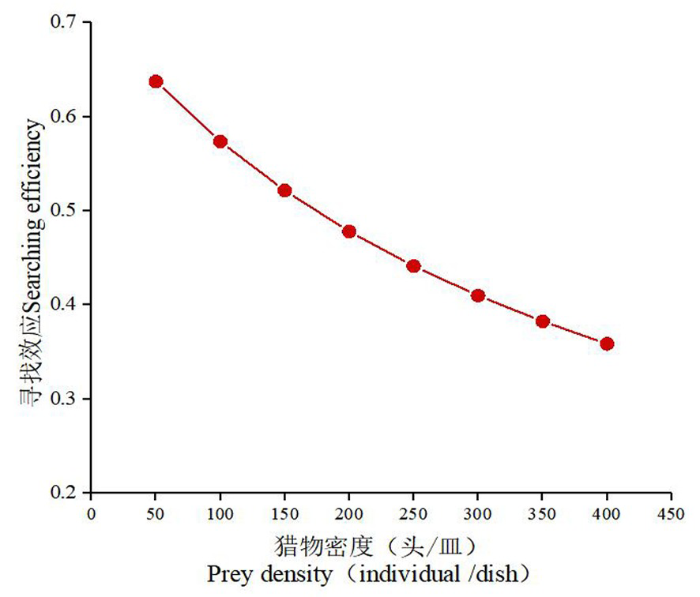
图2
四斑月瓢虫对紫薇长斑蚜的寻找效应
Fig.2
The searching efficiency of Chilomenes quadriplagiata to Tinocallis kahawaluokalani
2.3 种内干扰对四斑月瓢虫捕食紫薇长斑蚜的影响
研究表明,当空间和猎物密度一定,四斑月瓢虫对紫薇长斑蚜的日平均捕食量随天敌密度的增加逐渐减少,捕食作用率(E)也相应降低。搜索常数Q=0.464 4,干扰系数m=1.367 5,种内干扰方程为
图3

图3
种内干扰下四斑月瓢虫捕食紫薇长斑蚜变化
Fig.3
Effects of intraspecies interference on predation of Tinocallis kahawaluokalani by Chilomenes quadriplagiata
3 讨论
3.3 四斑月瓢虫对紫薇长斑蚜的捕食作用受到较强的种内干扰。即随着四斑月瓢虫自身密度的增加,捕食作用率逐渐降低。与红点唇瓢虫Chilocorus kuwanae对杨圆蚧Unaspis yanonensis[35]、越南斧瓢虫Axinoscymnus apioides对烟粉虱Bemisia tabaci[36]、叉角厉蝽Eocanthecona furcellate对草地贪夜蛾Spodoptera frugiperda[37]、马六甲肉食螨Cheyletus malaccensis对豌豆修尾蚜Megoura japonica[38]的种内干扰作用研究结果相一致。当空间和猎物密度一定,同种捕食者个体存在着明显的种内干扰反应,使其捕食作用率下降[39]。
4 结论
四斑月瓢虫对紫薇长斑蚜的捕食功能反应符合Holling-Ⅱ型,其拟合方程为
参考文献
5种杀虫剂对紫薇长斑蚜的毒杀效果研究
[J].
The toxicity experiment of Tino callis kaha waluokalani Kirkaldy under five pesticides
[J].
Paint-on application of acephate for aphid control on crape myrtle
[J]
棉蚜抗药性及其化学防治
[J].
Insecticide resistance in and chemical control of the cotton aphid, Aphis gossypi (Glover)
[J].
High Levels of Resistance to Carbamate and Pyrethroid Chemicals Widespread in Australian Myzus persicae (Hemiptera: Aphididae) Populations
[J].
The green peach aphid, Myzus persicae (Sulzer), is a serious pest throughout the world, attacking a broad range of crop plants across numerous agricultural industries. This species has a high propensity to develop chemical resistance, and has the unenviable title of having resistance to more insecticides than any other insect species. An extensive survey of field populations was undertaken across Australia, and showed widespread and high levels of resistance to carbamates and synthetic pyrethroids in M. persicae. Moderate levels of resistance to organophosphates were also observed in many populations, while there is new evidence of resistance developing to neonicotinoids. Isofemale (clonal) lines of M. persicae were generated and subsequently tested across a range of insecticides; individual genetic clones were found to contain resistance to multiple chemical classes. Resistance genotyping of these aphids were consistent with published literature of known resistant mechanisms. The high and widespread levels of resistance identified within Australia are concerning. Resistance in M. persicae has spread quickly across Australia, and thus farmers are likely to have fewer chemical control options in the future. There is a need to develop resistance management strategies that rotate insecticides, spray insecticides only when economically necessary, and incorporate nonchemical control options.
Regional susceptibilities of Rhopalosiphum padi (Hemiptera: Aphididae) to ten insecticides
[J]
蔬菜蚜虫抗药性现状及抗性治理策略
[J].
Current status and management strategies of insecticide resistance in aphids on the vegetable crops
[J].
益蝽对亚洲玉米螟幼虫的捕食行为及捕食功能反应
[J]益蝽Picromerus lewisi(Scott)是一种重要的捕食性天敌昆虫,本文研究了其对亚洲玉米螟Ostrinia furnacalis(Guenée)的捕食作用,为亚洲玉米螟的生物防治及益蝽的生防作用开发提供科学依据。本研究在室内(27±1)℃、光周期16L:8D条件下,采用圆盘法测定了益蝽2、3、4和5龄若虫及雌、雄成虫对亚洲玉米螟2和3龄幼虫的捕食作用与搜寻效应,利用HollingⅡ方程对捕食测定数据进行模拟,建立了益蝽对亚洲玉米螟幼虫的捕食功能反应模型。结果表明:益蝽2、3、4和5龄若虫及雌、雄成虫对亚洲玉米螟2和3龄幼虫均具有捕食作用,其捕食功能反应属于Holling II型,搜寻效应均随猎物密度的增加而降低。益蝽5龄若虫对亚洲玉米螟2龄幼虫的控害效能最强,为252.900,瞬时攻击率为1.012,实际日最大捕食量为26.40头/d;益蝽雌成虫对亚洲玉米螟3龄幼虫的控害效能最强,为202.900,瞬时攻击率为0.812,实际日最大捕食量为14.60头/d。益蝽雄成虫与益蝽5龄若虫和雌成虫之间各指数无显著性差异。综合以上结果,益蝽5龄若虫和成虫对亚洲玉米螟幼虫具有较强的捕食作用,具有良好的生防潜力。
Predation Behaviors and Functional Responses of Picromerus lewisi to the Larvae of Ostrinia furnacalis
[J].<i>Picromerus lewisi</i><b> </b>Scott is an important predatory natural enemy insect. Predation ability of different stages of <i>P. lewisi</i> to the Asian corn borer <i>Ostrinia furnacalis</i> Guenée and their biological control potential were examined through measurement of the predation function and searching efficiency of the 2<sup>nd</sup>, 3<sup>rd</sup>, 4<sup>th</sup>, 5<sup>th</sup> instar nymphs and adults of <i>P. lewisi</i> to the 2<sup>nd</sup> and 3<sup>rd</sup> instar larvae of <i>O. furnacalis</i> in an indoor light incubator at (27±1)℃ and photoperiod 16L:8D. The functional responses of different stages of nymphs and adult to the 2<sup>nd</sup> and 3<sup>rd</sup> instar larvae of <i>O. furnacalis</i> fitted well with Holling II model. The predation capacity of the 5<sup>th</sup> instar nymphs of <i>P. lewisi</i> to the 2<sup>nd</sup> instar larvae of <i>O. furnacalis</i> was 252.900, the instantaneous attack rate (a) was 1.012, and the daily maximum predation was 26.40. The predation capacity of <i>P. lewisi</i> females to the 3<sup>rd</sup> instar larvae of <i>O. furnacalis</i> was 202.900, the instantaneous attack rate (a) was 0.812, and the daily maximum predation was 14.60. There were no significant differences in the indexes between the male adults and the 5<sup>th</sup> instar nymphs or female adults of the <i>P. lewisi</i>. Based on the above results, the 5<sup>th</sup> instar nymph and adult of <i>P. lewisi</i> have a strong predation effect on larvae of <i>O. furnacalis</i> and have good biocontrol potential.
The functional response of parasitoids and its implications for biological control
[J].
异色瓢虫对与本土蚜虫共存的外来扶桑绵粉蚧的搜寻和捕食行为
[J].
Foraging and predation behaviors of the harlequin ladybird, Harmonia axyridis (Coleoptera: Coccinellidae), on the alien cotton mealybug Phenacoccus solenopsis (Hemiptera: Pseudococcidae ) coexisting With a native aphid
[J].
异色瓢虫幼虫对草地贪夜蛾卵和低龄幼虫的捕食作用
[J].
Predation functional response of Harmonia axyridis larvae to the eggs and low instar larvae of Spodoptera frugiperda
[J].
多异瓢虫对棉黑蚜的捕食能力
[J].本文在实验室内系统研究了多异瓢虫不同龄期幼虫、不同日龄雌、雄成虫对棉黑蚜的捕食能力。结果表明,多异瓢虫幼虫对棉黑蚜的日捕食量随龄期的增大而增多,1~4龄幼虫的日捕食量分别是17.20头、50.70头、121.50头和153.90头。多异瓢虫不同日龄雌、雄成虫对棉黑蚜的日捕食量呈先上升后逐渐降低的趋势,5日龄雌、雄成虫对棉黑蚜的日捕食量最高,分别为145.90头和157.30头。此外,同一性别不同日龄的成虫对棉黑蚜的日捕食量差异显著,同一日龄的雌虫与雄虫对棉黑蚜的日捕食量差异显著。以上研究表明多异瓢虫高龄幼虫和成虫对棉黑蚜具有较强的捕食能力,这为利用多异瓢虫防治棉黑蚜提供重要的理论基础。
Predation Capacity of Adoria Varieqata to Aphis atrata
[J].In this study, the predation capacity of ladybeetle <i>Adonia variegate</i> (Goeze) larvae at various instars, female and male adults at different ages on cotton black aphid <i>Aphis atrata</i> Zhang were systematically studied in the laboratory. The results showed that the predation amount of ladybeetle larvae on cotton black aphid increased with increasing larval instar, and the predation amount of 1-4 instar were 17.20 aphids, 50.70 aphids, 121.50 aphids and 153.90 aphids per day, respectively. In addition, the predation amount of ladybeetle adults at different ages on cotton black aphid were firstly increased and then gradually decreased, the peak predation amount was 5 days-old female and male adults (female:145.90 aphids per day, male:157.30 aphids per day). Significant difference were found for the predation amount of ladybeetle adults at different ages within the same gender, and there are significant difference for the predation amount of female and male adult at the same age. These results provide an important theoretical basis for the application of ladybeetles to the control of cotton black aphid.
捕食性天敌控害能力评价方法进展
[J].
Research advances in evaluation methods of predator’s control of insect pests
[J].
六斑月瓢虫对菊小长管蚜的捕食作用
[J].
Predation of Menochilus Sexmnaculata (Coleoptera: Coccinellidae) on Macrosiphoniella sanborni (Homoptera: Aphididae)
[J].
二双斑唇瓢虫对矢尖蚧的捕食作用
[J].
Predation of Chilocorus bijuqus (Col: Coccinellidae) to Unaspis yanonensIs (Hom: Diaspidae)
[J].
七星瓢虫对不同初始密度棉蚜种群的调控作用
[J].
Regulation of Coccinella septempunctata and Aphis gossypli with different initial density on cotton aphid population
[J].
小菜蛾幼虫天敌调查
[J].
A larval of plutella xylostella natural enemy survey
[J].
用赤眼蜂蛹饲养捕食性瓢虫初步试验
[J].
Tests on Rearing Predacious Coccinellid On TrichogrammaPupae
[J].
龟纹瓢虫和四斑月瓢虫对龙眼角颊木虱的捕食功能反应
[J].
Predatory functional responses of Propylaea japonica and Chilomenes quadriplagiat to Cornegenapsylla sinica
[J].
Some characteristics of simple types of predation and parasitism
[J].In an earlier study (Holling, 1959) the basic and subsidiary components of predation were demonstrated in a predator-prey situation involving the predation of sawfly cocoons by small mammals. One of the basic components, termed the functional response, was a response of the consumption of prey by individual predators to changes of prey density, and it appeared to be at least theoretically important in population regulation: Because of this importance the functional response has been further examined in an attempt to explain its characteristics.
The Components of Predation as Revealed by a Study of Small-Mammal Predation of the European Pine Sawfly
[J].The fluctuation of an animal's numbers between restricted limits is determined by a balance between that animal's capacity to increase and the environmenta1 cheks to this increase. Many authors have indulged in the calculating the propressive increase of a population when no checks nrerc operating. Thus Huxley calculated that the progeny of a single Aphis in the course of 10 generations, supposing all survived,would “contain more ponderable substance than five hundred millions of stout men; that is, more than the whole population of China”, (in Thompson, 1929). Checks, however, do occur and it has been the subject of much controversy to determine how these checks operate. Certain general principles—the density-dependence concept of Smith ( 1955), the competition theory of Nicholson (1933)—have been proposed both verbally and mathematically, but because they have been based in part upon untested and restrictive assumptions they have been severelv criticized (e.g. Andrewartha and Birch 1954). These problems could be considerably clarified if we knew the mode of operation of each process that affects numbers, if we knew its basic and subsidiary components. predation, one such process, forms the subject of the present paper.
New inductive population model for insect parasite and its bearing on biological control
[J].
Aphids (Hemiptera: Aphidoidea) of ornamental plants from São Carlos, São Paulo state, Brazil
[J].A total of 25 aphid species were collected from 49 ornamental plant species in São Carlos-São Paulo, Brazil; 12 aphids were monophagous, four oligophagous and nine polyphagous. A total of 58 aphid-plant associations are recorded, 43 unknown from Brazil. Eucarazzia elegans (Ferrari, 1872) (Aphididae: Aphidinae: Macrosiphini) is recorded for the first time from Brazil, and Nectandra megapotamica Spreng. (Lauraceae) is recorded for the first time as host plant for Lizerius tuberculatus (E.E. Blanchard, 1939) (Drepanosiphidae: Drepanosiphinae: Lizeriini). We also describe the injuries caused by aphids to the ornamental plants.
Afidofauna (Hemiptera: Aphididae) De Cuernavaca, Morelos, Mexico
[J].
A contribution to the aphid fauna of Greece
[J].
Aphididae (Hemiptera) on ornamental plants in Córdoba (Argentina)
[J].
瓢虫柄腹姬小蜂对茄二十八星瓢虫功能反应的研究
[J].
Functional responses of Pediobius foveolatus to Henosepilachna vigintioctopunctata
[J].
Effect of temperature on the functional response of Adalia bipunctata to Myzus persicae
[J].
巴氏新小绥螨对二斑叶螨的捕食功能及控制潜力研究
[J].
Functional response and control potential of Neoseiuus barkeri to Tetranychus urticae
[J].
加州新小绥螨和巴氏新小绥螨对二斑叶螨的捕食能力比较
[J].
Comparison of Neoseiulus californicus and Neoseiulus barkeri as biological controls for Tetranychus urticae
[J].
异色瓢虫对紫薇长斑蚜捕食及控制作用研究
[J].
Predation and Control of Harmonia axyridis against Tinocallis kahawaluokalani
[J].
Functional responses of immature stages of Propylea quatuordecimpunctata (Coleoptera: Coccinellidae) to Aphis fabae (Hemiptera: Aphididae)
[J].
The ladybird beetle Harmonia axyridis (Coleoptera: Coccinellidae) as a possible predator of grape phylloxera Daktulosphaira vitifoliae (Hemiptera: Phylloxeridae)
[J].
Predation of the ladybeetleChilocorus kuwanae on the scale Unaspis yanonensis
[J]
越南斧瓢虫对烟粉虱的捕食作用
[J].
Predation of Axinoscymnus apioides Kuznetsov & Ren on Bemisia tabaci (Gennadius)
[J].
叉角厉蝽对草地贪夜蛾的捕食功能反应
[J].
Functional response of Eocanthecona furcellate (Hemiptera: Pentatomidae) to Spodoptera frugiperda (Lepidoptera: Noctuidae)
[J].
Predation of Cheyletus malaccensis (Acari: Cheyletidae) on Megoura japonica (Hemiptera: Aphididae) under five different temperatures
[J]
斯氏钝绥螨对朱砂叶螨若螨的捕食作用
[J].
Predation of Amblyseius swirskii on Tetranychus cinnabarinus Nymphs
[J].
Effect of Temperature and Photoperiod on the Development, Reproduction, and Predation of the Predatory Ladybird Cheilomenes sexmaculata (Coleoptera: Coccinellidae)
[J].The polyphagous predatory ladybird Cheilomenes. sexmaculata (F.) (Coleoptera: Coccinellidae) is distributed throughout southern China and has been investigated as a potential biological control agent against herbivorous insects in various agroecosystems. In the current study, we evaluated the preimaginal development, eclosion rate, reproduction, fertility, adult longevity, and prey consumption of C. sexmaculata under five temperature and five photoperiod regimens. The results showed that preadult developmental duration decreased significantly with increasing temperature and amount of daylight. Adult eclosion rate was highest at 35 degrees C and under conditions of complete darkness. Higher temperatures shortened the duration of copulation and preoviposition, prolonged the duration of oviposition, and increased the level of fecundity. Hatchability was highest at 30 degrees C. By contrast, the shortest copulation and oviposition duration and lowest level of fecundity and hatchability occurred with a completely dark photoperiod. Temperature and the gender of C. sexmaculata influenced adult longevity. In addition, there was a significant interaction effect of photoperiod and gender on adult longevity. Furthermore, prey consumption by fourth instar larvae and adult females both increased with increasing temperature and photoperiod. Our results reveal the high thermal and light sensitivities of C. sexmaculata, which highlight the importance of environment regulation in the mass rearing of this natural enemy for application as a biological control in agroecosystems in China.
温度对南方小花蝽捕食西花蓟马功能反应的影响
[J].
Effect of Temperature on Predatory Functional Responses of Orius similis to Frankliniella occidentalis
[J].
The challenge of predicting temperature effects on short-term predator-prey dynamics
[J].Understanding how interacting species respond to changing temperatures is complicated because both inter‐ and intraspecific processes can be temperature‐dependent, and because the dynamics of interest often occur over short time scales. While efforts to document and integrate inter‐ and intraspecific effects are ongoing, few broad conclusions have emerged. Here, we use a simple structured predator–prey model to explore whether some such conclusions can be reached with incomplete knowledge about initial population sizes or about how temperature alters predation rates. We find that, despite strong sensitivity of quantitative predictions to the model's details, qualitative predictions for how predator–prey communities respond to temperature may still be possible. As a case study, we ask whether biological control of the herbivorous insect pea aphid will be strengthened or weakened by increasing temperatures. Our empirically derived parameter estimates suggest biological control will be strengthened, but we caution that this result is not inevitable given what we currently know about the effects of temperature in this system. Our work highlights the complex interaction between inter‐ and intraspecific effects of temperature in ecological communities.
温度对加州新小绥螨捕食东方真叶螨功能反应的影响
[J].为明确加州新小绥螨对橡胶重要害螨东方真叶螨的控害潜能,系统研究了21、24、27、30、33、36℃六个不同温度条件下加州新小绥螨对东方真叶螨各螨态的捕食作用。结果表明:不同温度条件下加州新小绥螨对东方真叶螨各螨态的功能反应均能很好的拟合Holling-Ⅱ型圆盘方程。在21~36℃条件下,加州新小绥螨对东方真叶螨成螨和卵的日均捕食量与捕食效能(a/Th)均在33℃时最强,但对若螨和幼螨的日均捕食量与捕食效能在30℃最强。在27℃条件下加州新小绥螨对东方真叶螨若螨、幼螨和卵的选择系数分别为0.62、1.40和1.01。在相同的猎物密度条件下,加州新小绥螨的平均捕食量随其自身密度的增加而逐渐降低,说明加州新小绥螨存在种内竞争和自我干扰作用,捕食作用率与其自身密度关系为E=0.1631P<sup>-0.395</sup>。
Effects of temperature on predatory functional responses of Neoseiuius californicus to Eutetranychus orientalis
[J].To explore the control potential of <i>Neoseiulus californicus</i> (McGregor) on <i>Eutetranychus orientalis</i> (Klein), an important harmful mite occurring in rubber, the predation <i>N.californicus</i> upon different stages of <i>E. orientalis</i> was investigated at six temperatures, i.e., 21, 24, 27, 30, 33and 36℃. The functional responses of <i>N. californicus</i> to <i>E. orientalis</i> at all the temperatures fitted well with the Holling-Ⅱ equation. At 21-36℃, the daily average predation and predation capability (<i>a</i>/<i>Th</i>) of <i>N. californicus</i> towards <i>E. orientalis</i> adults and eggs peaked at 33℃, while peaked at 30℃ when the preys were <i>E. orientalis</i> nymphs and larvae. The selective coefficient of <i>N. californicus</i> for <i>E. orientalis</i> nymphs, larvae and eggs at 27℃ were 0.62, 1.40 and 1.01, respectively. At a certain prey density, the average predation of <i>N. californicus</i> decreased gradually with the increase in its density, indicating an obvious competition and self-interference in <i>N. californicus</i>. The relationship between predation and predator density was established as the equation <i>E</i>=0.1631P<sup>-0.395</sup>.
Host plant effects on the functional response of Neoseiulus cucumeris to onion thrips larvae
[J].
瓜蚜寄主植物对多异瓢虫捕食功能反应的影响
[J].
Effect of host plants on the functional response of Hippodamia variegata (Goeze) to Aphis gossypii Glover
[J].
干扰作用及空间异质性对大草蛉雄成虫捕食作用的影响
[J].大草蛉雄成虫在捕食过程中,麦秆数越多,环境阻力越大,空间异质性越复杂,捕食作用率越低;大草蛉雄成虫种内干扰作用系数为0.9390,大草蛉雄成虫与龟纹瓢虫幼虫之间的种间干扰作用系数为0.8722,前者大于后者;竞争强度I与天敌P之间的关系为I=0.0640+1.11271gP.
Effect of mutual interference and spatial heterogeneity on predation of adult Chrysopa septempunctata
[J].The more wheat stalks the adult Chrysopa septempunctata encountered, the more interference was met during the predation of C. septempunctata, which means that the predation efficiency was low when the spatial heterogeneity was complex. The coefficient of mutual interference within C. septempunctata was 0.9390, and that between C. septempunctata and Propylaea japonica was 0.8722. The frontier was greater than the latter. The correlation of competition strength(I) and the number of natural enemy (P) could be described as I = 0.0640 + 1.1127 1gP.
Predation on immature parasitoids and its impact on aphid suppression
[J].Many predatory arthropods eat both unparasitized herbivores and herbivores that are parasitized and contain the immature stages of endoparasitoids, a form of intraguild predation. Thus, the biological control of herbivorous arthropods can be either enhanced or disrupted by introducing a predator species to an existing host-parasitoid system. We evaluate the impact of introducing a predator, the convergent ladybird beetle, Hippodamia convergens, on the biological control of the cotton aphid, Aphis gossypii, by the parasitoid Lysiphlebus testaceipes, under field conditions. Predation on immature parasitoids by H. convergens was intense: 98-100% of aphid mummies were consumed by the end of the experiment, and H. convergens substantially reduced immature parasitoid populations. Despite the negative impact of H. convergens on aphid parasitoids, aphid population suppression was greatest in treatments containing both H. convergens and parasitoids. The parasitoid alone or in combination with H. convergens suppressed cotton aphids in a density-dependent manner and increased total plant leaf area and biomass, H. convergens did not substantially alter the percentage of aphids mummified by parasitoids and showed a partial feeding preference for unparasitized aphids over aphid mummies. We conclude that under conditions where a predator shows both a partial preference for unparasitized hosts and high levels of predation on unparasitized hosts, we may expect the predator to improve suppression of herbivores even if it produces high levels of intraguild predation. While intraguild predation is an important ecological interaction in the early-season cotton agroecosystem, it does not disrupt cotton aphid biological control.
种间竞争对烟粉虱天敌日本刀角瓢虫和丽蚜小蜂捕食功能反应的影响
[J].
Influences of interspecific competition between ladybeetle Serangium japonicum and parasitoid Encarsia formosa on predation of tobacco whitefly Bemisia tabaci
[J].
Interspecific exploitative competition betweenHarmonia axyridis and other coccinellids is stronger than intraspecific competition
[J].The invasion of Harmonia axyridis has had negative consequences on coccinellid assemblages, with a decline in abundance and diversity, but the coexistence of invasive and resident species may depend on the strength of intra- and interspecific exploitative competitive interactions. These antagonistic interactions have been scarcely studied in coccinellids. Through a laboratory study we assessed aphid consumption, weight gain and reproduction when the invasive Harmonia axyridis, the alien Hippodamia variegata and the native Eriopis chilensis were alone, in conspecific and heterospecific groups, at low and high aphid densities. Under intraspecific competition, coccinellids were more voracious than when they were alone, particularly H. axyridis and H. variegata at high aphid density; H. axyridis and H. variegata gained more weight than E. chilensis, and H. axyridis barely reproduced at low aphid densities, even when alone, while in the other two species reproduction was not affected by the presence of conspecifics. Under interspecific competition, weight gain and reproduction results suggest that H. axyridis was responsible for most aphid consumption; H. variegata gained less weight and barely reproduced in heterospecific groups, but its reproduction was not affected. Eriopis chilensis weight gain and reproduction was low but not affected by the presence of the other species. The lack of negative effects of intraspecific competition on H. axyridis and its better performance in heterospecific groups suggests that this species is the stronger competitor, negatively affecting H. variegata, but not E. chilensis. Thus, exploitative interspecific competition is an important mechanism explaining the dominance of H. axyridis and the decline of some species following its invasion. Therefore, this interaction deserves more attention than what has been paid up to now.


