

0 引言
【研究意义】华北地区是我国冬小麦(Triticum aestivum L.)的主产区,该地区冬小麦产量和种植面积约占我国小麦总产量和种植面积的一半[1],在我国粮食生产中具有重要作用[1-2]。受季风气候的影响[3],华北地区春季降水稀少,农田土壤干旱时常发生,春旱已成为制约该地区冬小麦产量的关键因素[2]。水分作为参与作物物质合成、转运与代谢的组分之一,是影响其生长发育的重要因素。研究干旱胁迫对华北地区冬小麦光合生理特性和产量的影响具有重要意义。【前人研究进展】当土壤发生干旱时会削弱作物的光合能力,不利于碳同化物的积累,从而影响作物的产量[4-5]。在冬小麦苗期适当增加干旱胁迫程度对该时期冬小麦的气体交换过程影响不明显,且在复水后籽粒产量并未显著减少[6]。若在孕穗期对冬小麦进行控水,则会不同程度的抑制地下部分干物质量的积累,且冬小麦会因为受到土壤干旱环境的影响而提前进行灌浆,并且导致灌浆期缩短,对穗粒数、籽粒重等产量构成因素造成负面影响[7-8]。汤秋香等[9]研究指出,在相同的灌水时间与灌水次数前提下,适当减少总灌溉量对冬小麦孕穗期、扬花期和灌浆期的总干物质积累量有促进作用,但会降低成熟期的总干物质积累量。此外,当总灌溉量为常规灌溉量的70%时,可起到明显增加籽粒产量的效果。【本研究切入点】拔节期是冬小麦在生长过程对水分需求量较大的时期[10],该时期冬小麦的生长状况将直接影响后期的灌浆和产量[11-12]。目前,关于冬小麦光合特性、干物质积累量和最终产量对干旱胁迫响应的研究多集中于冬小麦的扬花期和灌浆期,而拔节期则鲜有报道。亟需研究不同干旱胁迫程度对拔节期冬小麦的光合特性、干物质积累及产量的影响。【拟解决的关键问题】以邯麦17号为材料,控制灌水量,在冬小麦拔节期设置不同干旱胁迫梯度,研究拔节期冬小麦光合特性、干物质积累和分配、水分利用效率以及产量等指标对干旱胁迫的响应,分析适宜冬小麦生长的土壤水分条件,为华北地区冬小麦春季灌溉制度提供理论依据和技术支撑。
1 材料与方法
1.1 材料
试验于河北工程大学农业水土资源综合管理与调控实验室自动遮雨棚中进行,该地区属温带大陆性季风气候,年均温度14℃,年均降水量为548 mm,年均日照为2 557 h。采用盆栽种植,供试材料为该地区常见的邯麦17号。盆栽容器为聚丙烯(PP)材质的塑料花盆(底部内径23 cm,顶部内径28 cm,盆高33 cm),在盆底钻孔,能够沥出多余水分。按照2∶1的比例拌匀0~20 cm耕层的黄壤土与营养土,用于冬小麦种植培养,土壤肥力及基本情况[13]。试验地土壤有机质5.26 g/kg、全氮0.68 g/kg、全磷0.57 g/kg、有效磷20 mg/kg、速效钾58 mg/kg、阳离子代换量15.5 cmol/kg、土壤容重1.58 g/cm3、田间持水量52%。
1.2 方法
1.2.1 试验设计
冬小麦拔节期共设置4个处理,包括3个干旱胁迫处理和1个充分灌水对照处理:对照组(CK)土壤相对湿度控制在65%~75%,轻度干旱(T1)、中度干旱(T2)和重度干旱(T3)土壤相对湿度依次为55%~65%,45%~55% 和 35%~45%,每个处理10次重复。
于2018年10月5日选取籽粒饱满的冬小麦种子,均匀播种至装有人工调配好的混合营养土的花盆内,每盆30粒,共计40盆。于2018年10月29日冬小麦长至三叶期定苗,每盆保留幼苗15株。控水时间为2019年3月28日冬小麦进入拔节期开始至4月23日拔节期结束,通过称重法控制土壤水分,并及时补水至水分处理条件。拔节期结束时,每个处理随机取样5盆测定光合参数、叶绿素含量和干物质积累量等指标。试验过程中除胁迫期外,其余时期土壤含水量均与对照组保持一致,胁迫期结束后及时复水至该水平,对照组全生育期内保持充分灌溉,此外,记录各处理冬小麦生育期间的灌水量。盆栽置于遮雨棚内,棚顶在降雨时放下,晴天时卷起,使冬小麦在自然光照、开放环境下生长发育。于2019年6月10日收获冬小麦,并测定产量。
1.2.2 测定指标
1.2.2.1 光合特性
利用LI-6400XT光合作用系统(Li-COR Inc.Lincoln,Nebraska,USA)于2019年4月23日选择长势良好,无病虫害的冬小麦旗叶,测定冬小麦的光合参数,测定指标包括净光合速率(Pn)、蒸腾速率(Tr)、气孔导度(Gs)和胞间CO2浓度(Ci)。将叶片平展铺满在与光合测定系统配套的2 cm × 3 cm标准气室内,测定前设定气室内光强为1 000 μmol/ (m2·s),CO2浓度为400 μmol/mol,流速为500 mmol/s,气室内空气相对湿度控制在60%~70%,叶片温度为25℃。测定时间为上午08:00~12:00,每个处理5次重复[14-15]。叶片水分利用效率(WUE)按WUE=Pn/ Tr计算[6]。
1.2.2.2 叶绿素含量
式中,D649nm、D665nm分别为在649和665 nm波长下的吸光度,V为待测液体积,W为样品质量(g)。
1.2.2.3 荧光参数
用调制式OS-30P+叶绿素荧光仪(Opti-Sciences,USA)暗适应夹夹住长势良好,形状完整的拔节期冬小麦叶片中部,进行20 min钟暗适应,将分析探头置于叶夹上测定初始荧光值Fo、最大荧光值Fm、PSⅡ最大光化学效率(Fv/Fm=(Fm-Fo)/Fm)和PSⅡ的潜在活性(Fv/Fo),并计算经过PSⅡ 的电子传递速率(Fm/Fo)[18]。每个处理5次重复。
1.2.2.4 干物质积累量
光合参数和荧光参数测定完成后,将每盆内冬小麦的地上部分全部剪下;随后,再将地下根系全部取出、洗净,分别放入标记好的牛皮纸袋内,置于75℃烘箱中烘干直至恒重,用电子称称重(MP2002,上海楚定分析仪器有限公司,精度0.1 g),获取冬小麦的地上部分和地下部分干物质积累量,并计算总干物质积累量,每个处理5次重复。
1.2.2.5 产量和灌溉水利用效率
冬小麦成熟后,小心挖出各处理盆内所有植株,放入纸箱,并在箱上覆盖纱网以防杂物落入,自然晒干后剥下冬小麦籽粒,装入标记好的牛皮纸袋内,用电子称(MP2002,上海楚定分析仪器有限公司,精度0.1 g)称量测定籽粒产量;冬小麦灌溉水利用效率(WUEI)按WUEI=Y/I计算,其中Y为籽粒产量(g),I为冬小麦全生育期间总灌水量(L)[19]。
1.3 数据处理
采用单因素方差分析(one-way ANOVA)比较不同处理对拔节期冬小麦光合参数、叶绿素含量、荧光参数和干物质积累量等指标的影响,最小显著差异法(LSD)[20]检验显著性。采用皮尔逊相关系数(Pearson correlation)探究光合参数、干物质积累量、产量和水分利用效率之间的相关性。利用Microsoft Excel 2019进行数据处理,SPSS25(SPSS25,IMB,USA)进行统计分析,OriginPro 2021(OriginLab,USA)进行数据作图。
2 结果与分析
2.1 冬小麦光合参数对干旱胁迫的响应
研究表明,干旱胁迫降低了拔节期冬小麦叶片净光合速率、蒸腾速率、气孔导度和胞间二氧化碳浓度,而水分利用效率呈先升高后降低的趋势。与CK相比,T1处理叶片净光合速率略有降低,T2和T3则分别显著降低了36.4% 和38.6%(P<0.05),在蒸腾速率、气孔导度和胞间二氧化碳浓度3个指标中,气孔导度因干旱程度的加强,降低幅度最大,与CK相比,T1、T2和T3处理气孔导度分别显著降低 34.9%、40.6% 和52.0%(P<0.05)。T1处理的水分利用效率比CK增加了10.3%,而T2和T3则分别减少19.6%和21.4%。图1
图1
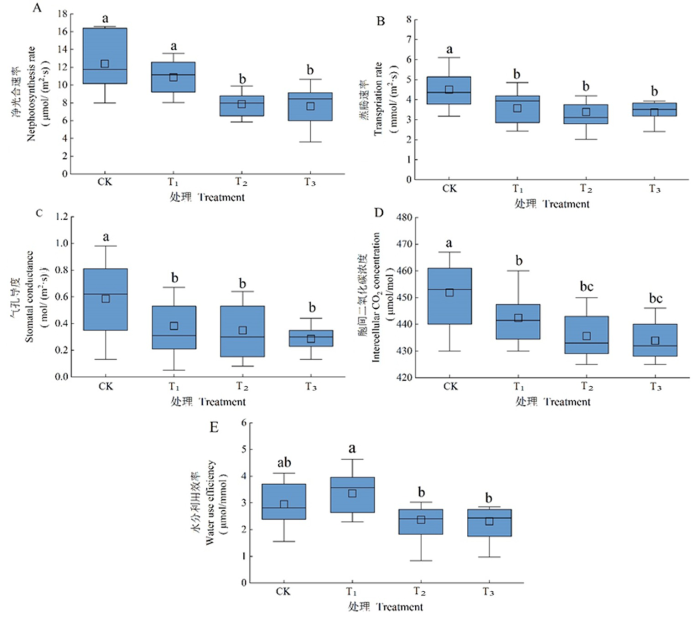
图1
冬小麦光合参数对干旱胁迫的响应
注:不同小写字母表示处理间差异显著(P<0.05)。CK:充分灌水;T1:轻度干旱;T2:中度干旱;T3:重度干旱,下同
Fig.1
Responses of photosynthetic parameters of winter wheat to drought stress
Note: Different lowercase letters above the box mean significant difference among treatments(P<0.05).CK: full irrigation; T1: mild drought; T2: moderate drought; T3: Severe drought,the same as below
2.2 冬小麦叶绿素含量和荧光参数对干旱胁迫的响应
研究表明,拔节期冬小麦叶绿素含量随干旱胁迫的加剧而降低。CK处理下叶绿素含量为3.68 mg/g,T1处理较CK降低了11.1%,T2和T3的叶绿素含量分别显著降低了30.4%和68.2%(P<0.05)。图2
图2
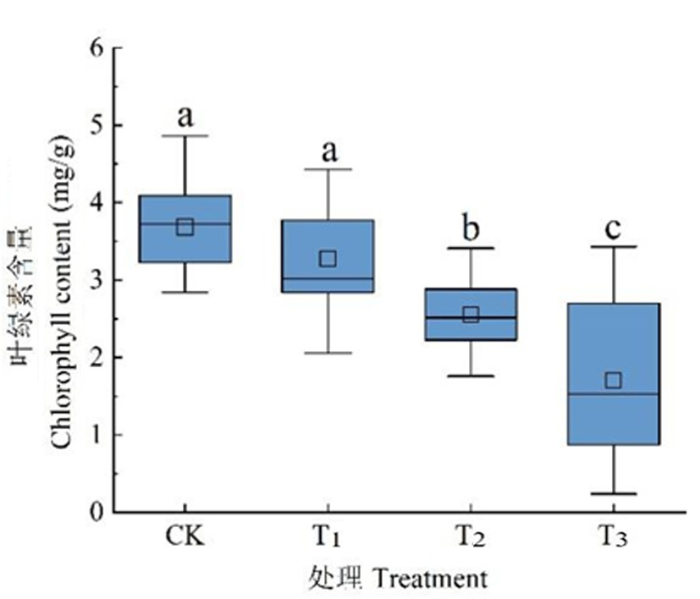
图2
冬小麦叶绿素含量对干旱胁迫的响应
Fig.2
Responses of chlorophyll of winter wheat to drought stress
轻度干旱促进了拔节期冬小麦叶片PSⅡ 最大光化学效率(Fv/Fm)、PSⅡ 潜在活性(Fv/Fo)和经过PSⅡ 的电子传递速率(Fm/Fo),随着干旱胁迫的增强,三者均明显降低。各处理的Fv/Fm、Fv/Fo和Fm/Fo均表现为T1 > CK > T2 >T3。表1
表1 冬小麦PSⅡ 最大化学效率、潜在活性及电子传递速率对干旱胁迫的响应
Tab.1
| 处理 Treat- ments | Fv/Fm | Fv/Fo | Fm/Fo |
|---|---|---|---|
| CK | 0.795±0.008ab | 3.876±0.181ab | 4.876±0.182ab |
| T1 | 0.802±0.005a | 4.054±0.134a | 5.055±0.134a |
| T2 | 0.791±0.011ab | 3.793±0.252b | 4.793±0.252b |
| T3 | 0.786±0.018b | 3.711±0.359b | 4.712±0.360b |
注:同一列不同小写字母表示处理间差异显著(P<0.05)。CK:充分灌水;T1:轻度干旱;T2:中度干旱;T3:重度干旱
Note: Different lowercase letters in the same column indicate significant differences among treatments(P<0.05).CK: full irrigation; T1: mild drought; T2: moderate drought; T3: Severe drought
2.3 冬小麦干物质积累量对干旱胁迫的响应
图3

图3
冬小麦总干物质积累量对干旱胁迫的响应
Fig.3
Responses of total dry matter accumulation of winter wheat to drought stress
图4
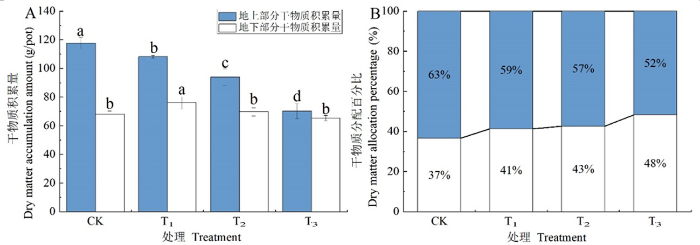
图4
冬小麦干物质分配对干旱胁迫的响应
Fig.4
Responses of dry matter distribution of winter wheat to drought stress
2.4 冬小麦产量和灌溉水利用效率对干旱胁迫的响应
研究表明,与对照组相比,拔节期3种干旱胁迫处理对冬小麦籽粒产量和灌溉水利用效率的影响有所不同。T1处理下籽粒产量较对照略有增加,但差异不显著,T2、T3处理分别显著降低14.8%和42.4%(P<0.05);就灌溉水利用效率而言,T1处理比CK提高11.4%,T3 处理比CK降低33.2%(P<0.05),而T2处理则降低不显著。图5
图5

图5
冬小麦产量和灌溉水利用效率对干旱胁迫的响应
Fig.5
Responses of grain yield of winter wheat and the irrigation water use efficiency to drought stress
2.5 冬小麦光合参数、干物质积累量、产量和灌溉水利用效率间的相关性
研究表明,拔节期冬小麦叶片净光合速率与水分利用效率、地上部分干物质积累量、总干物质积累量、籽粒产量和灌溉水利用效率之间具有极显著正相关关系(P<0.01),相关系数在0.80~0.90,与蒸腾速率和气孔导度呈显著正相关关系(P<0.05),相关系数分别为0.48和0.49。胞间二氧化碳浓度与水分利用效率呈极显著负相关关系(P<0.01),与净光合速率呈显著负相关关系(P<0.05),相关系数分别为-0.8和-0.5。冬小麦籽粒产量与拔节期冬小麦地上部分干物质积累量和总干物质积累量呈极显著正相关关系(P<0.01),相关系数为0.90和0.93,与地下部分干物质积累量呈显著正相关关系(P<0.05),相关系数为0.55。此外,灌溉水利用效率与地上部分和地下部分干物质积累量、总干物质积累量和籽粒产量也具有极显著正相关关系(P<0.01),相关系数在0.64~0.97。图6
图6
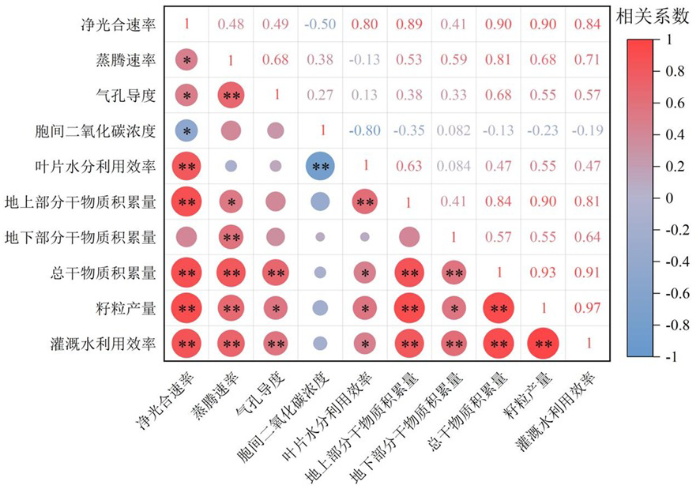
图6
Pearson相关系数
注;*表示显著相关(P<0.05), **表示极显著相关(P<0.01)
Fig.6
Pearson correlation coefficient analysis
Note: * means significant correlation at the 0.05 level,** means significant correlation at the 0.01 level
3 讨论
3.1 植物的光合作用对干旱胁迫的响应极为敏感[21]。干旱胁迫主要通过2种途径来降低植物光合作用:一是气孔限制因素,当植物处于干旱胁迫初期时,主要通过关闭气孔来限制二氧化碳扩散过程,从而降低光合速率;二是非气孔限制因素,植物在遭受严重干旱胁迫时,由于水分的缺少抑制了光化学反映过程,以致对植物生长发育产生不利影响 [22-23]。试验结果表明,干旱胁迫导致拔节期冬小麦净光合速率、蒸腾速率、气孔导度和胞间二氧化碳浓度下降,与张继波等[24]研究一致,由于土壤水分的亏缺引起了冬小麦叶片气孔关闭,降低蒸腾以减少叶片水分散失,同时气孔导度的下降又阻碍了二氧化碳进入植物叶片,削弱了冬小麦同化二氧化碳的能力,最终使得光合速率下降[25]。此外,叶片水分利用效率呈现先升后降的趋势,在轻度干旱时达到最高,可能是由于在轻度干旱胁迫下,气孔因素对水分的限制大于对冬小麦碳同化过程的限制,从而出现叶片水分利用效率升高的现象[13];随着干旱胁迫程度的加重,叶片水分利用效率降低,可能是因为较为严重的干旱环境启动了非气孔因素的抑制作用,冬小麦叶片水分利用效率从以气孔因素为主导逐渐转化为以非气孔因素为主导,作物体内生理代谢反应因严重缺水而降低甚至可能失活,致使叶片水分利用效率的降低 [25]。
Fv/Fm和Fv/Fo能够反映植物光系统反应中心利用光能的最大能力和PSⅡ 的潜在活性,二者在胁迫条件下的变化幅度可作为判定光系统受损程度的重要指标[30]。试验结果得出,当土壤达到中度和重度干旱时,拔节期冬小麦旗叶Fv/Fm和Fv/Fo均有所下降,与吴金芝等[31]的研究一致,在干旱胁迫程度较重的情况下,冬小麦发生光抑制,致使光系统受到损伤,PSⅡ 的潜在活性下降[32]。此外,Fm/Fo变化趋势也与Fv/Fm和Fv/Fo 一致,经过 PSⅡ 的电子传递活性降低,不利于拔节期冬小麦 PSⅡ 光反应的进行[33]。不同的是,研究中轻度干旱使得Fv/Fm、Fv/Fo和Fm/Fo略有提高,可能与冬小麦在长期的适应干旱过程中进化出的抗旱能力有关[34-35]。
3.3 植物会通过提高地下部分干物质占比以缓解干旱胁迫[36]。干旱胁迫会导致拔节期冬小麦总干物质积累量逐渐下降,而地下部分干物质分配占比逐渐升高[37],试验结果与上述相同,表明干旱环境会驱使冬小麦干物质的分配模式由地上向地下转移以缓解植株在干旱胁迫下水分和养分的供给矛盾。根系作为植物在土壤环境变化时最先感知的器官[38],在土壤缺水的情况下,其干物质积累量可以很好的指证植物的抗旱能力[39]。试验发现,轻度干旱胁迫下冬小麦可获得较高的地下部分干物质积累量,植物在遭受干旱胁迫初期时会促进根系生长,进而加大了根系与土壤环境的接触表面积,以便更好的汲取土壤中的水分和养分,从而进行物质积累,同时提高作物抗旱能力[40]。重度干旱时,冬小麦地上部分和地下部分干物质积累量与正常灌水处理对比均明显下降,这可能是由于根系在遭受严重干旱胁迫时,其利用水分和营养物质的能力下降[35],导致叶片缺水,致使冬小麦PSⅡ 原初光能转换效率下降并受到抑制[32],阻碍叶片进行光合作用,最终减少地上部分干物质的积累[3]。
3.4 干旱发生于作物生长阶段的不同和胁迫程度的差异,会对产量产生不同的影响[41⇓⇓-44]。在作物生长前期对其进行适度的干旱胁迫有利于光合产物向籽粒运输,促进作物经济产量提高[43]。而作物在单位面积灌溉用水下积累经济产量的多少可反映作物的灌溉水利用效率,是作物水分生产能力的重要体现[44-45]。在一定范围内,作物产量随灌溉水量同步变化,而过度灌水不仅造成水资源的浪费甚至抑制产量积累,从而降低灌溉水利用效率[46]。研究发现,在冬小麦拔节期适量减少灌溉水有利于增加籽粒产量并且提高灌溉水利用效率,当水分亏缺严重时则对二者起到明显抑制作用,可能是由于拔节期结束后的复水促进了冬小麦在后期生长中营养元素向籽粒的运转效率,为前期轻度干旱环境对自身生长发育产生的限制起到补偿作用,由此提高产量,从而实现作物在干旱逆境中对灌溉水利用效率的最大化[47]。冬小麦经历了轻度干旱胁迫,提高了其补偿恢复能力,拔高了作物抵抗干旱胁迫能力的阈值,若以籽粒产量作为抗旱性评价指标[42],试验结果也进一步佐证了拔节期适当的干旱胁迫有利于提高作物抗旱性。
3.5 植物会通过改变光合特性、生理生态等指标来表达出对环境适应的可塑性[48]。研究结果表明,拔节期冬小麦叶片水分利用效率与地上部分干物质积累量呈极显著正相关关系,与总干物质积累量、籽粒产量和灌溉水利用效率呈显著正相关关系,这一时期冬小麦叶片水分利用效率越高,越有利于地上部干物质和总干物质的积累,从而提高小麦产量,并且提高灌溉水的利用率。
4 结论
拔节期冬小麦的光合参数、叶绿素含量和总干物质积累量因干旱胁迫而降低,但叶片水分利用效率、地下部分干物质积累量、籽粒产量和灌溉水利用效率呈先升高后下降的趋势,当土壤相对湿度为55%~65%时最高,分别较CK处理提高了10.3%、11.8%、2.6%和11.4%。华北地区冬小麦拔节期可适当减少灌水量,将土壤相对湿度控制在55%~65%,以达到华北地区冬小麦产量与灌水量最优化灌溉模式。
参考文献
中国小麦种植区划研究(一)
[J].
Study on Chinese Wheat Planting Regionalization (Ⅰ)
[J].
华北地区冬小麦灌溉制度及其环境效应研究进展
[J].
Review on research of irrigation regime and its environmental effect in winter wheat field of North China Plain
[J].
2001-2013年华北地区植被覆盖度与干旱条件的相关分析
[J].
基于MODIS-NDVI遥感数据以及地表气象数据,计算了2001-2013年华北地区的修正Palmer干旱指数(Palmer Drought Severity Index,PDSI)和植被覆盖度,总结出植被覆盖度以及PDSI的年际变化规律,从华北地区生态分区的角度分析了二者的相关关系。结果表明:① 华北平原的植被覆盖度呈南高北低、中部高四周低的分布特点,最低为内蒙古高原草原生态区的0.61,最高为淮阳丘陵地区的0.84;② 2001-2013年,华北平原整体植被覆盖度主要呈上升趋势,其中华北的北部、西部、南部山区及丘陵地带植被覆盖度主要呈上升趋势,而华北平原农业区以及京津唐城郊地带植被覆盖度呈下降趋势;③ 华北地区的东北部有变潮湿的趋势,南部则有变干旱的趋势,其他地区干旱条件变化不明显;④ 华北地区植被覆盖度与气候干旱程度的平均相关系数为0.20,73.37%的地区相关系数为正,正相关关系最为明显的地区为华北地区的西北部,而北京、天津、以及河北省与河南省一级、二级城市的城郊地区相关系数多为负值。⑤ 在华北大部分地区,夏季和秋季的气候干旱条件对植被覆盖度的影响最为明显。
Correlation analysis between vegetation coverage and climate drought conditions in North China during 2001 - 2013
[J].Based on previous studies, the climate drought index can be used to assess the evolution trend of ecological environment under various arid climatic conditions. It is necessary for us to further explore the relationship between vegetation coverage (index) and climate drought conditions. Therefore, in this study, based on MODIS-NDVI products and meteorological observation data, the Palmer Drought Severity Index (PDSI) and vegetation coverage in North China were first calculated. Then the interannual variation of PDSI and vegetation coverage over 2001-2013 was analyzed by using a Theil-Sen slope estimator. Finally in an ecoregion perspective the correlation between them was discussed. The experimental results demonstrated that PDSI index and vegetation coverage value varied over different ecoregions. During the period 2001-2013, vegetation coverage increased in southern and northern mountains in North China, while it showed a decreasing trend in Beijing-Tianjin-Tangshan City Circle area and suburban agricultural zone. During the 13 years, the climate of the northeastern part of North China became more humid, while in the southern part of North China, it tended to be dry. According to the correlation analysis results, 73.37% of North China had a positive correlation between the vegetation coverage and climate drought index. A negative correlation was observed mainly in urban and periurban areas of Beijing, Tianjin, Hebei Province and Henan Province. In most parts of North China, drought conditions in summer and autumn had more influence on vegetation coverage.
华北平原不同等级干旱对冬小麦产量的影响
[J].
Impacts of different grades of drought on winter wheat yield in North China Plain
[J].
Effect of Drought Stress and Rewatering on the Photosynthetic Physiological Characteristics of Leaves and Bark of '84K' Poplar
[J].
冬小麦叶片气体交换参数对水分胁迫的响应
[J].
The Response of Gas Exchange Parameters of Winter Wheat Leaves to Water Stress
[J].
花前干旱胁迫对冬小麦生长指标的影响
[J].
Effect of Drought Stress before Anthesis on Growth Indexes of Winter
[J].
土壤水分胁迫下冬小麦籽粒灌浆特性的研究
[J].
Study on Grain Filling Characteristic of Winter Wheat Seed under Soil Water Stress
[J].
干旱胁迫对滴灌冬小麦产量形成及水分利用效率的影响
[J].
Analysis of Winter Wheat Yield Formation and Water Use Efficiency of Drip Irrigation under Drought Condition
[J].[目的]明确新疆南部极端干旱区滴灌小麦目前灌量是否合理及灌水量阈值.通过分析新疆南部极端干旱区滴灌小麦在水分利用方面的现状,为进一步解析滴灌冬小麦产量提升及节水灌溉的关键要素和限制因子提供研究基础.[方法]设计四种减量灌溉模式(总灌量分别为3 376、3 000、2 625和2 250 m3/hm2).以常规灌量为对照(总灌量为3 750 m3/hm2).监测冬小麦产量及水分利用效率.[结果]D4处理(灌量2250 m3/hm2)到D3处理(灌量2 625 m3/hm2)产量逐步增加,D3处理产量最高为9 450.kg/hm2,随灌溉量的增加,产量逐步降低.[结论]D4(灌溉量2 250 m3/hm2)到D2处理(灌溉量3 000 m3/hm2)水分利用效率逐步增加,而后波动性下降.说明灌溉量超出其阈值,水分利用效率随灌溉量的增加反而减少.
黄淮海平原典型区冬小麦水分胁迫规律与灌溉策略
[J].
Water stress of winter wheat and irrigation strategy in typical region of Huang-Huai-Hai Plain
[J].
灌浆期冬小麦生理特性和产量对不同灌水量的响应
[J].
Response of Physiological Characteristic at Grain Filling Stage and Yield of Winter Wheat to Different Irrigation Treatments
[J].
华北地区农业水资源现状和未来保障研究
[J].
Current Situation and Future Security of Agricultural Water Resources in North China
[J].
大气CO2倍增条件下冬小麦气体交换对高温干旱及复水过程的响应
[J].探究大气CO<sub>2</sub>浓度倍增条件下冬小麦气体交换参数对高温干旱及复水过程的生理响应机制, 有助于提高生态过程模型的模拟精度, 更加准确地预测全球气候变化对农田生态系统初级生产力及其生态服务功能的影响。利用4个可精准控制CO<sub>2</sub>浓度和温度的大型人工气候室, 研究了CO<sub>2</sub>浓度倍增条件下高温干旱及复水过程对冬小麦气孔特征和气体交换参数的影响。结果表明, CO<sub>2</sub>浓度倍增(E)导致冬小麦远轴面气孔密度增加、气孔宽度减小、气孔空间分布规则程度降低, 但提高叶片的净光合速率(P<sub>n</sub>)、气孔导度(G<sub>s</sub>)、蒸腾速率(T<sub>r</sub>)和水分利用效率(WUE)。高温干旱(HD)使叶片气孔长度、密度、周长和面积减小, 导致叶片气体交换参数均显著下降。然而, 高CO<sub>2</sub>浓度及高温干旱(EHD)导致气体交换参数下降幅度相对较小, 表明高CO<sub>2</sub>浓度对高温干旱具有一定的缓解作用。此外, 干旱复水后, 不同处理条件下冬小麦叶片气体交换参数均有所升高, 但高温干旱下叶片的气体交换参数仍未能恢复到对照水平, 暗示光合器官可能在高温干旱时遭到损伤和破坏。
Responses of leaf gas exchange to high temperature and drought combination as well as re-watering of winter wheat under doubling atmospheric CO2 concentration
[J].Understanding the responsible mechanisms of crops to combined environmental stresses such as elevated CO2 concentration, climate warming, and drought is critical to improve the accuracy of ecological process models, and thus accurately predict the impacts of global climate change on the Net Primary Production (NPP) and ecosystem service function of farmlands. Four environmental growth chambers accurately controlling CO2 concentration and temperature were employed to investigate the combined effects of high temperature and drought stresses on the stomatal traits and leaf gas exchange during re-watering under doubling CO2 concentration. We found that elevated CO2 concentration (E) increased the stomatal density, decreased the stomatal width and made the spatial distribution pattern of stomata irregular on the abaxial leaf surface, while enhanced the net photosynthetic rates (Pn), stomatal conductance (Gs), transpiration rates (Tr), and water use efficiency (WUE). The stomatal length, width, perimeter and area were substantially decreased under the combined high temperature and drought stress (HD), resulting in dramatic decline of leaf gas exchange parameters. Doubling CO2 concentration made the leaf gas exchange parameters enhanced under the HD treatment, suggesting that elevated CO2 concentration can compensate the negative impacts of heat and drought on the physiological processes of winter wheat. Additionally, the leaf gas exchange of winter wheat subjected to the high temperature and drought stresses was enhanced after re-watering, but these parameters were still lower than those of Control, suggesting that the photosynthetic apparatus may be damaged by the combined high temperature and drought stresses.
与冬小麦间作条件下轮台白杏间作巷道光环境特征
[J].
Light Environmental Characteristics in Intercropping Alley of Armeniaca vulgaris 'Luntaibaixing' with Winter Wheat
[J].
高温环境下枣光合特性及相关生理指标日变化
[J].【目的】研究两个枣品种在高温环境下光合特性及相关生理指标的差异。【方法】以10 a生骏枣和伏脆蜜为对象,在吐鲁番田间自然高温条件下,测定光合日变化参数,采集相同部位叶片,测定丙二醛(MDA)、渗透调节物质。【结果】伏脆蜜的净光合速率(P<sub>n</sub>)为单峰型;骏枣则呈双峰型,且在12:00有明显的光合午休现象。两品种蒸腾速率(T<sub>r</sub>)均呈双峰型,但伏脆蜜的蒸腾速率(T<sub>r</sub>)变化更剧烈,在14:00有明显的谷值。两品种的丙二醛(MDA)、脯氨酸(Pro)和可溶性蛋白(SP)含量变化趋势基本一致,其中骏枣的MDA和Pro明显高于伏脆蜜,且MDA含量骏枣较伏脆蜜提前4 h达到最大值。【结论】高温环境下,伏脆蜜无光合午休现象,叶片的净光合速率(P<sub>n</sub>)和蒸腾速率(T<sub>r</sub>)较骏枣高;骏枣叶片MDA和Pro含量明显高于伏脆蜜,其叶片细胞膜受损比伏脆蜜重。光合特性和生理指标两方面均证明伏脆蜜细胞膜稳定性较强,耐高温能力优于骏枣。
Study on Diurnal Variation of Photosynthetic Characteristics and Related Physiological Indexes of Jujube under High Temperature Environment
[J].【Objective】 To study the differences of photosynthesis and physiological responses to heat stress between two jujube cultivars in the areas of atypical warmth.【Method】The photosynthetic diurnal changes of 10-year-old Fucuimi and Junzao were determined under natural high-temperature conditions in the field of Turpan. Meanwhile, the leaves at the corresponding time were collected to determine the contents of malondialdehyde (MDA), osmoregulation substances in the laboratory. 【Result】The results showed that diurnal variation of net photosynthetic rate(<i>P<sub>n</sub></i>) of Fucuimi was single-peak curve, while that of Junzao was a typical bimodal curve with noon break at 12 o'clock. The Transpiration rate (<i>T<sub>r</sub></i>) of the two cultivars showed a bimodal curve, but Fucuimi changed more drastically, with obvious troughs at 14 o'clock. The trends of MDA, proline (Pro), and soluble protein (SP) content in the two varieties were the same. The MDA and Pro of Junzao were significantly higher than that of Fucuimi. The content of MDA in Junzao reached the maximum value 4 hours earlier than Fucuimi.【Conclusion】In the high temperature areas, Fucuimi didn't have a noon break in photosynthetic, and it's <i>P<sub>n</sub></i> and <i>T<sub>r</sub></i> of the leaves were higher than those of Junzao. The contents of MDA and Pro in the leaves of Junzao were significantly higher than those of Fucuimi. Both photosynthetic characteristics and physiological indexes proved that the cell membrane stability of Fucuimi was stronger than that of Junzao. Fucuimi was more resistant to high temperatures than Junzao.
小麦叶绿素含量测定方法比较
[J].
Comparative study on determination methods of chlorophyll content in wheat
[J].
开放式空气中CO2浓度和温度增高对水稻叶片叶绿素含量和SPAD值的动态影响
[J].目的 针对不断增高的大气二氧化碳(CO<sub>2</sub>)浓度和温度,研究这两个重要环境因子及其互作对大田生长水稻叶片叶绿素含量和SPAD值的动态影响。方法 利用农田T-FACE(Temperature-Free Air CO<sub>2</sub> Enrichment)系统,以高产优质粳稻武运粳23为供试材料,设置两个CO<sub>2</sub>浓度(环境CO<sub>2</sub>浓度和高CO<sub>2</sub>浓度)和两个温度处理(环境温度和高温),测定自然生长环境下水稻不同生育期叶片的叶绿素含量及SPAD值。结果 550 µmol/molCO<sub>2</sub>浓度使水稻移栽后41、77、94 d叶绿素a,b和a+b含量均增加(最大增幅为6.4%),但移栽110、119 d后均减少(最大降幅为5.4%)。由于叶绿素b含量对CO<sub>2</sub>较叶绿素a含量更敏感,故高CO<sub>2</sub>浓度使移栽后41、77和94 d叶绿素a/b值均下降,降幅分别为4.7%、2.3%和0.9%,但移栽110和119 d后分别增加1.9%和5.3%;以上对CO<sub>2</sub>的响应多达显著水平。对叶片SPAD值而言,高CO<sub>2</sub>浓度对水稻生长前、中期的影响较小,但移栽110和119 d后分别下降3.5%(P=0.1)和19.1%(P<0.01)。大田生长期增温1℃,各期叶绿素a、b以及a+b含量多呈增加趋势,叶绿素a/b值表现相反,但总体上变幅小于CO<sub>2</sub>效应;高温对水稻前、中期叶片SPAD的影响较小,但移栽110和119 d后SPAD值平均下降7.1%和14.8%,均达极显著水平。CO<sub>2</sub>与温度处理对上述测定参数多无显著互作效应,但CO<sub>2</sub>浓度、温度处理与生育期之间多存在明显的互作效应。结论 大气CO<sub>2</sub>浓度增高有利于水稻生长前中期叶片叶绿素的形成,但生长后期叶绿素含量和SPAD值均明显下降且伴随叶绿素a/b值的显著升高,这种早衰现象在不同生长温度下趋势一致。
Effects of Elevated Atmospheric CO2 and Temperature on Dynamics of Leaf Chlorophyll Contents and SPAD Value of Rice in Open-Air Field Conditions
[J].【Objcetive】In view of the potential impacts of increasing atmospheric carbon dioxide (CO2) concentration and air temperature, the dynamic effects of these two important environmental factors and their interaction on leaf chlorophyll contents and SPAD values of rice in field were studied.【Method】 By using T-FACE(Temperature-Free Air CO2 Enrichment) facility, a high yield and excellent-quality japonica rice (Oryza sativa L.) Wuyunjing 23 was grown at two levels of CO2 (ambient and elevated CO2 concentration) and two temperature regimes (ambient and elevated temperature) in a field experiment. We measured leaf chlorophyll contents and SPAD values during the whole growth period of rice plants.【Result】Elevated CO2 concentration increased chlorophyll a, b, a+b contents of rice on 41, 77 and 94 days after transplanting (DAT), with the maximum increase of 6.4%. On the contrary, they were decreased by elevated CO2 concentration on 110 and 119 DAT, with the maximum decrease of 5.4%. Due to the greater responses of chlorophyll b to CO2 concentration than that of chlorophyll a, elevated CO2 concentration decreased chlorophyll a/b ratio on 41, 77 and 94 DAT by 4.7%, 2.3% and 0.9%, but increased it on 110 and 119 DAT by 1.9% and 5.3%, respectively. No obvious effect of elevated CO2 concentration on leaf SPAD values was detected in the early and middle growth stages. But elevated CO2 concentration decreased leaf SPAD values by 3.5% (P=0.1) and 19.1% (P<0.01) on 110 and 119 DAT. 1℃increase in temperature on average had positive effects on chlorophyll a, b, a+b contents in each growth stage of rice, but negative effects were found on chlorophyll a/b ratio. In general, the magnitudes of variation induced by temperature were less than those by elevated CO2 concentration. No obvious effect of temperature elevation on leaf SPAD values was detected in the early and middle growth stages. But temperature elevation deceased leaf SPAD values by 7.1% (P<0.01) and 14.8% (P<0.01) on 110 and 119 DAT, respectively. No CO2-temperature interaction was detected for most of measured parameters, but significant CO2- or temperature-growth stage interactions were found.【Conclusion】The results indicated that elevated CO2 concentration favored the leaf chlorophyll formation of rice in the early and middle growth stages. But in the late growth stage, leaf chlorophyll contents and SPAD value declined, meanwhile chlorophyll a/b ration increased significantly. Such phenomenon of quick-leaf-senescence induced by elevated CO2 concentration was identical under the two temperature regimes.
新疆11个杏品种叶绿素荧光特征比较
[J].
Comparison of Chlorophyll Fluorescence Characters in Eleven Apricot Varieties in Xinjiang
[J].[目的]通过对11个新疆主要优良杏品种的叶绿素荧光参数及其日变化的观测,旨在了解其荧光特性和对塔里木盆地高光热环境的适应差异,以期为优良杏品种在环塔里木盆地的推广应用提供参考.[方法]采用调制式OS-30P荧光仪测定了供试品种的初始荧光(Fo)、最大荧光(Fm)、PSII最大光能转化效率(Fv/Fm)和PSII最大光能转化潜力(Fv/Fo)4个叶绿素荧光参数随太阳总辐射、空气温度和空气相对湿度变化的日变化以及不同作用光强下从初始荧光上升到最大荧光一半所需时间(T 1/2)的变化特征.[结果]11个测试杏品种的叶绿素荧光参数Fv/Fm和Fv/Fo品种间差异不显著(P>0.05),巴都玉吕克、大果胡安娜、阿克西米西全天具有相对较高的Fv/Fm 和Fv/Fo,粗黑叶杏、木牙格的Fv/Fm 和Fv/Fo日均值相对较低;Fo、Fm的品种间差异达到了极显著水平(P<0.01);在时间序列上Fv/Fm、Fv/Fo、Fo和Fm均表现为差异极显著(P<0.01);粗黑叶杏、木牙格的叶绿素荧光参数T1/2下午相比上午明显下降.[结论]测试品种耐光抑制能力的强弱为:巴都玉吕克、大果胡安娜、阿克西米西耐光抑制能力最强,雀斑杏、索格佳娜丽、库买提、细黑叶杏、黑叶杏、佳娜丽其次,粗黑叶杏、木牙格耐光抑制能力最弱.
水氮耦合对滴灌冬小麦氮素吸收、转运及产量的影响
[J].【目的】 研究南疆滴灌冬小麦氮素吸收和利用特征,为揭示滴灌冬小麦氮素高效利用机制打下基础。【方法】 以新冬22号为材料,开展水氮裂区设计试验,滴施纯氮为主区,设N<sub>1</sub>(138 kg/hm<sup>2</sup>)、N<sub>2</sub>(207 kg/hm<sup>2</sup>)、N<sub>3</sub>(276 kg/hm<sup>2</sup>)和N<sub>0</sub>(对照,不施氮肥)4个水平;滴水量为副区,在统一冬灌900 m<sup>3</sup>/hm<sup>2</sup>的基础上,起身期以后设W<sub>1</sub>(1 800 m<sup>3</sup>/hm<sup>2</sup>)、W<sub>2</sub>(3 150 m<sup>3</sup>/hm<sup>2</sup>)、W<sub>3</sub>(4 500 m<sup>3</sup>/hm<sup>2</sup>)3个滴灌水平,共12个处理。【结果】 (1)适当增加水氮供应量有利于提高冬小麦植株氮素积累量,其中N<sub>3</sub>W<sub>2</sub>、N<sub>3</sub>W<sub>3</sub>、N<sub>2</sub>W<sub>2</sub>和N<sub>2</sub>W<sub>3</sub>处理的积累量显著高于其他处理。(2)开花前是氮素积累量的主要时期,其平均积累量占总积累量的78.28%,拔节-扬花期是氮素吸收速率高峰期,并以N<sub>3</sub>W<sub>2</sub>、N<sub>2</sub>W<sub>3</sub>和N<sub>2</sub>W<sub>2</sub>处理最高,分别达6.38、5.81和5.01 kg/(hm<sup>2</sup>·d)。(3)各器官氮素转运量及对籽粒氮素积累的贡献率大小为叶片>茎鞘>颖壳+穗轴;N<sub>3</sub>W<sub>2</sub>和N<sub>2</sub>W<sub>3</sub>处理的营养器官氮素转移量显著高于其他处理,达158.34和147.49 kg/hm<sup>2</sup>;N<sub>3</sub>W<sub>2</sub>、N<sub>2</sub>W<sub>2</sub>和N<sub>2</sub>W<sub>3</sub>处理的籽粒蛋白质含量及蛋白质产量显著高于其他处理,分别达15.73%、15.41%和14.18%及1 475.94、1 256.97和1 217.78 kg/hm<sup>2</sup>。(4)滴灌冬小麦的产量构成及水、氮利用效率具有显著的水氮耦合效应,N<sub>3</sub>W<sub>2</sub>、N<sub>2</sub>W<sub>3</sub>和N<sub>2</sub>W<sub>2</sub>处理的产量较高,其氮肥农学利用率、氮肥利用效率及灌溉水利用效率也最大。【结论】 207~276 kg/hm<sup>2</sup>的施氮量和3 150~4 500 m<sup>3</sup>/hm<sup>2</sup>的春季滴水量是该地区较合适的水氮供应范围,当施氮量为275.08 kg/hm<sup>2</sup>和滴水量为4 457.89 m<sup>3</sup>/hm<sup>2</sup>包括冬灌900 m<sup>3</sup>/hm<sup>2</sup>时,产量可达最大为8 558.73 kg/hm<sup>2</sup>。
Effect of Water and Nitrogen Coupling on N Absorption, Translocation and Yield of Winter Wheat under Drip Irrigation
[J].<strong>【Objective】 </strong> To clarify the mechanism of efficient use of nitrogen, the characteristics of N absorption and utilization of winter wheat in drip irrigation in southern Xinjiang were studied.<strong>【Method】</strong> Xindong 22 was used as testing material, and split plot design was used where the main zone was fertigation treatments including N<sub>0</sub>(0 kg/hm<sup>2</sup>), N<sub>1</sub>(138 kg/hm<sup>2</sup>), N<sub>2</sub>(207 kg/hm<sup>2</sup>) and N<sub>3</sub>(276 kg/hm<sup>2</sup>); deputy district was drip irrigating treatments including W1(1,800 m<sup>3</sup>/hm<sup>2</sup>),W2(3,150 m<sup>3</sup>/hm<sup>2</sup>) and W3(4,500 m<sup>3</sup>/hm<sup>2</sup>) in spring based on the unified winter irrigation of 900 m<sup>3</sup>/hm<sup>2</sup>.<strong>【Result】</strong> (1) Proper increase of water and nitrogen supply was beneficial to increase nitrogen accumulation in winter wheat, and nitrogen accumulation of N<sub>3</sub>W<sub>2</sub>, N<sub>3</sub>W<sub>3</sub>, N<sub>2</sub>W<sub>2</sub> and N<sub>2</sub>W<sub>3</sub> was significantly higher than that of other treatments. (2) The main period of nitrogen accumulation was before anthesis with 78.28% of the total accumulation. The jointing-flowering stage was the peak of nitrogen uptake rate, and with N<sub>3</sub>W<sub>2</sub>, N<sub>2</sub>W<sub>3</sub> and N<sub>2</sub>W<sub>2</sub> treatments reaching the highest of 6.38 kg/(hm<sup>2</sup>·d), 5.81 kg/(hm<sup>2</sup>·d) and 5.01 kg/(hm<sup>2</sup>·d), respectively.(3) The amount of nitrogen translocation in each organ and its contribution rate to nitrogen accumulation of grain were leaf >stem + sheath > spike axis + glume. Nitrogen translocation amount in vegetative organs of N<sub>3</sub>W<sub>2</sub> and N<sub>2</sub>W<sub>3</sub> was significantly higher than that by other treatments, reaching 158.34 kg/hm<sup>2</sup> and 147.49 kg/hm<sup>2</sup>, the grain protein content and protein yield of N<sub>3</sub>W<sub>2</sub>, N<sub>2</sub>W<sub>2</sub> and N<sub>2</sub>W<sub>3</sub> were significantly higher than those by other treatments, reaching 15.73%, 15.41% and 14.18%,1,475.94 kg/hm<sup>2</sup>, 1,256.97 kg/hm<sup>2</sup> and 1,217.78 kg/hm<sup>2</sup>, respectively.(4) The yield components and water and nitrogen use efficiency of winter wheat under drip irrigation have significant coupling effects of water and nitrogen, the yields of N<sub>3</sub>W<sub>2</sub>, N<sub>2</sub>W<sub>3</sub> and N<sub>2</sub>W<sub>2</sub> were higher, and their agronomic efficiency of nitrogen fertilizer, nitrogen use efficiency and irrigation water use efficiency were also the largest.<strong>【Conclusion】</strong> 207-276 kg/hm<sup>2</sup> nitrogen rate and 3,150-4,500 m<sup>3</sup>/hm<sup>2</sup> spring drip amount were the suitable supply range in this region. When the nitrogen amount was 275.08 kg/hm<sup>2</sup>, the drip irrigation was 4,457.89 m<sup>3</sup>/hm<sup>2</sup> (including winter irrigation of 900 m<sup>3</sup>/hm<sup>2</sup>), the yield could reach the maximum of 8,558.73 kg/hm<sup>2</sup>.
Photosynthetic performance and light response of two olive cultivars under different water and light regimes
[J].
Effects of elevated CO2 concentration on water relations and photosynthetic responses to drought stress and recovery during rewatering in Tall Fescue
[J].Water availability for plant growth is becoming increasingly limited, whereas rising atmospheric carbon dioxide concentration may have interactive effects with drought stress. The objectives of this study were to determine whether elevated CO2 would mitigate drought-induced water deficit and photosynthesis inhibition and enhance recovery from drought damages on rewatering and to determine whether the mitigating effects during drought stress and the recovery in photosynthesis during rewatering by elevated CO2 were the result of the regulation of stomatal movement or carboxylation activities in tall fescue (Festuca arundinacea Schreb. cv. Rembrandt). Plants were grown in controlled-environment chambers with ambient CO2 concentration (400 μmol·mol−1) or elevated CO2 concentration (800 μmol·mol−1) and maintained well watered (control) or subjected to drought stress and subsequently rewatered. Elevated CO2 reduced stomatal conductance (gS) and transpiration rate of leaves during both drought stress and rewatering. Osmotic adjustment and soluble sugar content were enhanced by elevated CO2. Elevated CO2 enhanced net photosynthetic rate with lower gS but higher Rubisco and Rubisco activase activities during both drought and rewatering. The results demonstrated that elevated CO2 could improve leaf hydration status and photosynthesis during both drought stress and rewatering, and the recovery in photosynthesis from drought damages on rewatering was mainly the result of the elimination of metabolic limitation from drought damages associated with carboxylation enzyme activities.
叶片光合生理参数变化特征与小麦受旱状态的关系
[J].
Relationship between drought severity and leaf photosynthetic physiological parameter variation of spring wheat
[J].
水分胁迫对扬花期冬小麦光合特性和干物质生产及产量的影响
[J].
Effects of Water Stress on Photosynthetic Characteristics,Dry Matter Production and Yield of Winter Wheat at Flowering Stage
[J].
不同水分胁迫下的春小麦叶片气体交换参数和水分利用效率研究
[J].
Study on gas exchange parameters and water use efficiency of spring wheat leaves under different levels of water stress
[J].
BnaABF2,a bZIP transcription factor from rapeseed (Brassica napus L.),enhances drought and salt tolerance in transgenic Arabidopsis
[J].
Effects of zinc and salicylic acid on wheat under drought stress
[J].
CO2浓度升高对不同水分条件下冬小麦生长和水分利用的影响
[J].
Effects of elevated CO2 concentration and different water conditions on winter wheat growth and water use
[J].
干旱胁迫下冬小麦产量结构与生长、生理、光谱指标的关系
[J].
Relationship between indices of growth,physiology and reflectivity and yield of winter wheat under water stress
[J].
A rapid,non-invasive procedure for quantitative assessment of survival using chlorophyll fluorescence
[J].Analysis of survival is commonly used as a means of comparing the performance of plant lines under drought. However, the assessment of plant water status during such studies typically involves detachment to estimate water shock, imprecise methods of estimation or invasive measurements such as osmotic adjustment that influence or annul further evaluation of a specimen's response to drought.
不同冬小麦品种旗叶叶绿素荧光特性及其对干旱胁迫的响应
[J].
Flag Leaf Chlorophyll Fluorescence Characteristics and Its Response to Drought Stress in Different Cultivars of Winter Wheat
[J].
水分胁迫对不同抗旱性燕麦品种光合及产量形成的影响
[J].
Effects of Water Stress on Photosynthetic Characteristics and Yield Formation in Oats(Avena sativa L.) with Different Drought Resistance
[J].
拔节期与开花期测墒补灌对小麦旗叶荧光特性和水分利用效率的影响
[J].为研究依据不同土层的土壤质量含水量进行测墒补灌对小麦(Triticum aestivum)拔节期与开花期旗叶荧光特性和水分利用效率的影响, 2011–2012和2012–2013年度两个小麦生长季, 设置0–20 (D1)、0–40 (D2)、0–60 (D3)和0–140 cm (D4) 4个土层进行处理, 测定土壤质量含水量, 以各土层平均土壤相对含水量在拔节期为65%和在开花期为70%为目标相对含水量进行补灌, 全生育期不灌溉为对照(D0)。结果表明: (1) D2处理拔节至开花期40–100 cm土层和开花至成熟期40–140 cm土层的土壤贮水消耗量高于其他处理, 开花至成熟期是小麦贮水消耗的最大时期。(2)开花后旗叶水分利用效率、PSII潜在活性(F<sub>v</sub>/F<sub>o</sub>)、PSII电子传输活性(F<sub>m</sub>/F<sub>o</sub>)、相对电子传递速率(ETR)和光化学猝灭系数(q<sub>P</sub>) D2处理最高, D3次之, D0最低。(3)两个小麦生长季, 各处理的籽粒产量为D2 > D3 > D1 > D4 > D0, D2的水分利用效率分别为20.19 kg·hm<sup>–2</sup>·mm<sup>–1</sup>和21.92 kg·hm<sup>–2</sup>·mm<sup>–1</sup>, 高于D0、D3和D4处理, 与D1处理间无显著差异。综合分析, 小麦拔节期和开花期依据0–40 cm土层的土壤质量含水量进行测墒补灌可兼顾高产和高水分利用效率。
Effects of supplemental irrigation by measuring the moisture content at jointing and anthesis on fluorescence characteristics and water use efficiency in flag leaves of wheat
[J].<p><em>Aims</em> Our objective was to determine the effects of supplemental irrigation by measuring the moisture content at jointing and anthesis on fluorescence characteristics and water use efficiency in flag leaves of wheat (<em>Triticum aestivum</em>).</br><em>Methods</em> Four irrigation treatments were imposed, i.e. the average relative soil water content in the soil layer of 0–20 cm (D1), 0–40 cm (D2), 0–60 cm (D3), and 0–40 cm (D4) were raised to 65% (at jointing) and 70% (at anthesis), respectively, by supplemental irrigation, with zero-irrigation as a control treatment (D0) in 2011–2012 and 2012–2013.</br><em>Important findings</em> The soil water consumption in the D2 treatment was significantly higher than in other treatments in the 40–100 cm soil layer from jointing to anthesis and in the 40–140 cm soil layer from anthesis to maturity; the latter stage showed the highest soil water consumption during wheat growing. The flag leaves of wheat plants in the D2 treatment showed the highest water use efficiency, potential photosynthesis activity of PSII (<em>F</em><sub>v</sub>/<em>F</em><sub>o</sub>), electronic transpiration activity of PSII (<em>F</em><sub>m</sub>/<em>F</em><sub>o</sub>), relative electron transport rate (<em>ETR</em>) and photochemistry quenching index (<em>q</em><sub>P</sub>) after anthesis, followed by the D3 treatment, with those in the D0 treatment having the lowest values. In both growing seasons, the grain yield was ranked in the order of D2 > D3 > D1 > D4 > D0 among the treatments; water use efficiency (<em>WUE</em>) in the D2 treatment was 20.19 kg·hm<sup>–2</sup>·mm<sup>–1</sup> and 21.92 kg·hm<sup>–2</sup>·mm<sup>–1</sup>, respectively, higher than in the D0, D3, and D4 treatments. No significant difference was observed in any of the variables between the D1 and D2 treatments. Hence, the D2 treatment, with application of irrigation based on the soil moisture measurement in the 0–40 cm soil layer at jointing and anthesis, is the most optimal treatment for achieving high grain yield and high <em>WUE</em>.</p>
不同品种冬小麦苗期叶绿素荧光参数与抗旱性关系研究
[J].为了探寻快速高效筛选冬小麦抗旱品种的方法,给冬小麦抗旱品种筛选提供参考依据,以烟农999、泰麦1918、济麦22号、济麦23号、泰山27和师栾02-1 6个冬小麦品种为供试材料,设置正常水分处理(土壤相对含水量75%)、轻微干旱处理(土壤相对含水量55%)和中度干旱处理(土壤相对含水量40%),研究了苗期叶绿素荧光参数、生物量、根冠比、SPAD、超氧化物歧化酶(SOD)活性和丙二醛(MDA)含量及其之间相关关系。结果表明:与其他冬小麦品种相比,干旱胁迫下,泰麦1918的抗旱系数(DTC)最大,根冠比降低程度最小,SPAD值、光系统Ⅱ最大光合效率(Fv/Fm)、光系统Ⅱ实际光合效率(φPSⅡ)和相对电子传递速率(ETR)的降低程度最小,SOD活性的降低程度最小,非光化学淬灭(NPQ)升高程度最大,丙二醛含量升高程度最小。6个供试冬小麦品种的抗旱性强弱依次为泰麦1918 > 烟农999 > 济麦22号 > 济麦23号 > 泰山27 > 师栾02-1。通过相关性分析发现,叶绿素荧光参数与抗旱系数、SOD活性以及MDA含量的相关性均达到极显著水平。综上,供试材料中泰麦1918的抗旱性最强,叶绿素荧光参数可作为在苗期筛选冬小麦抗旱性品种的重要依据。
Relationship Analysis of Chlorophyll Fluorescence Parameters and Drought Resistance in Different Winter Wheat Varieties at Seedling Stage
[J].
Drought tolerance improvement in crop plants:an integrated view from breeding to genomics
[J].
不同生长期干旱胁迫对刺槐幼树干物质分配的影响
[J].
Effects of drought stress on dry matter partitioning of young Robinia pseudoacacia at its different growth stages
[J].
拔节期水分胁迫-复水对冬小麦干物质积累和水分利用效率的影响
[J].
Effects of Water Stress-Rewatering at Jointing Stage on Dry Matter Accumulation and WUE of Winter Wheat
[J].
干旱胁迫下紫花苜蓿根系形态变化及与水分利用的关系
[J].
Root morphological variation and water use in alfalfa under drought stress
[J].
高湿和干旱对夏玉米灌浆期叶片光合特性的影响
[J].[目的]针对土壤高湿和干旱影响夏玉米籽粒灌浆并对其造成减产的灾害问题,为了揭示其致灾的生理机制,[方法]2016年在夏玉米生长季通过人工控制土壤水分,设计了土壤高湿、干旱和对照3种处理,在玉米灌浆期测定叶片的光合特性日变化、光饱和点和光补偿点、夜间叶片暗呼吸等。[结果]结果表明:对照玉米叶片的净光合速率日变化曲线呈双峰型,即“M”型,而高湿处理被弱化为单峰型,干旱处理全天持续走低。气孔导度(Gs)和蒸腾速率(Tr)的日变化规律一致,呈显著正相关;胞间CO2浓度(Ci)和水分利用效率(WUE)的日变化曲线呈反向变化,呈显著负相关。高湿处理的叶片暗呼吸比对照提高0.5800-0.7767μmolCO2m-2.s-1,干旱处理比对照降低0.1767-0.4933μmolCO2m-2.s-1,可能因为土壤高湿情况下,玉米叶片等绿色器官呼吸作用强导致果穗籽粒养分积累少进而造成减产;分析光饱和点和光补偿点发现,高湿处理光合作用有效利用光强的区间拉大,干旱胁迫下,光合作用有效利用光强的区间缩小,这可能是玉米灌浆期干旱造成减产的主要生理原因。
High Humidity and Drought: Effects on Photosynthetic Characteristics of Summer Maize at Grain Filling Stage
[J].Aiming at the effects of high humidity and drought on grain filling and yield reduction of summer maize, and revealing its physiological mechanism to disaster, the authors designed 3 treatments of high humidity, drought and control of soil in the summer maize growing season by artificially controlling soil moisture in 2016, and measured the diurnal variation of photosynthetic characteristics, light saturation point, light compensation point and dark respiration of leaves at night at the grain filling stage. The results showed that: the diurnal variation curve of the net photosynthetic rate of maize leaves was bimodal, that was“M”, while that of the high humidity treatment was weakened into a single-peak pattern, and that of the drought treatment continued to decline throughout the day; the diurnal variation law of stomatal conductance (Gs) and transpiration rate (Tr) was consistent and they had a significant positive correlation; while that of intercellular CO2 concentration (Ci) and water use efficiency (WUE) showed a negative correlation; the dark respiration under the high humidity treatment increased by 0.5800-0.7767 μmol CO2/(m2 ·s) compared with that of the control, while that of the drought treatment reduced by 0.1767-0.4933 μmol CO2/(m2·s) compared with that of the control, the reason for this situation might be that the high humidity condition led to the intensified respiration process of maize leaves and other green organs, which resulted in the decrease of nutrient accumulation in grains and ergo the drop of yield; according to the analysis of light saturation points and light compensation points, the interval of photosynthesis effectively using light under high humidity treatment expanded, while under drought stress, that value went down, which might be the main physiological reason for the reduction of maize yield resulting from drought at the grain filling stage.
干旱胁迫下冬小麦光合产物分配格局及其与产量的关系
[J].
The pattern of photosynthate partitioning in drought-stressed winter wheat and its relationship with yield
[J].
干旱及灌溉对冬小麦根系和产量的影响研究
[J].
Impacts of Drought and Irrigation on Root and Yield of Winter Wheat
[J].
基于mRNA-Seq的沙漠植物花花柴干旱胁迫表达谱分析
[J].
Analysis of expression profile in Karelinia caspia seedling under drought stress based on mRNA-Seq
[J].
灌溉对干旱区冬小麦干物质积累、分配和产量的影响
[J].
Effects of irrigation on accumulation and distribution of dry matter and grain yield in winter wheat in arid regions of China
[J].<p><em>Aims</em> Our objective was to determine the effects of irrigation schedule on grain yield, water use efficiency (<em>WUE</em>), and accumulation and distribution of dry matter in winter wheat (<em>Triticum aestivum</em>) ‘Lingkang-2’ in the arid Hexi corridor of Northwest China.<br><em>Methods</em> Based on pre-winter irrigation quota of 180 mm, we set up five irrigation treatments, i.e., irrigation quota of 165 mm at the jointing stage (W1), irrigation quota of 120 mm at the jointing stage and 105 mm at the heading stage (W2), irrigation quota of 105 mm at the jointing, heading and grain filling stages, respectively (W3), irrigation quota of 75 mm at the jointing, heading and grain filling stages, respectively (W4), and irrigation quota of 105 mm at the jointing stage, 75 mm at the heading stage, and 45 mm at the grain filling stage (W5).<br><em>Important findings</em> Available soil water content (<em>AWC</em>) in the 0–150 cm layer across different irrigation treatments changed with wheat growth stages. The grain yield in both W3 and W4 treatments was obviously improved by higher leaf area index (<em>LAI</em>) and dry matter accumulation. Higher <em>AWC</em> was found in the W3 and W4 treatments, but there was no significant difference in the grain yield between the two treatments. Nevertheless, the highest water use efficiency (<em>WUE</em>) in the W4 treatment was associated with its higher value of growth index than those in the W1, W2 and W5 treatments. In contrast, <em>LAI</em> in the W1, W2 and W5 treatments quickly decreased after anthesis, corresponding to lower dry matter accumulation, shorter grain filling duration and fewer numbers of spike and lower 1000-grain weight. We also observed that drought stress after anthesis promoted dry matter translocation from vegetative organs to grains, with a complementary effect on grain yield occurring as drought stress increased. In the grain filling stage, drought stress stimulated average filling rate, but shortened the duration of grain filling. The duration of grain filling, effective period of grain filling, the value of increases in grain weight during effective period of grain filling, and the timing of the maximum filling rate were positively correlated with 1000-grain weight and grain yield of winter wheat (<em>p</em> < 0.05). In consideration of all results, winter wheat should be irrigated at 75 mm at the jointing, heading and filling stages to achieve reasonable water use efficiency and grain yield. Our findings may help with the decision makers by providing hydrological and ecological evidence in development of sustainable agriculture in arid regions.</p>
Effects of film mulching on evapotranspiration.yield and water use efficiency of a maize field with drip irrigation in northeastern China
[J].
Source-sink capacity responsible for higher maize yield with removal of plastic film
[J].Techniques based on the use of double ridges and furrows mulched with plastic film is very effective for improving water use efficiency and maize (Zea mays L.) yields in semiarid areas. Little is known, however, about the impact of removing the plastic film mulch during the reproductive stage (RS), i.e., during the July to September rainy season. We therefore performed a field experiment to investigate the effects of removing the film mulch during the RS. Two treatments were evaluated: (i) plastic film mulch in place during all growing stages (FM), and (ii) plastic film removed at the silking stage (RM). Relative to the FM treatment, the RM treatment decreased the cumulative soil temperature by 33°C in 2010 and 45°C in 2011 during the RS, thereby delaying leaf senescence and increasing the rate of photosynthesis. Grain growth measurements showed that the RM treatment extended the grain filling period by 3 to 4 d, resulting in greater ear biomass production, kernel numbers, and kernel volume. The greater grain production under the RM treatment was attributed to increases in source capacity or sink strength. Overall, the grain yields achieved under the RM treatment were greater than those for the FM treatment by 0.9 Mg ha−1 in 2010 and 1.3 Mg ha−1 in 2011, with concomitant increases in biomass production and harvest index. It may therefore be desirable to replace conventional film mulching with the RM treatment in regions with semiarid monsoon climates that have sufficient rainfall during the RS of maize growth to permit good yields.
不同水分条件对冬小麦根系时空分布、土壤水利用和产量的影响
[J].
Effects of different irrigation regimes on spatial-temporal distribution of roots, soil water use and yield in winter wheat
[J].
半干旱区箭舌豌豆播期对间作马铃薯生物量和水分利用效率的影响
[J].
Effects of the sowing date on aboveground biomass and water utilization of potato and spring vetch intercropping systems with vertical rotary subsoiling tillage on a semi-arid area
[J].
望天树幼苗光合特性与功能性状对光照和施肥的响应
[J].
Response of Photosynthetic Characteristics and Functional Traits of Parashorea chinensis' seedlings to Light and Fertilization
[J].


