

0 引言
【研究意义】磷是小麦必需的三大营养要素之一,且对小麦产量具有重要的影响和调控作用。相对于氮肥和钾肥而言,磷肥的利用效率较低。新疆地处干旱半干旱地区,土壤多为石灰性土壤,固磷能力比较强,如何减少磷在土壤中的固定,提高磷肥利用率对新疆绿洲农业的可持续发展至关重要。滴灌水肥一体化技术是提高水肥利用效率的最有效手段[1]。【前人研究进展】目前滴灌小麦水肥一体化条件下滴施氮肥[2⇓⇓⇓-6]研究较多,而小麦磷肥施用方式并未相应改变,仍是以播前基施为主,随水滴施磷肥的水肥互作效应未能充分发挥。在石灰性土壤上分次随水滴施磷肥,可显著减少磷在土壤中的固定,提高磷的移动性、有效性[7]。滴灌技术在节水节肥的同时,也能够有效提高磷肥养分利用率[8]。【本研究切入点】随着水溶性磷肥的出现,在滴灌条件下随水滴施磷肥成为可能,目前磷肥滴施多集中在玉米、棉花、水稻[8⇓-10]上,而关于小麦随水滴施磷肥的研究未见报道。需研究不同施磷方式对滴灌小麦生长和磷肥利用率的影响。【拟解决的关键问题】在大田滴灌条件下,以冬小麦品种新冬41号为材料,设置6个不同施磷方式,研究小麦干物质积累、养分吸收、产量及磷肥利用效率的影响,为新疆滴灌小麦磷肥的合理施用提供参考。
1 材料与方法
1.1 材料
试验于2020~2021年在新疆农业科学院玛纳斯试验站进行(N44°18',E86°13')。该地处于暖温带大陆性干旱半干旱气候区,年均日照时数可达2 800 h,年均气温7.2℃,年均降雨量173.3 mm,蒸发量2 141 mm,极端最高气温39.6℃,极端最低气温-37.4℃,全年无霜期可达172 d。试验地为沙壤土,播前0~20 cm土壤有机质15.7 g/kg,碱解氮64.7 mg/kg,速效磷16.9 mg/kg,速效钾152 mg/kg。在大田滴灌条件下,以冬小麦品种新冬41号为材料。
1.2 方法
1.2.1 试验设计
采用随机区组试验设计,等量氮磷钾的基础上(纯磷172.5 kg/hm2;纯氮300 kg/hm2,氮肥基追比为1∶1.6,其中氮肥追施时期及比例为拔节期∶孕穗期∶开花期=3∶1∶1;纯钾52.5 kg/hm2,全部基施),设置6个磷肥施用方式,分别为F0:不施磷、F1:100%基施、F2:75%基施+25%追施、F3:50%基施+50%追施、F4:25%基施+75%追施、F5:100%追施。基施磷肥为磷酸二铵,追施磷肥为磷酸一铵,追施时期为拔节期。各处理于2020年9月23日播种,15 cm等行距机械条播,基本苗525×104株/hm2,小区面积54 m2(5.4 m×10 m),每处理重复3次。表1
表1 各处理施肥
Tab.1
| 处理 Treatment | N(%) | P2O5(%) | K2O(%) | ||||
|---|---|---|---|---|---|---|---|
| 基施 Basic fertilizer | 拔节期追施 Topdressing at jointing stage | 孕穗期追施 Topdressing at booting stage | 开花期追施 Topdressing at anthesis stage | 基施 Basic fertilizer | 拔节期追施 Topdressing at jointing stage | 基施 Basic fertilizer | |
| F0 | 38 | 60 | 20 | 20 | 0 | 0 | 100 |
| F1 | 38 | 60 | 20 | 20 | 100 | 0 | 100 |
| F2 | 38 | 60 | 20 | 20 | 75 | 25 | 100 |
| F3 | 38 | 60 | 20 | 20 | 50 | 50 | 100 |
| F4 | 38 | 60 | 20 | 20 | 25 | 75 | 100 |
| F5 | 38 | 60 | 20 | 20 | 0 | 100 | 100 |
注:1、表中所列N肥基施比例为施氮总量百分比,拔节期、孕穗期、开花期追施比例为总施氮量减去基施氮量后的比例;2、表中所列P2O5、K2O肥施用比例均为施肥总量百分比
Note:1. the basic application ratio of N fertilizer listed in the table is the percentage of total nitrogen application, and the top application ratio at jointing stage, booting stage and flowering stage is the ratio of total nitrogen application minus basic nitrogen application;2.The application ratio of P2O5 and K2O listed in the table is the percentage of the total amount of fertilizer
1.2.2 测定指标
1.2.2.1 产量及产量构成因素
于成熟期从各小区选取2 m2(1 m×2 m)样点,人工单独收割脱粒测定产量,按照籽粒含水量13%折算每公顷产量。每小区选取1 m双行小麦植株样本,调查穗数、穗粒数和千粒重。
1.2.2.2 干物质
将成熟期每小区选取的1 m双行小麦全部植株剪去根系后,把植株分解为籽粒和秸秆两个部分,籽粒与秸秆分别在80℃烘箱中烘至恒重,用千分之一天平称取各部分干物质重量。
1.2.2.3 植株磷含量
将成熟期每小区选取的1 m双行小麦全部植株的籽粒和秸秆干物质样品分别粉碎过筛,用于测定籽粒和秸秆中的磷含量,采用H2SO4-H2O2消煮后,钒铝黄比色法测小麦植株各部分磷含量。
1.2.2.4 肥料利用效率
肥料农学利用效率=(施肥处理小麦籽粒产量-未施肥处理小麦籽粒产量)/施肥量;
肥料偏生产力=施肥处理小麦籽粒产量/施肥量;
肥料利用率=(施肥处理的植株吸收量-不施肥处理植株吸收量)/施肥量×100%。
1.3 数据处理
采用Microsoft Excel 2017进行数据整理,运用SPSS 19.0软件分析数据。
2 结果与分析
2.1 施磷方式对滴灌小麦地上干物质积累量的影响
研究表明,不同施磷方式下滴灌小麦地上干物质积累量存在差异。与不施磷F0处理相比,施磷处理能显著提高小麦秸秆和籽粒的干物质积累量,施磷处理的秸秆和籽粒干物质积累量比不施磷F0处理分别增加7.05%~55.41%、17.67%~55.51%。秸秆、籽粒的干物质积累量均表现为F3>F2>F4>F1>F5。秸秆、籽粒干物质积累量均以F3处理最高,分别为14 569.17、11 978.99 kg/hm2,F5处理最低,F3处理的秸秆、籽粒干物质积累量比F5处理分别增加45.17%、32.16%,且差异显著。图1
图1
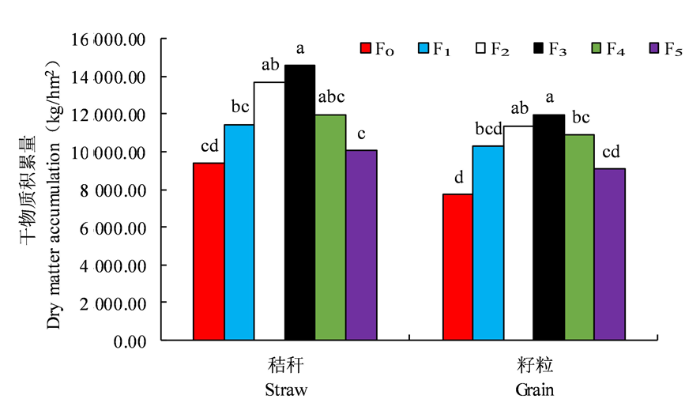
图1
不同处理下小麦地上部干物质积累量变化
注:小写字母表示差异达0.05显著水平,下同
Fig.1
Dry matter accumulation of wheat under different treatments
Note: lowercase letters indicate that the difference is 0.05 significant, the same as below
2.2 施磷方式对滴灌小麦产量及构成因素影响
研究表明,相较于不施磷F0处理,施磷处理提高了穗数、穗粒数、千粒重,施磷处理的穗数、穗粒数、千粒重分别比F0处理增加5.93%~23.99%、0.32%~8.76%、1.78%~6.45%,促进了小麦产量的增加,产量最高增加1 468.30 kg/hm2。不同施磷处理下小麦产量和构成因素存在差异。穗数、穗粒数、千粒重均以F3处理表现最好,F5处理表现最差,F3处理的穗数、穗粒数、千粒重比F5处理分别增加17.05%、8.41%、4.59%,F3处理的产量比F5处理增加10.21%,且差异显著。表2
表2 不同处理下小麦产量及构成因素
Tab.2
| 处理 Treat- ment | 穗数 The harvesting panicles (104/hm2) | 穗粒数 Grain number per panicle (个) | 千粒重 Grain weight per 1000 grains (g) | 产量 Yield (kg/hm2) |
|---|---|---|---|---|
| F0 | 412.43c | 41.10b | 46.29a | 6 406.00e |
| F1 | 463.57abc | 41.60b | 47.27a | 7 045.19d |
| F2 | 495.80a | 43.17ab | 48.82a | 7 484.76b |
| F3 | 511.37a | 44.70a | 49.27a | 7 874.31a |
| F4 | 485.80ab | 42.47ab | 48.84a | 7 378.69bc |
| F5 | 436.89bc | 41.23b | 47.11a | 7 144.77cd |
注:小写字母表示差异达0.05显著水平,下同
Note: lowercase letters indicate that the difference is 0.05 significant, the same as below
2.3 施磷方式对滴灌小麦地上部养分积累量的影响
研究表明,不同施磷处理下滴灌小麦地上部养分积累量表现一定差异。与不施磷F0处理相比,施磷能提高小麦的秸秆和籽粒中养分的积累量,施磷处理的秸秆和籽粒养分的积累量比不施磷F0处理分别增加17.46%~120.40%、24.30%~79.00%。秸秆、籽粒养分积累量均表现为F3>F2>F4>F1>F5。秸秆、籽粒养分积累量均以F3处理最高,F5处理最低,F3处理的秸秆、籽粒养分积累量比F5处理分别增加87.64%、44.01%,且差异显著。图2
图2
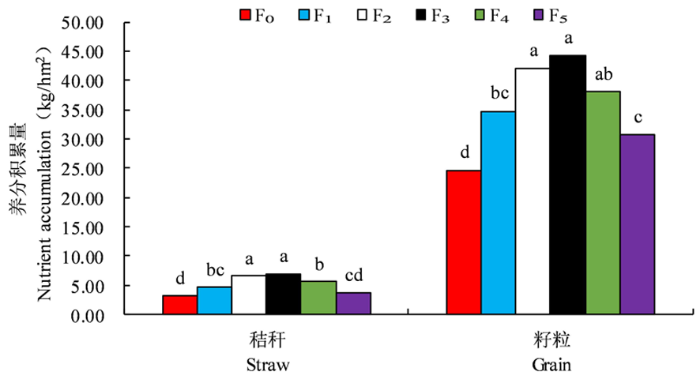
图2
不同处理下小麦磷素积累量变化
Fig.2
Phosphorus accumulation of wheat under different treatments
2.4 施磷方式对滴灌小麦肥料利用率的影响
研究表明,不同施磷处理下滴灌小麦肥料利用率存在一定差异。磷肥利用率、磷肥偏生产力、磷肥农学效率均表现为F3>F2>F4>F5>F1。磷肥利用率、磷肥偏生产力、磷肥农学效率均以F3处理最高,分别为14.25%、45.65 kg/kg、8.51 kg/kg,与其他处理差异显著,F3处理的磷肥利用率、磷肥偏生产力、磷肥农学效率比F1处理分别增加11.00%、4.81 kg/kg、4.80 kg/kg,且差异显著。表3
表3 不同处理下小麦磷肥利用效率
Tab.3
| 处理 Treatment | 磷肥利用率 REP (%) | 磷肥偏生产力 PEPP (kg/kg) | 磷肥农学效率 AEP (kg/kg) |
|---|---|---|---|
| F0 | — | — | — |
| F1 | 3.25e | 40.84d | 3.71c |
| F2 | 10.48b | 43.39b | 6.25b |
| F3 | 14.25a | 45.65a | 8.51a |
| F4 | 8.13c | 42.78bc | 5.64b |
| F5 | 5.58d | 41.42cd | 4.28c |
3 讨论
3.1
决定小麦产量高低的因素除与其本身的遗传特性有关外,主要受土壤水、肥、气、热等因素的影响[11⇓-13]。刘毅志等[14]指出磷肥底施效果最好,随着施磷时间的推移,增产效果逐渐减小,在没有底施磷肥的条件下,追施磷肥的时间越早,增产效果越好。姜宗庆等[15]发现在施磷量一定的情况下,不同磷肥基追比处理间植株干物质积累量、穗数、每穗粒数表现为7∶3处理>5∶5处理>10∶0处理>3∶7处理>0∶10处理,基追比5∶5处理的千粒重最高。邓兰生等[16]认为滴施磷肥有利于提高马铃薯块茎中的磷质量浓度,磷肥全部滴施,马铃薯块茎中的含磷量显著高于磷肥基施;50%磷肥基施、50%磷肥追施的马铃薯块茎产量最高。目前关于磷肥基追肥比例的研究结果尚不统一,可能与当地的生态条件、土壤状况、作物及品种类型有关。试验中,小麦的产量构成因素(穗数、穗粒数、千粒重)均以F3处理表现最好,施磷可以提高小麦穗数、穗粒数、千粒重。在施磷量相同的条件下,磷肥基施配合部分磷肥随水滴施有利于提高小麦产量,尤其以F3处理(50%基施+50%追施)表现最好,产量为7 874.31 kg/hm2,较F0、F1、F2、F4和F5分别提高22.92%、11.76%、5.20%、6.72%和10.21%。作物产量的提高与磷素的吸收密切相关,滴灌条件下可根据作物需磷规律随水施磷,从而实现产量和的磷素养分利用的协同提高。
3.2
磷是植物生长发育的必需营养元素之一,直接影响植株光合效率和产量[17-18],施用磷肥可以促进作物的生长发育和产量的增加。磷素养分利用效率与磷肥品种、施用技术方法密切相关[19⇓⇓⇓-23]。以往表层撒施磷肥,磷素易被土壤固定,磷素利用率很低[24]。Kafkafi[25]认为随水施肥有利于提高磷素利用率;刘洪亮等[26]研究表明,在滴灌条件下磷肥利用率为18.73%~26.33%,其中磷肥基施配合滴施处理利用率最高。试验中,磷肥利用率、磷肥偏生产力和磷肥农学效率均以F1处理(100%基施磷肥)最小,分别为3.25%、40.84 kg/kg和3.71 kg/kg,各处理表现为F3>F2>F4>F5>F1,相比于磷肥全部基施,等量施磷量条件下磷肥部分随水追施配合基施或磷肥全部随水追施,可显著提高磷肥利用效率,与前人研究结果相似。
4 结论
施磷利于小麦植株的生长发育,可显著增加小麦产量。等量养分条件下,不同施磷方式对滴灌小麦的生长和磷肥利用效率产生影响。F3处理(50%基施+50%追施)小麦群体生长发育较好,群体产量构成因素表现最优,磷素的养分积累量也最高,具有较高的磷肥利用率。
参考文献
不同形态氮肥对膜下滴灌棉花15N回收率和产量的影响
[J].
Effects of different nitrogen forms on 15N recovery, seed cotton yield of cotton under drip irrigation under mulch
[J].
氮肥运筹对滴灌甜菜糖分积累期叶片光合特性的影响
[J].
以甜菜品种Beta356为材料,设置3种氮肥运筹模式,在甜菜叶丛生长期∶块根膨大期∶糖分积累期的氮肥施用比例分别为100∶0∶0(N1),70∶30∶0(N2),50∶30∶20(N3),以不施氮肥处理(CK)为对照,比较氮肥运筹对滴灌甜菜糖分积累期叶片光合特性、荧光参数和叶绿素含量的影响。结果表明:与其他处理相比,N2处理条件下甜菜糖分积累期叶片最大净光合速率和叶绿素含量显著增加,与CK相比分别增加了33.6%和93.37%;该处理甜菜叶片的气孔导度、二氧化碳交换、电子传递活性以及抗氧化能力等参数均显著提升;甜菜总干物质产量增加显著,分别比CK、N1 和N3提高了22.3%、8.6%和6.7%。因此,滴灌甜菜叶丛生长期∶块根膨大期∶糖分积累期氮肥施用比例为70∶30∶0的处理能够提高糖分积累期叶片光合能力,从而延缓甜菜生育后期叶片衰老。
Effects of nitrogen management on photosynthetic characteristics of sugarbeet leaves in the period of sugar accumulation under drip irrigation
[J].
氮肥对滴灌冬小麦籽粒灌浆特性的影响
[J].
Effect of nitrogen fertilizer on grain filling characteristics of winter wheat under drip irrigation
[J].
滴灌条件下不同氮肥处理对红枣生长及产量的影响
[J].为探究滴灌条件下不同氮肥施用水平对枣树生长及产量的影响,并确定适宜当地的氮肥施用量,以民勤当地7 a生枣树为研究对象,设置4个氮肥施用水平(407 kg/hm<sup>2</sup>,CK;610 kg/hm<sup>2</sup>,T1;814 kg/hm<sup>2</sup>,T2;1 020 kg/hm<sup>2</sup>,T3)作为处理进行大田试验。结果表明:各生育时期叶片SPAD值均随着施氮量的增加而上升;氮肥量的增加可以在一定程度上促进枣吊的生长,T3处理较CK枣吊长度增加了16.75 cm,增幅为11.57%;增施氮肥可有效提高当地枣树坐果率,坐果率最高的处理为T3,比CK和T1的坐果率分别增加了3.69%和3.06%;T3处理下红枣产量最高,较CK处理增产2 444.44 kg/hm<sup>2</sup>,增幅为24.76%。通过使用隶属函数法进行综合评价,认为T3处理(1 020 kg/hm<sup>2</sup>氮肥施用量)为最优处理,是适宜当地的氮肥施用水平。
Effects of different nitrogen fertilizer levels on jujube growth indexes and leaf SPAD values under drip irrigation
[J].In order to explore the effects of different nitrogen fertilizer levels on the growth indexes and SPAD value of jujube under drip irrigation, and determine the appropriate local nitrogen application rate, the field experiment was conducted with 7-year-old jujube trees in Minqin, and four nitrogen fertilizer levels (407 kg/hm2, CK; 610 kg/hm2, T1;814 kg/hm2,T2; 1 020 kg/hm2,T3) were set as the treatment. The results showed that the SPAD value of leaves increased with the increase in nitrogen application rate in each growth period.The increase in nitrogen fertilizer can promote the growth of jujube bearing branches to a certain extent. Compared with CK, T3 treatment can increase the length of jujube bearing branches by 16.75 cm, an increase of 11.57%.Increasing nitrogen fertilizer can effectively improve the fruit setting rate of local jujube trees, and T3 has the highest fruit setting rate. Compared with CK and T1, the fruit setting rate increases by 3.69% and 3.06% respectively. T3 treatment has the highest yield, which is 162.99 kg/m2 higher than CK treatment, with an increase of 24.76%. Through the comprehensive evaluation by using the membership function method, it is considered that T3 treatment (1 020 kg/hm2 nitrogen fertilizer application rate) is the optimal treatment and is suitable for the local nitrogen fertilizer application.
风沙土膜下滴灌氮肥运筹对玉米生长、干物质和产量的影响
[J].为风沙土地区精准、高效地实施玉米膜下滴灌施肥管理提供科学依据。以玉米为供试作物,进行田间试验。在推荐施氮量300 kg/hm<sup>2</sup>下,设置5个不同时期氮肥配比,分别为常规施肥(F1:基肥、拔节肥质量比为1∶2),兼顾拔节和粒肥(F2:基肥、拔节肥、粒肥质量比为1∶1∶1),均匀施肥(F3:基肥、苗期肥、拔节肥、穗肥、粒肥质量比为2∶1∶1∶1∶1),重拔节肥(F4:基肥、拔节肥、穗肥、粒肥质量比为2∶2∶1∶1),攻粒肥(F5:基肥、拔节肥、穗肥、粒肥质量比为2∶1∶1∶2)。分析膜下滴灌不同时期氮肥配比对玉米生长指标、干物质质量和产量的影响。F1处理玉米生育期叶绿素含量最高,生育后期茎秆、叶面积指数和叶绿素含量下降幅度最大,F2处理玉米各项生长指标一般,F3处理玉米植株最高,叶面积指数最大,F4处理玉米获得较粗壮的茎秆,F5处理玉米前期株高和叶面积指数较小,后期茎粗和叶面积指数减少最少;拔节期F3处理干物质显著高于F1、F4和F5处理,穗期F2处理穗轴干物质占比最小,灌浆期各处理籽粒占比从大到小依次为F3、F4、F5、F1和F2;F3处理产量和WUE均最高,分别为12.3 t/hm<sup>2</sup>和2.16 kg/m<sup>3</sup>。综合考虑玉米生长、干物质质量、产量和水分利用效率,推荐在辽西北风沙土地区玉米滴灌水肥一体化种植模式下均匀施肥为最佳氮肥运筹。
Effects of nitrogen application of drip irrigation under mulch on growth, dry matter and yield of maize in aeolian sandy soil
[J].In order to provide scientific basis for precise and efficient fertilization management of maize under drip irrigation in aeolian sandy soil area, the field experiment was conducted with corn as the test crop. Under the recommended nitrogen application rate of 300 kg/hm2, five nitrogen fertilizer ratios were set at different stages, including conventional fertilization (F1, the mass ratio of base fertilizer to jointing fertilizer was 1∶2), taking into account jointing and grain fertilizer (F2, the mass ratio of base fertilizer to jointing fertilizer to grain fertilizer was 1∶1∶1), uniform fertilization (F3, the mass ratio of base fertilizer to seedling fertilizer to jointing fertilizer to panicle fertilizer to grain fertilizer was 2∶1∶1∶1∶1), heavy jointing fertilizer (F4, the mass ratio of base fertilizer to jointing fertilizer to ear fertilizer and grain fertilizer was 2∶2∶1∶1), and attack grain fertilizer (F5, the mass ratio of base fertilizer to jointing fertilizer to ear fertilizer to grain fertilizer was 2∶1∶1∶2). The effects of nitrogen fertilizer ratio on growth index, dry matter quality and yield of maize were analyzed. The results showed that the chlorophyll content of F1 treatment was the highest at growth stage, and the stem, leaf area index and chlorophyll content decreased the most at later growth stage. The growth indexes of F2 treatment were general. The plant height and leaf area index of F3 treatment were the highest, and the leaf area index was the largest. Corn in F4 treatment obtained stronger stem. The plant height and leaf area index of F5 treatment were smaller at early growth stage, and the stem diameter and leaf area index decreased the least at later growth stage; The dry matter of F3 treatment at jointing stage was significantly higher than that of F1, F4 and F5 treatment, and the proportion of dry matter in rachis of F2 treatment at panicle stage was the smallest; At the filling stage, the grain proportions of each treatment were F3, F4, F5, F1 and F2 in descending order; the yield and WUE of F3 treatment were the highest, which were 12.3 t/hm2 and 2.16 kg/m3 respectively. Considering the growth, dry matter quality, yield and water use efficiency of maize, it is recommended that uniform fertilization is the best way of nitrogen management under the integrated planting mode of drip irrigation, water and fertilizer for maize in Northwest Liaoning sandy soil area.
中国棉花产业发展现状及展望
[J].棉花是中国种植业生产中产业链最长的大田经济作物,其商品率高达95%以上,但棉花产业尚存在许多不足之处,需要涉棉企业、棉农、科技人员、学者进一步关注,如自主种业、品牌培育、清洁生产、统防统治、贸易依存度、产业安全、规模经济、产业组织等因素影响中国棉花的产业竞争力和可持续发展。中国棉花种植以新疆、黄河流域、长江流域为主,其中新疆棉花产量占全国产量的67%,已形成规模化和机械化种植,而长江、黄河流域仍以小规模种植为主,没有充分发挥新型经营主体的带动作用,无法形成规模化种植和机械化生产,且缺乏集棉花生产、加工、销售为一体的综合数据平台,在棉花的专业化服务、全程服务和托管式服务方面仅有数家。中国棉花产业未来发展方向和目标应是提升棉田生产规模化、机械化、智能化、信息化、服务社会化水平,研发轻简化生产技术使棉农有尊严快乐植棉,降低生产成本,解决谁来种地的问题,掌控棉花产业链条的主动权。文中从棉花产业链的供求角度出发,阐述了中国棉花种植面积和总产量大幅减少、产业布局上新疆一枝独秀、国内消费有所降低但供求形势有所好转、进口量长期大于出口量和纺织业优势递减的发展现状,分析了中国棉花产业在生产环节、产业布局、组织管理、平台建设等方面存在的问题,借鉴美国和澳大利亚在棉花品种、生产技术、机械化和国家政策的种植经验和发展优势,结合中国供给侧结构改革的政策背景,从培育棉花新品种、研发轻简化和机械化新技术、投入农机设备、优化品种品质和区域布局、科学防治病虫害提高棉花质量、制定棉花目标价格制度、提高棉花生产保险额度、加大对棉农、棉商、农机制造商、纺织企业、出口商等的补贴力度和政策保障力度、发挥产学研优势和棉花协会功能、构建产供销一体化平台、完善棉花供需调控体系、建设现代植棉业服务体系、借助“一带一路”契机带动棉花和纺织业走出国门等多个层面提出相应的对策建议,从而刺激国内有效供给,尽快实现中国棉花产业供需平衡。最后,对中国棉花产业进行展望,将“三去一降一补”应用于棉花产业,并顺应全球棉花去库存的格局,未来两年棉价将有所上涨。
The present situation and prospects of cotton industry development in China
[J].Cotton is the longest chain of field commercial crops of China’s planting industry, which the commodity rate is as high as more than 95%, but still exists many shortcomings of the cotton industry which require further attention from cotton enterprises, cotton farmers, scientific and technical personnel, and scholars, such as independent seed industry, brand cultivation, cleaner production, unified management and pest control, dependence on foreign trade, industrial security and economies of scale, industrial organization and other factors that influence China's cotton industry competitiveness and sustainable development. The major production areas of cotton in China are Xinjiang, the Yellow River basin and the Yangtze river basin, for example, Xinjiang cotton production accounts for 67% of the national output and has formed scale and mechanization planting, but the Yangtze river basin and the Yellow River basin still practice the small scale economy, not full play the leading role of the new type of management main body, the scale planting and mechanized production, is lack of the integrated data platform of cotton production can not be formed, and processing and marketing, and only several departments are engaged in professional service, one-on-one full service and hosted service. The development direction and goal of cotton production in China should be improved the level of cotton production scale, mechanization, intelligence, informationization, socialization service, development of light-simplified production technology that makes cotton farmers to grow cotton more happily and with more dignity, reduce production cost, solve the problem who is going to a tiller of the ground, control tightly cotton industry chain. From the Angle of the cotton industry chain of supply and demand, this paper expounded the present situation of development of cotton industry that the Chinese cotton planting area and output decreased, the industrial layout in Xinjiang outshines others, the domestic consumption has decreased, but the supply and demand situation has been improved, the imports are greater than the exports over a long period of time and the advantages of textile industry decreased gradually, and so on. A series of problems about Chinese cotton industry in the production process, the industrial layout, organization and management, and platform construction were analyzed. Based on the practice of the growing experience and development advantages of the United States and Australia in cotton varieties, production technology, mechanization and national policy, combining with the policy background of China's reform of structure of the supply side, the corresponding countermeasures and suggestions were put forward including cultivating new cotton varieties, researching new technology of light-simplified and mechanized production, the input of agricultural machinery equipment, optimization of varieties, quality and area layout, scientifically preventing and controlling plant diseases and insect pests to improve the quality of cotton, develop cotton price target system, improve the insurance amount of cotton production, increase subsidies and policy support dynamics of cotton farmers, cotton business, agricultural machinery manufacturers, textile companies, exporters and so on, giving play to the advantages of production and cotton association function, building platforms of production-supply-sales integration, perfecting the regulation system of cotton supply and demand, construction of the modern cotton industry service system, driving the cotton and textile industry abroad with the help of One Belt And One Road, and so on, in order to stimulate domestic effective supply, achieve the equilibrium of supply and demand of China's cotton industry as soon as possible. Finally, the prospects for China's cotton industry were presented, the three cuts-one reduction-one subsidy (cut overcapacity, cut stores, cut levers-one-reduction-one subsidy) should be used in cotton industry and conform to the pattern of global cotton to get rid of the inventory, and cotton prices will be higher in the coming two years.
水肥一体化施磷对滴灌玉米产量、磷素营养及磷肥利用效率的影响
[J].
Effect of water and P fertilizer coupling on corn yield, P uptake, and P utilization efficiency with drip irrigation in a calcareous soil
[J].
滴施磷肥和钾肥对棉花产量的影响
[J].
Modulating effect of phosphate and potassium factors on drip irrigated cotton yield
[J].
不同基追比施磷对滴灌稻田土壤无机磷组分及水稻产量的影响
[J].
Effects of different ratios of base P to dressing P on inorganic phosphorus fractions in paddy soil and rice yield
[J].
茬口和施氮水平对小麦品质性质及其变异系数的影响
[J].
Effect of crop rotation and nitrogen fertilization on wheat quality and variation coefficient
[J].
氮用量对大穗型小麦品种同化物供应及子粒灌浆的影响
[J].
Effects of nitrogen application on assimilate supply and grain filling of large spike wheat varieties
[J].
四十年来我国磷肥研究进展概况
[J].
Research progress of phosphate fertilizer in China in the past 40 years
[J].
氮磷钾化肥对高产夏玉米籽粒品质的影响
[J].
Effect of nitrogen, phosphorus and potassium fertilizer on grain quality of high yield summer maize
[J].
磷肥基追比对扬麦12号磷素利用及物质生产和产量的影响
[J].
Effect of base dressing ratio of phosphate fertilizer on phosphorus utilization, material production and yield of Yangmai 12
[J].
滴灌下不同供磷方式对马铃薯生长的影响
[J].
Effects of P application methods on growth of potato under drip fertigation
[J].
Effects of long-term straw incorporation on the net global warming potential and the net economic benefit in a rice-wheat cropping system in China
[J].
耕作方式与秸秆还田对冬小麦-夏玉米轮作系统中干物质生产和水分利用效率的影响
[J].为探讨黄淮海地区一年两熟制下土壤耕作方式与秸秆还田相结合的适宜模式, 2010—2012年进行了两年度的田间试验, 研究不同处理对冬小麦–夏玉米轮作系统干物质生产和水分利用效率的影响。通过比较常规耕作+秸秆还田、常规耕作+无秸秆还田、深耕+秸秆还田、深耕+无秸秆还田、深松+秸秆还田、深松+无秸秆还田6个处理, 发现深松(耕)与秸秆还田可以增加冬小麦和夏玉米的农田耗水量, 降低休闲期农田耗水量, 提高作物叶片相对含水量、净光合速率、蒸腾速率和茎秆伤流量, 促进植株干物质积累, 进而提高作物籽粒产量和水分利用效率。耕作方式与秸秆还田对冬小麦和夏玉米的干物质生产和水分利用效率存在显著交互作用。与常规耕作+无秸秆还田相比, 深耕+秸秆还田和深松+秸秆还田处理的作物干物质积累量分别提高19.3%和22.9%, 周年作物产量分别提高18.0%和19.3%, 水分利用效率分别提高15.9%和15.1%, 且两处理无显著差异。因此认为, 与本试验相似环境条件下, 宜在秸秆还田的基础上配合深松或深耕。
Effects of tillage and straw returning on biomass and water use efficiency in a winter wheat and summer maize rotation system
[J].<p><span lang="EN-US" style="font-size: 10.5pt; font-family: "Times New Roman","serif"; mso-ansi-language: EN-US; mso-fareast-language: ZH-CN; mso-bidi-language: AR-SA; mso-fareast-font-family: 宋体; mso-bidi-font-size: 12.0pt">Straw returning to the field has been carried out in Huang-Huai-Hai Plain for ten years. In a consecutive two-year field experiment from 2010 to 2012, the effects of </span><span lang="EN-US" style="font-size: 10.5pt; font-family: "Times New Roman","serif"; mso-ansi-language: EN-US; mso-fareast-language: ZH-CN; mso-bidi-language: AR-SA; mso-fareast-font-family: 宋体; mso-bidi-font-size: 9.0pt">conventional tillage (CT), </span><span lang="EN-US" style="font-size: 10.5pt; font-family: "Times New Roman","serif"; mso-ansi-language: EN-US; mso-fareast-language: ZH-CN; mso-bidi-language: AR-SA; mso-fareast-font-family: 宋体; mso-bidi-font-size: 12.0pt">deep tillage (DT) and subsoiling (SS) on dry matter accumulation and water use efficiency were tested in a winter wheat–summer maize rotation system for setting up a tillage practice suitable for straw returning. </span><span lang="EN-US" style="font-size: 10.5pt; font-family: "Times New Roman","serif"; mso-ansi-language: EN-US; mso-fareast-language: ZH-CN; mso-bidi-language: AR-SA; mso-fareast-font-family: 宋体; mso-bidi-font-size: 9.0pt">The results were obtained from the comparison among six treatments, including CT+AS (all straw returning), CT+NS (no</span><span lang="EN-US" style="font-size: 7.5pt; font-family: "Times New Roman","serif"; mso-ansi-language: EN-US; mso-fareast-language: ZH-CN; mso-bidi-language: AR-SA; mso-fareast-font-family: 宋体"> </span><span lang="EN-US" style="font-size: 10.5pt; font-family: "Times New Roman","serif"; mso-ansi-language: EN-US; mso-fareast-language: ZH-CN; mso-bidi-language: AR-SA; mso-fareast-font-family: 宋体; mso-bidi-font-size: 9.0pt">straw returning), DT+AS, DT+NS, SS+AS, and SS+NS. </span><span lang="EN-US" style="font-size: 10.5pt; font-family: "Times New Roman","serif"; mso-ansi-language: EN-US; mso-fareast-language: ZH-CN; mso-bidi-language: AR-SA; mso-fareast-font-family: 宋体; mso-bidi-font-size: 12.0pt">Under straw returning condition, either DT or SS practice</span><span lang="EN-US" style="font-size: 10.5pt; font-family: "Times New Roman","serif"; mso-ansi-language: EN-US; mso-fareast-language: ZH-CN; mso-bidi-language: AR-SA; mso-fareast-font-family: 宋体; mso-bidi-font-size: 9.0pt"> increased</span><span lang="EN-US" style="font-size: 10.5pt; font-family: "Times New Roman","serif"; mso-ansi-language: EN-US; mso-fareast-language: ZH-CN; mso-bidi-language: AR-SA; mso-fareast-font-family: 宋体; mso-bidi-font-size: 12.0pt"> </span><span lang="EN-US" style="font-size: 10.5pt; font-family: "Times New Roman","serif"; mso-ansi-language: EN-US; mso-fareast-language: ZH-CN; mso-bidi-language: AR-SA; mso-fareast-font-family: 宋体; mso-bidi-font-size: 9.0pt">water consumption amount during </span><span lang="EN-US" style="font-size: 10.5pt; font-family: "Times New Roman","serif"; mso-ansi-language: EN-US; mso-fareast-language: ZH-CN; mso-bidi-language: AR-SA; mso-fareast-font-family: 宋体; mso-bidi-font-size: 12.0pt">winter</span><span lang="EN-US" style="font-size: 10.5pt; font-family: "Times New Roman","serif"; mso-ansi-language: EN-US; mso-fareast-language: ZH-CN; mso-bidi-language: AR-SA; mso-fareast-font-family: 宋体; mso-bidi-font-size: 9.0pt"> wheat or summer maize growth period but decreased it during fallow period. In addition, relative water content, net photosynthetic rate (<em style="mso-bidi-font-style: normal">P</em><sub>n</sub>), transpiration rate (<em style="mso-bidi-font-style: normal">T</em><sub>r</sub>) of leaf, and bleeding sap in stalk were also increased in both crops, leading to more biomass and higher water use efficiency together with increased grain yields in </span><span lang="EN-US" style="font-size: 10.5pt; font-family: "Times New Roman","serif"; mso-ansi-language: EN-US; mso-fareast-language: ZH-CN; mso-bidi-language: AR-SA; mso-fareast-font-family: 宋体; mso-bidi-font-size: 12.0pt">winter</span><span lang="EN-US" style="font-size: 10.5pt; font-family: "Times New Roman","serif"; mso-ansi-language: EN-US; mso-fareast-language: ZH-CN; mso-bidi-language: AR-SA; mso-fareast-font-family: 宋体; mso-bidi-font-size: 9.0pt"> wheat and summer maize seasons. The effects of interactions between soil tillage (DT or SS) and straw returning on dry matter accumulation and water use efficiency were significant in both crops. Compared with conventional tillage under no straw returning, DT and SS under straw retuning resulted in increased dry matter accumulation (19.3% and 22.9%, respectively), annual crop yield (by 18.0% and 19.3%, respectively), and water use efficiency (by 15.9% and 15.1%, respectively). The difference of the effect between DT and SS under straw returning was not significant. Therefore, we recommend DT or SS practice in straw returning field under the environment similar to that of this experiment.</span></p>
不同磷肥对石灰性土壤磷效率小麦基因型生长发育的影响
[J].
Effects of different forms of P fertilizers on P availability in calcareous soil and growth of wheat with different genotypes
[J].
不同磷源对作物根际效应影响的研究
[J].
Effect of sources of P on crop rhizosphere
[J].
磷肥种类和用量对土壤磷素有效性和棉花产量的影响
[J].
Effect of applying different forms and rates of phosphoric fertilizer on phosphorus availability and cotton yield
[J].
磷肥施用深度对夏玉米产量和养分吸收的影响
[J].
Effects of phosphorus placement depth on yield and nutrient uptake of summer maize
[J].
超高产栽培下磷肥运筹对春玉米根系特性的影响
[J].
Effects of phosphorus application on root characteristics of super-high-yield spring maize
[J].
Celery yield responds to phosphorus rate but not phosphorus placement on his-tosols
[J].
Combined irrigation and fertilization in arid zone
[J].Sand dunes and highly calcareous soils occupy vast areas in arid zones. The soils are characterized by low available nutrient content and low to medium water-holding capacity of the upper soil surface. These features result in low vegetation density under arid climate conditions. The introduction of trickle irrigation coupled with liquid fertilizers turned desert sand dunes and highly calcareous soils into productive agricultural soils for high cash crops. The intensity of daily nutrient supply dictates the farmer's consideration of the form of nitrogen supplied to the crop and to the variable sensitivity of plants to the different forms of N supplied by various fertilizers through the irrigation system. The combination of high root temperature and high ammonium concentration is of particular importance. Plants that have relatively low carbohydrate content in their roots might suffer from ammonia toxicity if a high daily supply of ammonium is available. High concentrations of urea and very high calcium carbonate content in the soil are also dangerous to ammonium- sensitive plants like tomatoes. Planning the irrigation system and nutrient supply to the crops according to their physiological stage of development, and consideration of the soil and climate characteristics, can give high yields and high quality crops with minimum pollution, but salt accumulation on the soil surface should be prevented, either by sprinkle irrigation, or by plastic mulch during the growing season.


