


0 引言
【研究意义】昆虫形成复杂且灵敏的化学感受系统,对于昆虫各项生命活动至关重要[1⇓⇓-4]。昆虫的化学感受系统离不开化学器官的参与[5,6],其中胸足可以直接接触到寄主植物,是昆虫感知外界环境中化学线索的重要器官,具有嗅觉、味觉与机械感受等功能,在寄主定位、产卵场所选择和躲避天敌等生命活动中起到关键的作用[7]。当环境中的化学线索激活外周神经系统中相关化学感受蛋白后,将化学信号转换成电信号,传导到中枢神经系统[8,9]。在中枢神经系统的水平上,这些信号被整合与加工,影响昆虫行为选择[10⇓-12]。研究昆虫足上感器的类型,对了解其行为机制有重要意义。【前人研究进展】根据感器的大小、形状和结构等特征,可以将昆虫感器分为多种类型。主要分为毛形感器(Sensilla trichodea, ST)、锥形感器(Sensilla basiconica, SB)、腔锥形感器(Sensilla coeloconica, SCo)、刺形感器(Sensilla chaetica, SC)、棒状感器(Sensilla clavate, SCl)、栓锥形感器(Sensilla styloconica, SSt)、板形感器(Sensilla placodea, SP)、耳形感器(Sensilla auricillica, SAu)、Böhm氏鬃毛(Böhm bristles, BB)、微毛(Microtrichiae, Mt)、感觉窝(Sensory pit)、感觉囊(Sensory sacculus)等[13⇓⇓⇓-17]。足上的感器常集中分布在足跗节上,是昆虫足感受外界环境最重要的区域,主要感知来自植物的次生代谢产物、产卵基质表面物质以及微生物代谢产生的化合物,如蔗糖、奎宁、洛贝宁、肌醇和烟碱等[18⇓⇓⇓-22]。鳞翅目昆虫棉铃虫Helicoverpa armigera和烟青虫Helicoverpa assulta成虫足跗节上存在两种味觉感受器,能够感受糖类、肌醇和氨基酸,在取食花蜜和选择合适的产卵选择时具有关键作用[23,24]。此外,模式昆虫黑腹果蝇Drosophila melanogaster的前足跗节上的两个味觉感器能够识别苦味物质,帮助果蝇避免在不利介质上产卵[25]。【本研究切入点】大灰优蚜蝇属于双翅目Diptera,蚜蝇科Syrphinae,优蚜蝇属Eupeodes,是农田生态系统中一种非常重要且具有双重服务功能的有益昆虫[26,27],关于大灰优蚜蝇感器的研究仅在触角上有报道,发现了10种不同类型的感器,包括Böhm 氏鬃毛、刺形感器、微毛感器、毛形感器、锥形感器、棒状感器、腔锥形感器、栓锥形感器、板形感器和感觉窝,并证明触角中锥形感器神经元参与了对寄主植物挥发物的远距离识别[28,29]。此外,野食蚜蝇Syrphus torvus、虚构食蚜蝇Syrphus opinator等食蚜蝇触角上的感器类型和分布均有一定研究[30]。在近距离接触植物或猎物时,大灰优蚜蝇雌虫胸足跗节可以直接接触到产卵位点,食蚜蝇的足在产卵过程中发挥着重要的作用。目前对食蚜蝇足跗节上分布的感器及其类型尚不明确。需要分析大灰优蚜蝇Eupeodes corollae雌成虫胸足的感器类型、特征及分布。【拟解决的关键问题】利用扫描电镜观察大灰优蚜蝇雌成虫胸足各节及其上感器的超微结构,研究这些部位感器的类型、特征及分布,并分析在产卵选择过程中的作用,为深入探究大灰优蚜蝇产卵选择机制提供理论依据。
1 材料与方法
1.1 材料
大灰优蚜蝇成虫采集于中国农业科学院植物保护研究所廊坊基地灌浆期小麦地,在实验室内饲养。饲养条件为温度(25±1)℃,相对湿度(60%±5%),光周期14 L∶10 D。幼虫用豌豆蚜Acyrthosiphon pisum饲养,成虫羽化后将雌、雄虫分开,以10%蜂蜜水和油菜花粉饲养。蚜虫用土培蚕豆苗饲养,饲养条件为温度(20±2)℃,相对湿度(70%±5%),光周期16 L∶8 D。选取大灰优蚜蝇羽化后2~3 d雌成虫足进行扫描电镜观察。
1.2 方法
1.2.1 样品制备与电镜观察
选择发育良好的羽化2~3 d的大灰优蚜蝇雌成虫,用精细解剖剪剪下其前、中、后足以及前足跗节,在70%乙醇溶液中超声清洗5 min,以除去表面粘附的杂质。样品分别在80%、90%和100%的梯度乙醇中脱水5 min。在CO2临界点干燥仪(LEICA EM CPD030, 德国)中干燥后,用导电胶带将样品固定到样品台上,用离子溅射仪(HITACHI MC 1000, 日本)喷金粉。采用扫描电子显微镜(HITACHI SU8010, 日本)对大灰优蚜蝇足跗节不同部位进行了显微观察,电镜工作电压为12 kV。
1.2.2 感器的鉴定与命名
2 结果与分析
2.1 足的一般特征
研究表明,大灰优蚜蝇雌成虫胸足分为前足、中足和后足,每种胸足由基节、转节、腿节、胫节、跗节和前跗节6个部分组成。腿节、胫节和跗节的长度相近。其中,腿节较发达,基部膨大,表面稀疏分布毛状感觉毛簇;胫节次之,内侧端部有排列整齐的刺状感觉毛簇;跗节有5个亚节,分节明显,第1节最长,依次递减,跗节上分布大量的感觉毛;前跗节较短,具2个弧形爪,爪呈锥形,向内弯曲,且爪尖有钝化趋势,表面有纵纹,爪间有爪垫,无附齿。图1
图1
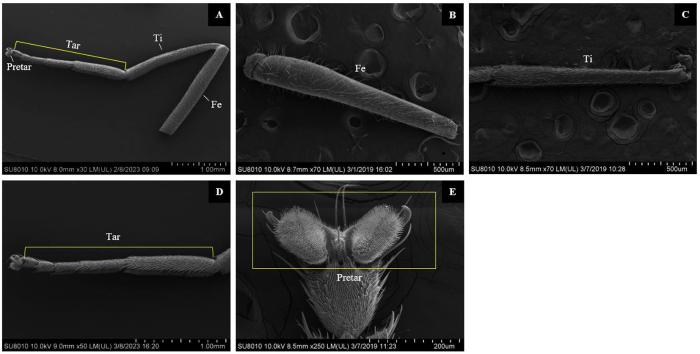
图1
大灰优蚜蝇雌虫前足扫描电镜图
注:A. 大灰优蚜蝇足部分整体图,由腿节、胫节、跗节和前跗节构成;B. 腿节整体图;C. 胫节整体图;D. 跗节整体图;E. 前跗节整体图(黄色矩形边框);腿节Femur(Fe);胫节Tibia(Ti);跗节Tarsus(Tar);前跗节Pretarsus(Pretar)
Fig.1
Scanning electron micrographs of foreleg in female adults of Eupeodes corollae
Note: A. General view of the part of leg from Eupeodes corollae, showing the femur, the tibia, the tarsus, the pretarsus; B. General view of the femur; C. General view of the tibia; D. General view of the tarsus; E. General view of the pretarsus (yellow rectangular border); Femur (Fe); Tibia (Ti); Tarsus (Tar); Pretarsus (Pretar)
2.2 足的感器类型及分布
研究表明,大灰优蚜蝇雌成虫胸足感器共5种类型,分别为毛形感器(ST)、锥形感器(SB)、刺形感器(SC)、微毛感器(Mt)和Böhm 氏鬃毛(BB)。其中,腿节以毛形感器和Böhm 氏鬃毛为主,毛形感器的数量较少,Böhm氏鬃毛散布在各个毛形感器周围;胫节以刺形感器和Böhm 氏鬃毛为主,刺形感器主要分布在胫节的两侧,Böhm氏鬃毛在胫节上分布广泛;5种类型的感器在跗节均有分布,是足上感器类型最多的区域;前跗节上并没有观察到这5类感器,但分布大量的刚毛。
2.2.1 腿节和胫节的感器类型
研究表明,腿节上稀疏的分布着毛形感器(ST),可根据长短分为长毛形感器 I型(LST I)和短毛形感器 I型(SST I)2种亚型。毛形感器的毛干从基部向端部逐渐变细,靠近端部明显弯曲,呈毛发状,表面有纵脊,基部着生于一个小的表皮窝内。在毛形感器的周围散布Böhm 氏鬃毛(BB),数量较多,这类感器外形似短刺,表面光滑,无气孔和纵向刻纹,基部无臼状窝,毛干与触角表面呈锐角。图2
图2
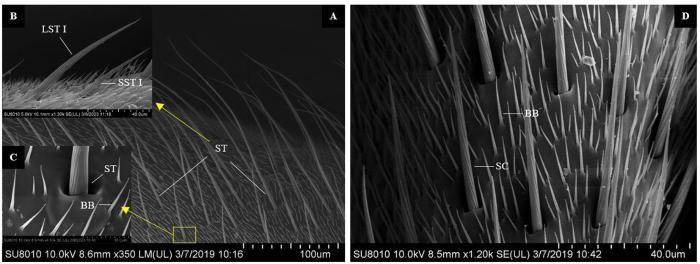
图2
大灰优蚜蝇雌虫前足腿节和胫节扫描电镜图
注:A. 位于腿节的毛形感器;B. 长毛形感器 I型long sensilla trichodea I(LST I)和短毛形感器 I型short sensilla trichodea I(SST I);C. Böhm 氏鬃毛(BB),毛形感器(ST)基部的表皮窝;D. 位于胫节的刺形感器(SC)和Böhm 氏鬃毛(BB)
Fig.2
Scanning electron micrographs of femur and tibia in foreleg of female adults of E. corollae
Note: A. Sensilla trichodea in the femur; B. Long sensilla trichodea I (LST I) and short sensilla trichodea I (SST I); C. Böhm bristles (BB), epidermal fossa at the base of sensilla trichodea (ST); D. Sensilla chaetica (SC) and böhm bristles (BB) at the tibia
胫节上的刺形感器(SC),毛干刚直如刺,表面着生纵向排列的刻纹,无壁孔,感器基部陷入由足表皮向上隆起形成的臼状窝内。Böhm 氏鬃毛(BB)的形态与腿节无明显差异。图2
2.2.2 足跗节感器类型
研究表明,足跗节是足上感器类型和数量最多的区域,也是足上最重要的化学感受区域。刺形感器主要分布在足跗节的侧面和背面。根据感器的外部形态,可分为长刺形感器(LSC)和短刺形感器(SSC)2种亚型。LSC主要分布在各跗分节的背面前侧和两侧区域,SSC分布于各跗分节背面的中间区域。足跗节的刺形感器形态与胫节上的刺形感器无差异。Böhm 氏鬃毛在足跗节的各跗分节表面均有分布,数量较多,其形态与足上其他区域无差异,毛干刚直如刺。微毛感器(Mt)分布于整个前足,散布于各种类型的感器之间。这类感器细长、略弯曲、外似毛发状,表面有明显的纵向刻纹,从基部延伸到端部。感器基部无明显的臼状窝。
足跗节的毛形感器(ST)同样分为长毛形感器 II型(LST II)和短毛形感器 II型(SST II)2种亚型,主要分布于大灰优蚜蝇的足跗节腹面,在第五跗分节腹面前侧有两对明显的LST II和SST II,与腿节的毛形感器相比,足跗节上毛形感器的毛干宽度较宽,靠近端部弯曲程度较小。
足的锥形感器仅在跗节分布,根据感器的外部形态特征,可将锥形感器分为3种亚型(SB I~ SB III)。锥形感器 I型呈指状,具钝尖,顶部有小孔,感器表面具纵纹。锥形感器 II型呈短锥形,具纵纹,顶部无孔,毛干从基部到端部逐渐变细,靠近端部略弯曲。锥形感器 III型毛干宽度相对较细,具纵纹,靠近端部明显弯曲。图3
图3
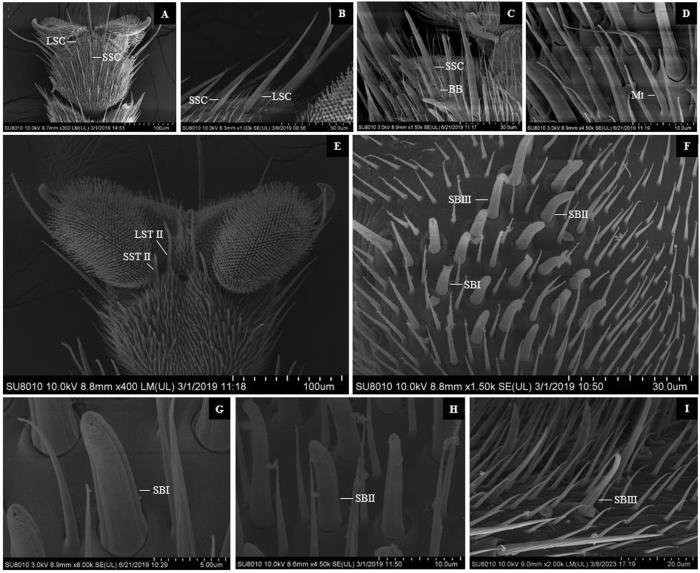
图3
大灰优蚜蝇雌虫前足跗节扫描电镜图
注:A. 位于跗节背面的短刺形感器short sensilla chaetica(SSC)和长刺形感器long sensilla chaetica(LSC);B. 位于跗节两侧的短刺形感器(SSC)和长刺形感器(LSC);C. 位于跗节的短刺形感器(SSC)和Böhm 氏鬃毛(BB);D. 微毛感器(Mt);E. 位于跗节腹面的长毛形感器 Ⅱ型long sensilla trichodea Ⅱ(LST Ⅱ)和短毛形感器 Ⅱ型short sensilla trichodea Ⅱ(SST Ⅱ);F. 跗节腹面的锥形感器(SB)SB I,SB II和SB III亚型;G. 锥形感器 I型(SB I);H. 锥形感器 II型(SB II);I. 锥形感器 III型(SB III)
Fig.3
Scanning electron micrographs of tarsus in foreleg of female adults of E. corollae
Note: A. Short sensilla chaetica (SSC) and long sensilla chaetica (LSC) at the back of the tarsus; B. Short sensilla chaetica (SSC) and long sensilla chaetica (LSC) at the both sides of the tarsus; C. Short sensilla chaetica (SSC) and böhm bristles (BB) at the tarsus; D. Microtrichiae (Mt); E. Long sensilla trichodea Ⅱ (LST Ⅱ) and short sensilla trichodea Ⅱ (SST Ⅱ) at the ventral sides of the tarsus; E. SB I, SB II and SB III at the ventral sides of the tarsus; G. SB I; H. SB II; I. SB III
2.2.3 前跗节的感器类型
研究表明,前跗节由一对爪垫组成,呈椭圆状。背面末端有一对弧形爪,爪的尖端逐渐变细,最终形成钝状,爪的基部分布少量的刚毛。前跗节爪垫上紧密排列着大量的柔软刚毛,其末端向外弯曲,形成匙形尖端。前跗节上未观察到感器存在。图4
图4
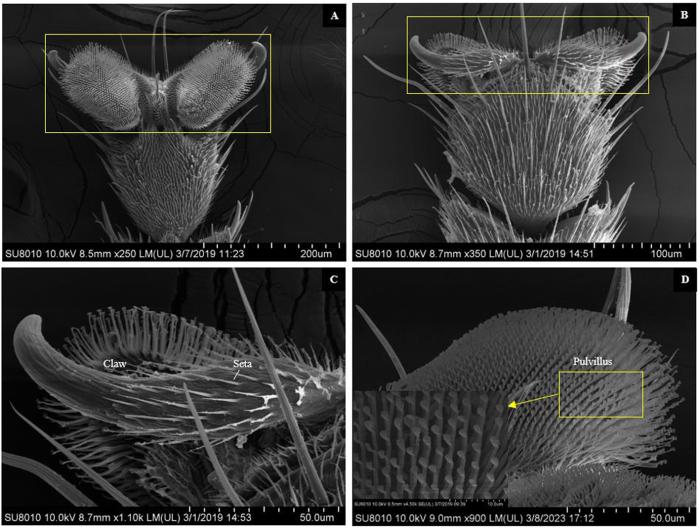
图4
大灰优蚜蝇雌虫前足前跗节扫描电镜图
注:A. 黄色框为前跗节的腹面图;B. 黄色框为前跗节的背面图;C. 位于前跗节背面的爪(claw)和刚毛(seta);D. 位于前跗节腹面的爪垫(puvillus)
Fig.4
Scanning electron micrographs of pretarsus in foreleg of female adults of E. corollae
Note: A. General view of ventral view of the pretarsus (yellow rectangular border); B. General view of back view of the pretarsus (yellow rectangular border); C. Claw and seta at the back side of the pretarsus; D. Puvillus at the ventral side of the pretarsus
3 讨论
3.1
相比大灰优蚜蝇触角感器[28],胸足感器的类型较少,未发现腔锥形感器、棒状感器、栓锥形感器、板形感器和感觉窝等感器类型,而是以毛形感器和锥形感器为主,大灰优蚜蝇足中主要以这两种感器中表达的神经元参与对产卵基质的识别。
青凤蝶Graphium sarpedon足跗节上顶端带孔的锥形感器中表达的神经元能够识别寄主植物挥发物[33]。此外,家蚕Bombyx mori雌虫足跗节毛形感器具孔,电生理结果显示桑叶提取物能够激活该感器中的神经元;雌虫的感器数量明显多于雄虫,毛形感器在家蚕雌成虫识别产卵位点的过程中发挥了关键作用[34]。研究发现大灰优蚜蝇足跗节的锥形感器呈指状,具钝尖,其中SB I亚型的顶部有小孔,其超微结构特征与上述昆虫足跗节上的感器相似,推测这一类具孔的锥形感器可能在大灰优蚜蝇雌虫产卵选择过程中具有重要的功能。此外,足上的锥形感器可能还参与对温度的感受。例如,黑腹果蝇中的一些锥形感器中的神经元可以感知环境中温度的变化,帮助果蝇寻找适宜的生存环境[35]。
3.2
Böhm氏鬃毛可控制昆虫的飞行速度,并能够感受外界重力变化,在昆虫降落时起到缓冲作用[36]。研究结果显示,大灰优蚜蝇足上分布着大量的Böhm氏鬃毛,可能同样具有机械感受的功能。刺形感器的基部具明显的臼状窝,表明该类感器可以活动,具有感受机械振动的功能,从而参与调节昆虫对产卵适宜场所的选择[37]。艺神袖蝶Heliconius erato的长刺形感器是典型的机械感受器,主要用于调整最佳的产卵角度[38]。在双翅目的埃及伊蚊Aedes aegypti中,足上的刺形感器能够探测产卵地点的理化性质,从而有助于选择合适的产卵位点[39]。大灰优蚜蝇胸足各跗分节的前侧和两侧均分布着刺形感器,具有典型的机械感器特征,可能参与感受胸足的相对运动和位置。此外,研究发现大灰优蚜蝇雌虫胸足各跗节前侧分布的刺形感器长度远超过其他感器,该感器类型在与产卵基质接触时最先发挥作用,从而调控产卵决策。研究发现表面无孔的毛形感器同样具有机械感受功能。例如,双翅目家蝇Musca domestica足跗节上表面无孔的毛形感器能够感受产卵环境中的机械刺激,在雌虫寻找适合产卵位点时能够提供重要信息[40]。基于此,大灰优蚜蝇跗足上的毛形感器可能也具有类似的功能。足上的微毛在昆虫清洁触角和产卵器的过程中起到关键作用[41],与大灰优蚜蝇雌虫梳理行为相类似,食蚜蝇足上的微毛感器参与了该过程。
3.3
由于果蝇与食蚜蝇同属于双翅目昆虫,因此果蝇的研究结果对探究大灰优蚜蝇足感器功能和产卵选择机制具有一定的指导和借鉴作用。对果蝇的研究显示,果蝇足上的感器根据功能类型划分为味觉感器和机械感器[42]。味觉感器包括刺形感器、栓锥形感器和腔锥形感器等,典型的特征是感器的末端有孔,该类型感器内通常具有4个味觉感受神经元和1个机械感受神经元[43]。研究发现黑腹果蝇足跗节上味觉感受神经元中表达的DmelIR76b和DmelIR25a能够识别产卵基质中的柠檬酸、乙酸和辛酸等多种酸类物质,进而调控果蝇的产卵行为[44]。果蝇足跗节第四和第五跗分节中味觉感受神经元表达的DmelGR32a能够识别幼虫信息素(Z)-9-十八烯酸乙酯,从而介导果蝇的产卵偏好[45]。另外,果蝇足上的机械感器包括刺形感器和毛形感器等,其形态特征为基部具可活动的臼状窝[42]。研究发现足跗节第三和第四跗分节机械感器内神经元表达的Nanchung、Inactive和DmelPiezo参与果蝇对产卵介质硬度的探测,以帮助果蝇选择合适的产卵位点[46]。根据模式昆虫果蝇的研究思路,后续仍需利用透射电镜进一步观察大灰优蚜蝇足上感器内部的超微结构,结合单感器记录技术以明确足感器内神经元的数量和功能。同时,利用转录组测序技术鉴定足跗节上表达的化学感受基因。
4 结论
大灰优蚜蝇雌虫足上共鉴定到了5种类型的感器,分别为毛形感器(2种亚型I~II)、锥形感器(3种亚型I~III)、刺形感器(2种亚型I~II)、微毛感器和Böhm 氏鬃毛。这些类型感器在足跗节上均有分布,胸足的跗节是大灰优蚜蝇主要的化学感受区域。其中锥形感器I亚型顶端具孔,在化学感受过程中发挥重要的作用。
参考文献
Combinatorial codes and labeled lines: how insects use olfactory cues to find and judge food, mates, and oviposition sites in complex environments
[J].
Insects, including those which provide vital ecosystems services as well as those which are devastating pests or disease vectors, locate their resources mainly based on olfaction. Understanding insect olfaction not only from a neurobiological but also from an ecological perspective is therefore crucial to balance insect control and conservation. However, among all sensory stimuli olfaction is particularly hard to grasp. Our chemical environment is made up of thousands of different compounds, which might again be detected by our nose in multiple ways. Due to this complexity, researchers have only recently begun to explore the chemosensory ecology of model organisms such as Drosophila, linking the tools of chemical ecology to those of neurogenetics. This cross-disciplinary approach has enabled several studies that range from single odors and their ecological relevance, via olfactory receptor genes and neuronal processing, up to the insects' behavior. We learned that the insect olfactory system employs strategies of combinatorial coding to process general odors as well as labeled lines for specific compounds that call for an immediate response. These studies opened new doors to the olfactory world in which insects feed, oviposit, and mate.
Insect olfactory communication in a complex and changing world
[J].Insect intraspecific olfactory communication occurs in a complex sensory environment. Here we present recent results on how the olfactory system extracts specific information from a sensory background, and integrates it with complementary information to improve odor source localization. Recent advances on mechanisms of olfactory mixture processing, multi-modal integration, as well as plasticity of sensory processing are reviewed. Significant progress in the understanding of neural coding and molecular bases of olfaction reinforce our perception of the tremendous adaptability of insects to a changing environment. However several reports demonstrate that anthropogenic environmental perturbations interfere with insect olfactory communication and might as a consequence significantly alter the functioning of ecosystems and agroecosystems.Copyright © 2020 Elsevier Inc. All rights reserved.
Drosophila sensory receptors-a set of molecular Swiss Army Knives
[J].Genetic approaches in the fruit fly, Drosophila melanogaster, have led to a major triumph in the field of sensory biology-the discovery of multiple large families of sensory receptors and channels. Some of these families, such as transient receptor potential channels, are conserved from animals ranging from worms to humans, while others, such as "gustatory receptors," "olfactory receptors," and "ionotropic receptors," are restricted to invertebrates. Prior to the identification of sensory receptors in flies, it was widely assumed that these proteins function in just one modality such as vision, smell, taste, hearing, and somatosensation, which includes thermosensation, light, and noxious mechanical touch. By employing a vast combination of genetic, behavioral, electrophysiological, and other approaches in flies, a major concept to emerge is that many sensory receptors are multitaskers. The earliest example of this idea was the discovery that individual transient receptor potential channels function in multiple senses. It is now clear that multitasking is exhibited by other large receptor families including gustatory receptors, ionotropic receptors, epithelial Na+ channels (also referred to as Pickpockets), and even opsins, which were formerly thought to function exclusively as light sensors. Genetic characterizations of these Drosophila receptors and the neurons that express them also reveal the mechanisms through which flies can accurately differentiate between different stimuli even when they activate the same receptor, as well as mechanisms of adaptation, amplification, and sensory integration. The insights gleaned from studies in flies have been highly influential in directing investigations in many other animal models.© The Author(s) 2021. Published by Oxford University Press on behalf of Genetics Society of America. All rights reserved. For permissions, please email: journals.permissions@oup.com.
Molecular principles of insect chemoreception
[J].Chemoreception, an ability to perceive specific chemical stimuli, is one of the most evolutionarily ancient forms of interaction between living organisms and their environment. Chemoreception systems are found in organisms belonging to all biological kingdoms. In higher multicellular animals, chemoreception (along with photo- and mechanoreception) underlies the functioning of five traditional senses. Insects have developed a peculiar and one of the most sophisticated chemoreception systems, which exploits at least three receptor superfamilies providing perception of smell and taste, as well as chemical communication in these animals. The enormous diversity of physiologically relevant compounds in the environment has given rise to a wide-ranging repertoire of chemoreceptors of various specificities. Thus, in insects, they are represented by several structurally and functionally distinct protein classes and are encoded by hundreds of genes. In the current review, we briefly characterize the insect chemoreception system by describing the main groups of receptors that constitute it and putting emphasis on the peculiar architecture and mechanisms of functioning possessed by these molecules.Copyright ® 2020 National Research University Higher School of Economics.
Olfactory receptor and circuit evolution promote host specialization
[J].
Neuronal mechanisms underlying innate and learned olfactory processing in Drosophila
[J].
Chemosensation and evolution of Drosophila host plant selection
[J].
Odor stimuli: not just chemical identity
[J].In most sensory modalities the underlying physical phenomena are well understood, and stimulus properties can be precisely controlled. In olfaction, the situation is different. The presence of specific chemical compounds in the air (or water) is the root cause for perceived odors, but it remains unknown what organizing principles, equivalent to wavelength for light, determine the dimensions of odor space. Equally important, but less in the spotlight, odor stimuli are also complex with respect to their physical properties, including concentration and time-varying spatio-temporal distribution. We still lack a complete understanding or control over these properties, in either experiments or theory. In this review, we will concentrate on two important aspects of the physical properties of odor stimuli beyond the chemical identity of the odorants: (1) The amplitude of odor stimuli and their temporal dynamics. (2) The spatio-temporal structure of odor plumes in a natural environment. Concerning these issues, we ask the following questions: (1) Given any particular experimental protocol for odor stimulation, do we have a realistic estimate of the odorant concentration in the air, and at the olfactory receptor neurons? Can we control, or at least know, the dynamics of odorant concentration at olfactory receptor neurons? (2) What do we know of the spatio-temporal structure of odor stimuli in a natural environment both from a theoretical and experimental perspective? And how does this change if we consider mixtures of odorants? For both topics, we will briefly summarize the underlying principles of physics and review the experimental and theoretical Neuroscience literature, focusing on the aspects that are relevant to animals' physiology and behavior. We hope that by bringing the physical principles behind odor plume landscapes to the fore we can contribute to promoting a new generation of experiments and models.Copyright © 2019 Pannunzi and Nowotny.
Plasticity and modulation of olfactory circuits in insects
[J].Olfactory circuits change structurally and physiologically during development and adult life. This allows insects to respond to olfactory cues in an appropriate and adaptive way according to their physiological and behavioral state, and to adapt to their specific abiotic and biotic natural environment. We highlight here findings on olfactory plasticity and modulation in various model and non-model insects with an emphasis on moths and social Hymenoptera. Different categories of plasticity occur in the olfactory systems of insects. One type relates to the reproductive or feeding state, as well as to adult age. Another type of plasticity is context-dependent and includes influences of the immediate sensory and abiotic environment, but also environmental conditions during postembryonic development, periods of adult behavioral maturation, and short- and long-term sensory experience. Finally, plasticity in olfactory circuits is linked to associative learning and memory formation. The vast majority of the available literature summarized here deals with plasticity in primary and secondary olfactory brain centers, but also peripheral modulation is treated. The described molecular, physiological, and structural neuronal changes occur under the influence of neuromodulators such as biogenic amines, neuropeptides, and hormones, but the mechanisms through which they act are only beginning to be analyzed.
Olfactory neurons and brain centers directing oviposition decisions in Drosophila
[J].
Olfactory encoding within the insect antennal lobe: the emergence and role of higher order temporal correlations in the dynamics of antennal lobe spiking activity
[J].
The role of the Drosophila lateral horn in olfactory information processing and behavioral response
[J].Animals must rapidly and accurately process environmental information to produce the correct behavioral responses. Reactions to previously encountered as well as to novel but biologically important stimuli are equally important, and one understudied region in the insect brain plays a role in processing both types of stimuli. The lateral horn is a higher order processing center that mainly processes olfactory information and is linked via olfactory projection neurons to another higher order learning center, the mushroom body. This review focuses on the lateral horn of Drosophila where most functional studies have been performed. We discuss connectivity between the primary olfactory center, the antennal lobe, and the lateral horn and mushroom body. We also present evidence for the lateral horn playing roles in innate behavioral responses by encoding biological valence to novel odor cues and in learned responses to previously encountered odors by modulating neural activity within the mushroom body. We describe how these processes contribute to acceptance or avoidance of appropriate or inappropriate mates and food, as well as the identification of predators. The lateral horn is a sexually dimorphic and plastic region of the brain that modulates other regions of the brain to ensure that insects produce rapid and effective behavioral responses to both novel and learned stimuli, yet multiple gaps exist in our knowledge of this important center. We anticipate that future studies on olfactory processing, learning, and innate behavioral responses will include the lateral horn in their examinations, leading to a more comprehensive understanding of olfactory information relay and resulting behaviors.Copyright © 2016 Elsevier Ltd. All rights reserved.
Comparison of the antennal sensilla and compound eye sensilla in four Drosophila (Diptera: Drosophilidae) species
[J].
Scanning electron microscopic studies on antenna of Hemipyrellia ligurriens (Wiedemann, 1830) (Diptera: Calliphoridae)—a blow fly species of forensic importance
[J].
Characterization of antennal chemosensilla and associated odorant binding as well as chemosensory proteins in the Eupeodes corollae (Diptera: Syrphidae)
[J].
A dual-target molecular mechanism of pyrethrum repellency against mosquitoes
[J].
Types and numbers of sensilla on antennae and maxillary palps of small and large houseflies, Musca domestica (Diptera, Muscidae)
[J].Houseflies, Musca domestica, obtained from a high-larval-density culture were significantly (ca. 1.5 times) smaller than those from a low-larval-density culture. The same held true for their antennae and maxillary palps. Structure, number, and distribution of sensilla on antennae and palps of small and large flies were investigated using Scanning electron microscopy and Transmission electron microscopy. In each funiculus three pits were present, two (Type I) consisting of several compartments and one (Type II) of one compartment. Four types of olfactory sensilla were detected: trichoid sensilla on the funiculi, basiconic sensilla on funiculi and palps, grooved sensilla on funiculi and in pits Type I, and clavate sensilla on funiculi and in pits Type II. Type I pits also contained striated sensilla (presumably hygroreceptors). Mechanosensory bristles were present on scapes, pedicels, and palps. Noninnervated microtrichia were found on the palps and all antennal segments. The large houseflies possessed nearly twice as much sensilla as the small flies. So far, we did not observe differences in behavior between small and large flies. We assumed that small flies, being olfactory less equipped than large flies, may be able to compensate for this by, e.g., visual cues or by their olfactory sensilla being more sensitive than those of large flies. To be able to answer these questions careful studies have to be done on the behavioral responses of small and large flies to environmental stimuli. In addition, electrophysiological studies should be performed to reveal whether the responses of individual sensilla of flies reared under different conditions have been changed.2008 Wiley-Liss, Inc.
Gr64f is required in combination with other gustatory receptors for sugar detection in Drosophila
[J].
Avoiding DEET through insect gustatory receptors
[J].DEET is the most widely used insect repellent worldwide. In Drosophila olfactory receptor neurons (ORNs), DEET is detected through a mechanism employing the olfactory receptor, OR83b. However, it is controversial as to whether ORNs respond directly to DEET or whether DEET blocks the response to attractive odors. Here, we showed that DEET suppressed feeding behavior in Drosophila, and this effect was mediated by gustatory receptor neurons (GRNs). DEET was potent in suppressing feeding as <0.1% DEET elicited aversive behavior. Inhibition of feeding required multiple gustatory receptors (GRs) expressed in inhibitory GRNs. DEET stimulated action potentials in GRNs that respond to aversive compounds, and this response was lost in the Gr32a, Gr33a, and Gr66a mutants. Since 0.02% DEET elicited action potentials, we conclude that DEET directly activates of GRNs. We suggest that the effectiveness of DEET in pest control owes to its dual action in inducing avoidance simultaneously via GRNs and ORNs.2010 Elsevier Inc. All rights reserved.
Nutrient sensors
[J].
A Drosophila gustatory receptor essential for aversive taste and inhibiting male-to-male courtship
[J].
Taste discriminating capability to different bitter compounds by the larval styloconic sensilla in the insect herbivore Papilio hospiton (Géné)
[J].
Tarsal taste neurons of Helicoverpa assulta (Guenée) respond to sugars and amino acids, suggesting a role in feeding and oviposition
[J].
Tarsal taste neuron activity and proboscis extension reflex in response to sugars and amino acids in Helicoverpa armigera (Hubner)
[J].
The molecular and cellular basis of taste coding in the legs ofDrosophila
[J].
Flower visitation by hoverflies (Diptera: Syrphidae) in a temperate plant-pollinator network
[J].
Non-bee insects are important contributors to global crop pollination
[J].Wild and managed bees are well documented as effective pollinators of global crops of economic importance. However, the contributions by pollinators other than bees have been little explored despite their potential to contribute to crop production and stability in the face of environmental change. Non-bee pollinators include flies, beetles, moths, butterflies, wasps, ants, birds, and bats, among others. Here we focus on non-bee insects and synthesize 39 field studies from five continents that directly measured the crop pollination services provided by non-bees, honey bees, and other bees to compare the relative contributions of these taxa. Non-bees performed 25-50% of the total number of flower visits. Although non-bees were less effective pollinators than bees per flower visit, they made more visits; thus these two factors compensated for each other, resulting in pollination services rendered by non-bees that were similar to those provided by bees. In the subset of studies that measured fruit set, fruit set increased with non-bee insect visits independently of bee visitation rates, indicating that non-bee insects provide a unique benefit that is not provided by bees. We also show that non-bee insects are not as reliant as bees on the presence of remnant natural or seminatural habitat in the surrounding landscape. These results strongly suggest that non-bee insect pollinators play a significant role in global crop production and respond differently than bees to landscape structure, probably making their crop pollination services more robust to changes in land use. Non-bee insects provide a valuable service and provide potential insurance against bee population declines.
Morphological and ultrastructural characterization of antennal sensilla and the detection of floral scent volatiles in Eupeodes corollae (Diptera: Syrphidae)
[J].
Molecular basis of (E)-β-farnesene-mediated aphid location in the predator Eupeodes corollae
[J].
Antennal sensilla of some aphidophagous Syrphidae (Diptera): fine structure and electroantennogramme study
[J].
Morphometry and distribution of sensilla on the antennae of Anastrepha fraterculus (Wiedemann) (Diptera: Tephritidae)
[J].Antennal sensilla of Anastrepha fraterculus (Wied.) were examined using scanning electron microscopy. In the flagellum, there are trichoid, basiconic, clavate type I and II, and styloconic sensilla and microtrichia. Only microtrichiae and chaetica sensilla were observed in the scape and pedicel. The number of sensilla in the flagellum was similar between sexes. At the apex there was a higher density of trichoid and an absence of clavate sensilla, while basiconic sensilla were more abundant in the proximal region.
Ultrastructural morphology of the antenna and maxillary palp of Sarcophaga tibialis (Diptera: Sarcophagidae)
[J].A scanning electron microscopy investigation of the antenna and maxillary palp of the adult of Sarcophaga tibialis Macquart (Diptera: Sarcophagidae), a species of medical, veterinary, and forensic relevance, is presented for the first time. Adults of both sexes used in this study were obtained from larvae collected in a case of traumatic myiasis in a domestic cat in northern Italy. The antenna of S. tibialis is that typical of cyclorrhaphan Diptera, consisting of three segments: the scape, the pedicel, and the postpedicel, bearing the arista. The scape is covered by microtrichia and has a row of long chaetic sensilla. The pedicel is also covered by microtrichia and has three types of chaetic sensilla and a cluster of setiferous plaques. Trichoid, styloconic, clavate, and basiconic sensilla are distributed among the microtrichia on the postpedicel. Invaginated basiconic-like sensilla and olfactory pits are also present, the latter ones more numerous in the female. Our results are compared with those obtained for other calyptrate flies, mainly in the family Sarcophagidae. The data obtained may represent a basis for electrophysiological studies on the sensorial activity of the species related to the search for food sources, mates, and suitable larviposition sites, and for comparative morphological studies with other Diptera.© The Authors 2016. Published by Oxford University Press on behalf of Entomological Society of America. All rights reserved. For Permissions, please email: journals.permissions@oup.com.
Scanning electron microscopic studies of the external morphology of sensilla on the legs of a butterfly, Graphium sarpedon (Lepidoptera—Papillionidae)
[J].
Morphological and electrophysiological differences in tarsal chemosensilla between the wild silkmoth Bombyx mandarina and the domesticated species Bombyx mori
[J].
A gustatory receptor paralogue controls rapid warmth avoidance in Drosophila
[J].
Morphology and distribution of sensilla on tarsi and ovipositors of six fruit flies (Diptera: Tephritidae)
[J].
Sensing the plant surface prior to feeding and oviposition: differences in external ultrastructure and function among tarsi of Heliconius erato
[J].Adult foretarsi of Heliconius erato Linnaeus (Lepidoptera, Nymphalidae) are reduced in size and are not used for walking. Foretarsi of the female have specialized sensilla that are presumably used to identify the host plant, by drumming. The mid- and hind tarsi also bear sensilla in both sexes, but these have not been described in detail, nor has their chemosensory function been determined. We described and compared the tarsi of H. erato under light and scanning electron microscopy. Behavioral experiments showed that differences in the shape, number, and size of sensilla were related to feeding and oviposition behaviors. Two types of sensillum (chaeticum and trichodeum) were found in similar numbers and size on the mid- and hind tarsi of both sexes. Sensilla on the female foretarsi act in host-plant site selection, strongly affecting oviposition rates when isolated. Male foretarsi lack sensilla, which may have been selected against due to the absence of function and thus lost. Sensilla on the mid- and hind tarsi are involved in sugar detection in both sexes, responding to an effective dose of sucrose (ED) near 0.01 M, and therefore might be used to identify food resources when the butterflies settle on flowers.
Fine structure of tarsal sensilla of Aedes aegypti (L.) (Diptera: Culicidae)
[J].The tarsi of all three pairs of legs of both sexes of Aedes aegypti (L.) bear spine sensilla, five types of hair sensilla, which are designated A, B, C1, C2 and C3, and campaniform sensilla. Type A and B hairs, spines, and cam-paniform sensilla are innervated by one neuron with a tubular body, a characteristic of cuticular mechanoreceptors. In particular the hairs and spines are tactile receptors and the campaniform sensilla are proprioceptors. The C1, C2, and C3 hair sensilla have the morphological features of contact chemoreceptors. Type C1 and C3 hairs are innervated by five and four neurons, respectively, which extend to the tip of the hair. Type C2 is innervated by five neurons, one of which terminates at the base of the hair in a tubular body while the remaining four extend to the tip of the hair. The role of the type C hairs in oviposition behavior, nectar feeding, and recognition of conspecific females is discussed. Presumed efferent neurosecretory fibers occur near the spine and hair sensilla.Copyright © 1978 Wiley-Liss, Inc.
雌家蝇产卵器和足上感受器的形态学研究
[J].目的 从形态学上观察分析雌家蝇产卵器和足上与产卵基质选择行为相关的感受器。方法 利用扫描电镜对雌家蝇的产卵器和足进行超微结构观察。结果 雌家蝇的产卵器和足上存在6种形态的感受器,包括感受鬃、刺形感受器、毛形感受器、锥形感受器、腔形感受器和腔锥形感受器。其中,感受鬃、刺形感受器和毛形感受器分布最广泛,其次是锥形感受器、腔形感受器和腔锥形感受器。感受鬃毛体伸展方向与体表的夹角较大。毛形感受器与体表连接膜的分节可见或不可见。第5腹节上的刺形感受器长300~700 μm,而足上的刺形感受器长度不超过120 μm。肛下板上的锥形感受器着生在臼状窝内,端部稍微变细、较钝;而足跗节上的锥形感受器基部不具有臼状窝,端部突变尖细。在中足胫节基部有一腔形感受器密集的区域。在左侧肛尾叶末端有一腔锥形感受器。结论 家蝇可能通过这些感受器的感受作用,获取产卵基质的机械和湿度信息,对产卵行为进行调节。
Morphological study of the sensilla on ovipositors and legs of female houseflies
[J].<p>Objective To analyze the morphological characteristics of the receptors on ovipositors and legs related to the selection of oviposition substrates in female houseflies. Methods Ultrastructural observation of ovipositors and legs of female houseflies was performed under a scanning electron microscopy. Results Six receptors of different morphologies were found on the ovipositors and legs of female houseflies, including bristle sensilla, styliform sensilla, trichoid sensilla, basiconic sensilla, cavity sensilla and coeloconic sensilla. Among them, they were mostly presented on bristle, styliform and trichoid sensilla, followed by basiconic, cavity and coeloconic ones. The bristle sensilla formed a large angle between its stretch direction and the surface. Segmentation of the surface junctional membrane of trichoid sensilla could be seen or not. The length of the styliform sensilla on the 5th abdominal segment was 300-700 μm, while those on the legs no more than 120 μm. The basiconic sensilla under the hypopygium were inserted in the cotyloid cavity, the ends slightly thin and blunt; and those on the hindtarsus did not have such basal cavity, suddenly tapering at the ends. In the tibial base of the mid legs there were cavity sensilla?intensive areas. At the end of the left cerci was a coeloconic sensillum. Conclusion It is implied that houseflies regulate their oviposition behaviors according to the mechanical and humidity information of oviposition substrates detected by the sensitization of these sensilla.</p>
Description of the antennal sensilla of Habrobracon hebetor
[J].
The organization of the chemosensory system in Drosophila melanogaster: a review
[J].This review surveys the organization of the olfactory and gustatory systems in the imago and in the larva of Drosophila melanogaster, both at the sensory and the central level. Olfactory epithelia of the adult are located primarily on the third antennal segment (funiculus) and on the maxillary palps. About 200 basiconic (BS), 150 trichoid (TS) and 60 coeloconic sensilla (CS) cover the surface of the funiculus, and an additional 60 BS are located on the maxillary palps. Males possess about 30% more TS but 20% fewer BS than females. All these sensilla are multineuronal; they may be purely olfactory or multimodal with an olfactory component. Antennal and maxillary afferents converge onto approximately 35 glomeruli within the antennal lobe. These projections obey precise rules: individual fibers are glomerulus-specific, and different types of sensilla are associated with particular subsets of glomeruli. Possible functions of antennal glomeruli are discussed. In contrast to olfactory sensilla, gustatory sensilla of the imago are located at many sites, including the labellum, the pharynx, the legs, the wing margin and the female genitalia. Each of these sensory sites has its own central target. Taste sensilla are usually composed of one mechano- and three chemosensory neurons. Individual chemosensory neurons within a sensillum respond to distinct subsets of molecules and project into different central target regions. The chemosensory system of the larva is much simpler and consists essentially of three major sensillar complexes on the cephalic lobe, the dorsal, terminal and ventral organs, and a series of pharyngeal sensilla.
昆虫味觉研究进展及相关原理在害虫防治中的应用
[J].
Progress in insect gustatory research and the application of related principles to pest control
[J].
Ionotropic receptors mediate Drosophila oviposition preference through sour gustatory receptor neurons
[J].Carboxylic acids are present in many foods, being especially abundant in fruits. Yet, relatively little is known about how acids are detected by gustatory systems and whether they have a potential role in nutrition or provide other health benefits. Here we identify sour gustatory receptor neurons (GRNs) in tarsal taste sensilla of Drosophila melanogaster. We find that most tarsal sensilla harbor a sour GRN that is specifically activated by carboxylic and mineral acids but does not respond to sweet- and bitter-tasting chemicals or salt. One pair of taste sensilla features two GRNs that respond only to a subset of carboxylic acids and high concentrations of salt. All sour GRNs prominently express two Ionotropic Receptor (IR) genes, IR76b and IR25a, and we show that both these genes are necessary for the detection of acids. Furthermore, we establish that IR25a and IR76b are essential in sour GRNs of females for oviposition preference on acid-containing food. Our investigations reveal that acids activate a unique set of taste cells largely dedicated to sour taste, and they indicate that both pH/proton concentration and the structure of carboxylic acids contribute to sour GRN activation. Together, our studies provide new insights into the cellular and molecular basis of sour taste.Copyright © 2017 Elsevier Ltd. All rights reserved.
Cross-generation pheromonal communication drives Drosophila oviposition site choice
[J].
Parallel mechanosensory pathways direct oviposition decision-making in Drosophila
[J].


