

0 引言
【研究意义】新疆盐渍化土壤分布广泛,约占全国盐渍化面积36.80%[1],新疆北疆由于冬季降雪的淋洗作用,已普遍适应了“干播湿出”的出苗方式;而南疆干旱少雨,冬季降雪量少,目前仍普遍采用冬灌进行盐分淋洗。在实际生产中冬灌用水量较大,且尚存在农田“重灌轻排”现象[2],与此同时,当地下水矿化度较高时,地下水在土壤毛管作用下盐分上移,容易导致土壤盐渍化[3⇓-5],因此灌排协同是治理土壤次生盐渍化的关键。【前人研究进展】冬灌是应对土壤盐渍化的有效措施,具有蓄水保墒、降低土壤盐分、平抑地温、疏松土壤等优势,可为作物生长创造良好的水土环境[6⇓⇓⇓-10]。随着节水灌溉面积增加,田间明沟被平整,造成田间排水不畅。暗管排水是实现灌排协同的重要途径,比传统的明沟节水节地[11],目前,对暗管下水盐运移、滤料结构、排水参数模拟和优化的研究较多,也有相关结论[12⇓⇓⇓⇓⇓-18]。【本研究切入点】新疆南疆盐渍化土壤面积较大,棉花种植面积亦较大,以往大多数研究主要集中在冬灌定额和方式对土壤水盐及次年作物长势上。通过测箱进行不同埋深下控制性水盐运移试验,将冬灌和控制排水相结合,探究新疆南疆灌区灌排相互作用下的水盐调控研究却鲜有报道。需探究灌排协同下冬灌对盐碱土壤的水盐调控效应。【拟解决的关键问题】在新疆巴音郭楞蒙古自治州(简称巴州)灌溉试验站设置的测箱原位试验,研究灌排协同下冬灌期地下水埋深与灌水方式对土壤水盐动态的运移机理,分析不同地下水埋深和灌水方式对土壤水盐分布特征及棉花苗期长势的影响,为灌区非生育期水盐调控模式的改进提供理论依据。
1 材料与方法
1.1 材料
图1

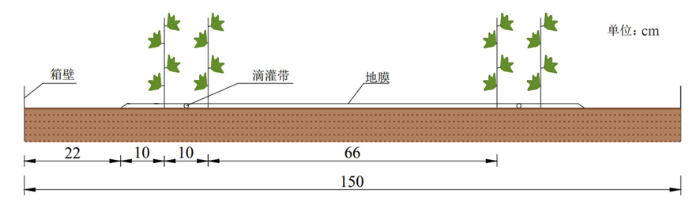
供试棉花品种为新陆中67号,种植方式为1膜2管4行,棉花采用夹带播种,株行距与大田相当,行距10 cm+66 cm+10 cm,株距8 cm,滴灌带为内镶贴片式,滴头流量2.2 L/h,滴头间距30 cm。
1.2 方法
1.2.1 试验设计
试验为2种地下水埋深G1(2 m)、G2(3 m)和2种灌水方式W1(冬灌)、W2(非冬灌),地下水位使用马氏瓶控制,以补给潜水蒸发和排出下渗水量。共设4个处理(G1W1、G1W2、G2W1、G2W2),土壤填装前均已过2 mm筛,土壤为分层填装,容重控制为1.54 g/cm3,使土壤结构保持一致,每个试验处理重复1组。冬灌于2022年11月2日进行,灌水量参照大田2 100 m3/hm2的定额控制进行。试验时间为2022年10月1日~2023年6月20日,其中10月1日~翌年4月5日为剖面水盐运移阶段,4月6日~6月20日为作物苗期生长阶段。冬灌和生育期灌溉均为河水,电导率在800~1 000 μs/cm。表1
表1 不同地下水埋深和灌水方式水盐调控试验设计
Tab.1
| 灌水方式 Irrigation method | 地下水位 Groundwater depth(m) | 冬灌定额 Winter irrigation quota(mm) | 翌年滴水 出苗定额 The following year's drip quota (mm) |
|---|---|---|---|
| 冬灌 Winter irrigation | 2 | 210 | 67.50+15 |
| 非冬灌 Non-winter irrigation | 2 | 0 | 67.50+45 |
| 冬灌 Winter irrigation | 3 | 210 | 67.50+15 |
| 非冬灌 Non-winter irrigation | 3 | 0 | 67.50+45 |
通过测箱种植棉花可评估不同处理对作物的生长效应。各处理均采用滴水出苗的方式,滴水出苗水量为67.50 mm,出苗后非冬灌处理补水45 mm、冬灌处理补水15 mm,并配合施加生物菌肥(15 kg/hm2)和矿源黄腐酸钾(7.50 kg/hm2)以避免棉花苗期盐害。图2
图2
1.2.2 测定指标
1.2.2.1 土壤水盐
冬灌期分别在冬灌前(11月1日)、冬灌后(11月7日)、翌年4月4日春播前使用土钻采集0~5、5~10、10~20、20~30、30~40、40~60、60~80和80~100 cm土壤样品。每个小区各重复4次,利用烘干法测定土壤质量含水率,并使用DDSJ-308A(上海仪电)电导率仪测定土壤浸取液(土水比1∶5)电导率值。
1.2.2.2 土壤温度、地下水位、排水电导率
土壤温度采用国产智墒ET100监测,监测时间间隔为1 h,监测深度为0~100 cm,垂向监测间距为10 cm;地下水位用玻璃管由箱壁橡皮塞连通测箱内部以观测地下水位;排水量由容器收集后称重获得,并同步测量其电导率。
1.2.2.3 棉花出苗率及苗蕾期生长指标
棉花出苗后每3 d统计1次出苗率,将第3次统计值作为出苗率指标。每个小区随机选取能代表棉花生长水平的5株棉花测量相关指标,茎粗采用“十字交叉法”在距地上2 cm处用电子游标卡尺测量(精度为0.01 mm)。
1.2.2.4 计算
土壤电导率转化为土壤全盐量计算公式为[20]:
式中,C为土壤全盐量( g/kg);
排水电导率(EC)和全盐量(Cw)计算公式为[21]:
式中,
土壤脱盐率为土壤剖面在灌溉后某一时刻与灌溉前相比土壤含盐量的减少率,计算式为:
式中,ω 是土壤脱盐率(%);S0 为灌溉前土壤含盐量( g/kg),St 为灌溉后土壤含盐量( g/kg)。
土壤积盐率为土壤剖面某一时刻与其前一时刻相比土壤含盐量的增加率,计算公式为:
式中,t是土壤积盐率(%);Wi是第i时刻土壤含盐量( g/kg);
根据测得的各土层含盐量,第j次取样时第i层土壤储盐量计算公式[22]为:
式中,
前后2次取样时段内土壤储盐量的变化量为:
式中,
一维水盐运动条件下的各土层盐分满足均衡关系,土层内储盐量的变化量与其流入流和出量之差相等,故有[22]下式成立:
式中,
2 结果与分析
2.1 冬灌与非冬灌土壤冻融变化特征
研究表明,由于冬灌水温低于土壤温度,冬灌后土壤温度降幅大于非冬灌土壤。0~100 cm土层冬灌前一周到冬灌后一周的温度降幅(2.14~2.70℃)大于同一时期非冬灌土壤(1.77~2.11℃)。冬灌可提高土壤热容量,随着气温降低,气温对冬灌后土壤温度的影响程度低于非冬灌土壤。在灌后第1周到第2周、第2周到第3周0~100 cm土温降幅(1.53~4.33℃和1.81~2.22℃)小于非冬灌土温降幅(1.63~4.63℃和2.01~2.33℃),使得冬灌土壤的冻融循环时间滞后且持续时间比非冬灌土壤短。图3
图3

图3
各层土壤平均温度随时间的变化
Fig.3
Changes of the average soil temperature of each layer changes with time
土壤冻融过程随着土层深度的增加表现出一定的滞后效应,滞后时间随土层深度增加而增加。根据土壤日最高温度Tmax与日最低温度Tmin,将土壤在冬春季冻融过程分为不同阶段。冬季日冻融循环阶段(Tmax>0℃>Tmin),此时气温逐渐降低,直到完全冻结阶段(0℃>Tmax>Tmin),春季气温回暖,土壤经历春季日消融循环阶段(Tmax>0℃>Tmin)。冻融循环区域主要在0~20 cm土层,随着土层深度增加,日间温差逐渐变小。土壤冬季日冻融循环和春季日消融循环发生在土壤0~20 cm土层区,且在时间上冬灌滞后于非冬灌;其中,冬季0~10 cm土层冻融交替作用持续时间比非冬灌短8 d;春季0~20 cm土层经历了日消融循环,10 cm土层冻融交替作用持续时间比非冬灌短13 d,20 cm土层处短5 d。图4
图4

图4
日最高温度和最低温度随时间的变化
Fig.4
Changes of daily maximum and minimum temperatures vary with time
冬灌和非冬灌土壤在不同土层冻结和消融过程存在不同的差异,在土壤完全冻结时间上,不同土层深度冬灌滞后非冬灌0~5 d,土壤自上向下冻结。土壤消融过程中冬灌土壤上层(0 cm)和下层(100 cm)处先消融,中间(30~40 cm)最后消融;非冬灌土壤自然而下消融。表2
表2 土壤冻融持续时间
Tab.2
| 土壤深度 Soil depth (cm) | 灌水方式 Irrigation method | 冬季日冻融循环 Winter daily freeze-thaw cycle | 完全冻结期 Complete freezing period | 春季日消融循环 Spring diurnal ablation cycle | |||
|---|---|---|---|---|---|---|---|
| 起止日期 Start-stop date (M/D) | 持续时间 Duration(d) | 起止日期 Start-stop date (M/D) | 持续时间 Duration(d) | 起止日期 Start-stop date (M/D) | 持续时间 Duration(d) | ||
| 10 | 冬灌 | 11/26~11/28 | 3 | 11/29~翌年2/19 | 83 | 翌年2/20~2/26 | 7 |
| 非冬灌 | 11/18~11/28 | 11 | 11/29~翌年2/06 | 70 | 翌年2/07~2/26 | 20 | |
| 20 | 冬灌 | 11/30~翌年2/22 | 85 | 翌年2/23~2/25 | 3 | ||
| 非冬灌 | 11/29~翌年2/10 | 74 | 翌年2/11~2/18 | 8 | |||
| 30 | 冬灌 | 12/04~翌年2/25 | 84 | ||||
| 非冬灌 | 11/30~翌年2/15 | 78 | |||||
| 40 | 冬灌 | 12/07~翌年2/25 | 81 | ||||
| 非冬灌 | 12/02~翌年2/15 | 76 | |||||
| 60 | 冬灌 | 12/14~翌年2/23 | 72 | ||||
| 非冬灌 | 12/11~翌年2/16 | 68 | |||||
| 80 | 冬灌 | 12/22~翌年2/21 | 62 | ||||
| 非冬灌 | 12/22~翌年2/16 | 57 | |||||
| 100 | 冬灌 | 12/28~翌年2/18 | 53 | ||||
| 非冬灌 | 12/28~翌年2/17 | 52 | |||||
2.2 不同地下水埋深下冬灌与非冬灌土壤水盐迁移特征
研究表明,2 m埋深较3 m先排水,排水量分别占灌溉水量的57%和33%。在淋洗过程中,灌水溶滤盐分向下运移,排水的电导率随时间不断变大,排水累积量呈指数函数分布。2 m埋深开始排水的时间早于3 m埋深,同时2 m埋深排水的电导率升高较快,土壤盐分得到了淋洗,鉴于两个处理间土壤盐分含量相当,3 m埋深下土壤盐分淋洗程度低于2 m,淋洗的盐分主要储存在土壤下部中。图5
图5
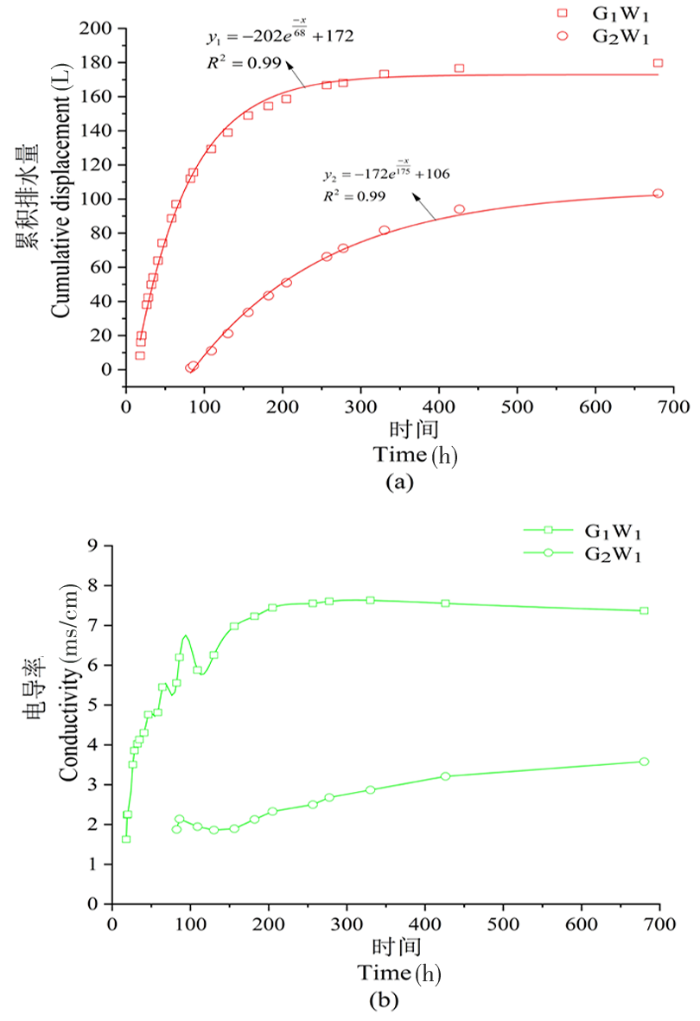
图5
不同埋深下冬灌排水水量与盐分动态过程
Fig.5
Dynamic process of drainage quantity and salinity of winter irrigation under different buried depths
冬灌能有效淋洗土壤中的盐分,冬灌后,盐分在土壤中重新分布,0~60 cm土层盐分减少,60~100 cm土层盐分增加。2和3 m埋深在0~60 cm土层平均脱盐率为35.36%和43.42%,60~100 cm土层平均积盐率为7.71%和8.01%。
土壤在经历冬-春季的冻融、消融循环过程中,盐分在温度势的作用下以上升为主。到翌年耕作前,大气蒸发势的作用逐渐增强,此时盐分易在表层集聚。非冬灌土壤0~20 cm盐分达到了19.23和15.8 g/kg,属中度盐土;冬灌2和3 m埋深0~20 cm盐分达到7.28和5.68 g/kg,则属轻度盐土,盐分在表层的聚集差异显著。图6
图6
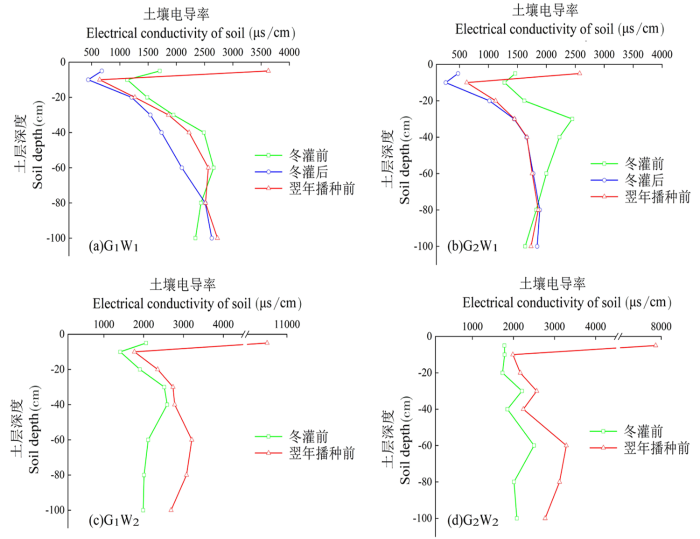
图6
冬灌前-翌年播种前盐分剖面动态的变化
Fig.6
Changes of dynamic change of salt profile from winter irrigation to sowing in the next year
2.3 地下水埋深与灌水方式共同作用下盐分变化
研究表明,各阶段盐分迁移方向与土壤水的运动方向一致,灌水时盐分整体向下移动,在非灌水期,盐分随潜水蒸发向上运动。
表3 各处理不同土层盐分通量
Tab.3
| 盐分通量 边界 Salt flux boundary (cm) | G1W1 | G1W2 | G2W1 | G2W2 | ||
|---|---|---|---|---|---|---|
| 冬灌前至 冬灌后 Before and after winter irrigation | 冬灌后至 翌年4月初 After winter irrigationuntil early April of the following year | 冬灌前至 翌年4月初 Before winter irrigation until early April of the following year | 冬灌前至 冬灌后 Before and after winter irrigation | 冬灌后至 翌年4月初 After winter irrigation until early April of the following year | 冬灌前至 翌年4月初 Before winter irrigation until early April of the following year | |
| 0 | -149.10 | 0.00 | 0.00 | -149.10 | 0.00 | 0.00 |
| 5 | -180.06 | 88.97 | 254.87 | -172.91 | 66.45 | 183.65 |
| 10 | -200.92 | 95.07 | 265.65 | -194.53 | 80.43 | 189.68 |
| 20 | -217.56 | 98.53 | 292.60 | -224.97 | 86.90 | 215.82 |
| 30 | -242.28 | 117.91 | 305.79 | -285.50 | 87.24 | 237.49 |
| 40 | -287.59 | 147.38 | 317.11 | -319.82 | 87.58 | 260.90 |
| 60 | -355.66 | 203.97 | 449.22 | -347.26 | 85.44 | 355.64 |
| 80 | -346.53 | 204.49 | 578.01 | -339.92 | 82.33 | 489.50 |
| 100 | -311.75 | 216.67 | 662.39 | -314.91 | 69.53 | 572.53 |
| 100处 盐分净通量 Net salt flux at 100 | -95.08 | 662.39 | -245.38 | 572.53 | ||
注:0 cm为冬灌灌水引入的盐分,盐分通量向下为负,向上为正
Notes: 0 cm is the salt introduced by winter irrigation, and salt flux is negative downward and positive upward
表4 不同处理各时期盐储量变化
Tab.4
| 盐储量 变化范围 Salt flux boundary (cm) | G1W1 | G1W2 | G2W1 | G2W2 | ||
|---|---|---|---|---|---|---|
| 冬灌前至 冬灌后 Before and after winter irrigation | 冬灌后至 翌年4月初 After winter irrigationuntil early April of the following year | 冬灌前至 翌年4月初 Before winter irrigation until early April of the following year | 冬灌前至 冬灌后 Before and after winter irrigation | 冬灌后至 翌年4月初 After winter irrigation until early April of the following year | 冬灌前至 翌年4月初 Before winter irrigation until early April of the following year | |
| 0~5 | -30.96 | 88.97 | 254.87 | -23.81 | 66.45 | 183.65 |
| 5~10 | -20.86 | 6.10 | 10.78 | -21.62 | 13.98 | 6.03 |
| 10~20 | -16.63 | 3.46 | 26.95 | -30.44 | 6.47 | 26.14 |
| 20~30 | -24.73 | 19.38 | 13.19 | -60.53 | 0.33 | 21.67 |
| 30~40 | -45.30 | 29.48 | 11.32 | -34.32 | 0.35 | 23.40 |
| 40~60 | -68.07 | 56.58 | 132.11 | -27.44 | -2.14 | 94.74 |
| 60~80 | 9.13 | 0.53 | 128.79 | 7.34 | -3.11 | 133.86 |
| 80~100 | 34.78 | 12.18 | 84.38 | 25.01 | -12.80 | 83.03 |
| 100至 地下水位 100 cm to the water table | -461.58 | -201.19 | -637.95 | 136.91 | -67.68 | -556.07 |
| 排水盐量 The amount of salt contained in the drain water | 773.33 | 0.00 | 0.00 | 178.00 | 0.00 | 0.00 |
| 补水盐量 The amount of salt contained in the make-up water | 0.00 | -15.48 | -24.44 | 0.00 | -1.85 | -16.46 |
| 灌水盐量 The amount of salt contained in irrigation water | -149.10 | 0.00 | 0.00 | -149.10 | 0.00 | 0.00 |
将1 m土层按0~20 cm、20~60 cm、60~100 cm分为三个区域,0~20 cm是盐分易聚集区和种子萌发区,20~60 cm是耕作及根系生长区。60~100 cm是水盐运移的过渡区,此处盐分的稳定有利于耕作区土壤安全。冬灌前到播种前,在0~20 cm,冬灌返盐量小于非冬灌处理;在20~60 cm,不同埋深的冬灌均脱盐,非冬灌则积盐;在60~100 cm,各处理均有不同程度的积盐,非冬灌积盐量大于冬灌。图7
图7

图7
冬灌前至翌年耕作前不同土层区域储盐量的变化
Fig.7
Changes of salt storage in different soil layers before winter irrigation and before tillage in the next year g
2.4 不同埋深下冬灌与非冬灌对棉花苗期生长的影响
研究表明,冬灌与非冬灌相比,平均出苗率、株高、茎粗、叶片数分别增加了33.03%、55.16%、25.56%和24.60%。非冬灌下2 m埋深苗期根层含水率显著大于3m,对苗期根层电导率、出苗率和生长指标则无显著差异;冬灌对不同埋深各指标均无显著差异。
地下水位对根层含水率和苗期株高有极显著影响(P<0.01),2 m埋深苗期根层含水率大于3 m埋深。灌水方式与地下水位交互作用对棉花出苗率有极显著影响(P<0.01),冬灌2 m埋深出苗率最好,非冬灌2 m埋深出苗率最差。表5
表5 不同埋深与灌水处理棉花出苗率及苗期植株生长
Tab.5
| 灌水方式 Irrigation method | 地下水 埋深 Groun- dwater depth (m) | 根层电导率 Root layer conductivity (ms/cm) | 根层含水率 Root layer moisture content (%) | 出苗率 Emergence rate (%) | 株高 Plant height (cm) | 茎粗 Stem diameter (mm) | 叶片数 Number of blades (片/株) |
|---|---|---|---|---|---|---|---|
| 冬灌 Winter irrigation | 2 | 1.85±0.67a | 10.55±1.65a | 91.58±2.22a | 23.09±3.66a | 4.69±0.36a | 11.40±1.46a |
| 3 | 1.44±0.06a | 8.32±0.63a | 89.03±0.72a | 30.28±4.41a | 5.05±0.59a | 13.40±2.73a | |
| 非冬灌 Non-winter irrigation | 2 | 4.87±0.81a | 10.38±0.33a | 51.40±6.93a | 15.97±2.98a | 3.27±0.61a | 7.90±0.97a |
| 3 | 4.00±0.94a | 7.20±0.51b | 63.15±1.36a | 17.96±1.93a | 3.98±0.33a | 10.80±1.17a | |
| 灌水方式 Irrigation method | ** | ns | ** | ** | ** | ** | |
| 地下水埋深 Groundwater depth | ns | ** | ns | ** | ns | ns | |
| 灌水方式×地下水位 Irrigation method and Groundwater depth | ns | ns | ** | ns | ns | ns | |
注:同列不同字母表示处理间差异显著(P<0.05)。*表示在P<0.05水平下差异显著;**表示在P<0.01水平下差异显著;ns表示差异不显著。根层电导率和含水率指播种前0~20 cm土层盐分和水分的平均值
Notes:Different letters in the same column indicate significant differences between treatments (P< 0.05). * indicates that the difference is significant at the P< 0.05 level; ** indicates that the difference is significant at the P< 0.01 level; ns indicates that the difference is not significant. The electrical conductivity and water content of root layer refer to the average value of salt and water in 0-20 cm soil layer before sowing
3 讨论
3.2 冬灌过程中包气带越厚,水盐湿润锋下移至地下水的距离增加,盐分在剖面内的驻留时间增加。试验中冬灌量2 100 m3/hm2对2和3 m埋深在60 cm以上土层盐分的淋洗效果相近。但两者间的排水排盐差异显著,3 m埋深排水的响应时间与水量均低于前者。2和3 m埋深的土壤岩性、含盐量等基本相同,但3 m埋深下淋洗液电导率低于2 m的原因应与土壤剖面含水率和包气带厚度相关。盐分淋洗可分为2个过程,首先土壤水大孔隙排水速率快,带出的盐分少,排盐效率低。随后,从小孔隙内驱替出的水量逐渐增多,这部分水的含盐量高,排盐效率也较高。在盐分迁移的微观尺度上分析:埋深越浅,土壤含水率越高,土粒薄膜水厚度大,淋洗时盐分的水动力弥散作用强,盐分易被淋洗出来;反之,埋深增大,剖面土壤含水率变小,薄膜水厚度减小,土粒对水盐的吸附力强,淋洗时的水动力弥散作用弱,盐分排出土体需要较长的时间。
4 结论
4.1 冬灌土壤相比非冬灌土壤在冬季日冻融循环、完全冻结和春季日消融循环阶段存在滞后效应:在冬季日冻融阶段,10 cm土层处滞后8 d,完全冻结期0~100 cm土体滞后0~5 d,在春季日消融阶段10、20 cm处滞后12~13 d;冬灌后的土壤水可降低气-土界面温度差,减少0~20 cm土壤冻融交替持续时间,可抑制土壤向上的返盐;非冬灌下的气-土界面温差较大,土壤返盐程度高于前者。
4.2 非生育期冬灌灌水入渗期间,土壤盐分向土壤下层迁移,入渗结束后潜水蒸发作用土壤盐分向上迁移;非冬灌土壤盐分则在非生育期呈持续向上迁移的特征。翌年春播时,各处理的主要积盐区都在0~20 cm土层。冬灌返盐量明显低于非冬灌,有利于棉花的促生保苗,平均出苗率比非冬灌高33.03%,苗期株高、茎粗和叶片数等生长指标均优于非冬灌。
4.3 2 100 m3/hm2的冬灌定额可有效淋洗土壤0~60 cm盐分,2和3 m埋深0~60 cm土层的脱盐率可达35.36%和43.42%,冬灌排水量分别占灌水量的57%和33%,2 m埋深排盐量是3 m埋深的4.35倍。随着排水深度增加,水盐运移至地下水的时间增加,盐分不易排出土体。
4.4 针对非冬灌期气候与水盐运移的特征,通过洗盐、排盐、控盐的方式达到优化调控返盐的目标。即在入冬期利用潜水蒸发与返盐同步变弱的自然特征,通过冬灌将盐分淋洗至地下水中;春季升温期则适时抽取地下水,通过降低地下水位来抑制多风干燥气候下土壤表层的快速返盐,达到灌排协同控制盐分的目标。
参考文献
中国的农田排水技术进展与研究展望
[J].
Advancement and prospect of farmland drainage in China
[J].
地下水浅埋区土壤水TDS变化规律分析
[J].
Study on variation and influence factor of soil-water TDS in shallow groundwater areas
[J].
Groundwater uptake and sustainability of farm plantations on saline sites in Punjab Province, Pakistan
[J].
Impact of non-drained irrigated rice cropping on soil salinization in the Senegal River Delta
[J].
滴灌方式及定额对北疆冬灌棉田土壤水盐分布及次年棉花生长的影响
[J].
Effects of winter drip irrigation mode and quota on water and salt distribution in cotton field soil and cotton growth next year in northern Xinjiang
[J].
Effects of winter irrigation on soil salinity and jujube growth in arid regions
[J].
Distribution and dynamics of soil water and salt under different drip irrigation regimes in Northwest China
[J].
Evaluating salinity distribution in soil irrigated with saline water in arid regions of Northwest China
[J].
苜蓿草田地下滴灌适宜冬灌量
[J].
Optimum winter irrigation amount of subsurface drip irrigation in alfalfa grassland
[J].
Subsurface drainage and salt leaching in irrigated land in south-east Turkey
[J].
基于DRAINMOD-S模型的滨海盐碱地农田暗管排水模拟
[J].
Simulating subsurface pipe drainage in saline-alkali farmland along coastlines using the DRAINMOD-S model
[J].
暗管间距和埋深对田间水盐运移变化的影响
[J].
Effects of tube spacing and buried depth on field water and salt migration
[J].
滴灌条件下排水暗管间距对土壤盐分淋洗的影响
[J].
Effects of drainage pipe spacing on soil salinity leaching under drip irrigation condition
[J].
滴灌条件下暗管滤层结构对排水、排盐效果的影响
[J].
Proposed gravel filters for pipe-drain to improve the efficacy of the drainage system under drip irrigation
[J].
考虑排盐和控盐的干旱区暗管布局参数研究
[J].
Subsurface drains layout in arid areas with purposes of salt control and discharge
[J].
基于渗流槽试验的吸附性外包滤料改善暗管排水脱盐效果
[J].
Improvement of desalting effect of closed pipe drainage by adsorbent filter material based on seepage tank test
[J].
滨海盐碱农田暗管排盐渗流场模拟
[J].
Seepage field simulation of subsurface pipe salt drainage processes in coastal saline-alkali farmland
[J].
基于灰色关联分析的地下水化学成分特征
[J].
Analysis of groundwater chemical composition characteristic based on gray relation analysis
[J].
秋浇条件下季节性冻融土壤盐分运动规律
[J].
Salt movement of seasonal freezing-thawing soil under autumn irrigation condition
[J].
冻融交替作用对表层黑土结构的影响
[J].
Effects of alternate freezing and thawing on the structure of black topsoil
[J].
不同冻融时期土壤水分运动参数特征分析及数值模拟
[J].
Analysis and simulation of soil moisture movement parameters during different freezing-thawing periods
[J].


