

0 引言
【研究意义】土壤盐渍化严重影响粮食安全[1-2] 。全球约有80×104 hm2的灌溉土壤受到土壤盐渍化的影响,约占总灌溉面积的40%[3]。据估计至2050年世界上50%的农业用地将会发生不同程度的土壤盐渍化[4]。我国干旱和半干旱地区次生盐渍化发生面积逐年增加[5]。我国新疆降水稀少,蒸发量大,土壤中无机盐聚集,浓度升高,容易发生土壤盐渍化[6]。盐碱土是不同盐渍化土壤的总称,包括盐土、碱土、碱化土壤和其他表现出不同程度盐碱化的土壤[7-8]。盐土含有高含量中性盐,主要包括NaCl和Na2SO4,通过影响渗透平衡、离子毒害、营养吸收合成和呼吸影响作物生长及发育等[9⇓⇓⇓-13]。棉花(Gossypium hirsutum L.)属锦葵科,是一种具有较好抗旱、耐盐、耐瘠薄能力的农作物,是开发利用盐碱地的“先锋作物”[14]。棉花也是我国主要的经济作物之一[15-16]。高盐胁迫影响叶绿素合成,使得幼苗生长缓慢,且叶片畸形生长,子叶难以平展[17]。棉花幼苗二叶期、三叶期时,体内已开始花芽分化,对盐较敏感[18]。通常盐胁迫下的棉花植株与干旱胁迫下的植株相似,表现出叶缘焦化、叶片颜色变暗、子叶脱落和植株萎蔫等症状,由于土壤溶液中的渗透压增加,导致生理干旱和离子积累,阻碍养分和水分的吸收[19]。因此,提高棉花对盐碱环境的耐受性尤为重要。【前人研究进展】关于耐盐机理研究,前人从膜脂过氧化与抗氧化酶,如丙二醛(MDA)、过氧化氢酶(CAT) 、超氧化物歧化酶(SOD)和过氧化物酶(POD)等进行了研究[20]。盐胁迫下植物细胞内过量累积Na+,诱导活性氧(ROS)过度产生,并启动膜脂过氧化和膜脂脱脂作用,导致膜蛋白和膜脂损失,从而破坏膜结构,影响生长发育[21-22]。植物也会将叶肉细胞中过多的Na+转运至叶脉,减少细胞质中的Na+毒害,因此植物叶绿素合成受阻,进而降低叶绿素含量[23-24]。为了适应盐胁迫,植物展现出了多种适应性策略[6]。耐盐型植物在盐胁迫下可能会增加叶片厚度[25]和根系发育[26],以提高吸收水分和营养元素。牧草Imperata cylindrica(L.Raeuschel)的盐田生态型较正常无盐环境生态型,盐碱胁迫下角质层增厚,叶片肉质化,栅栏组织发达,气孔下陷[27]。【本研究切入点】植物在盐胁迫下的显微结构和生理生化变化可反映该植物对盐的敏感性,而盐胁迫对棉花解剖结构的影响研究较少[28]。盐胁迫下植物复水是恢复其表型、生理和基因表达的有效措施。复水可以降低植物受盐度影响的程度,但是目前有关复水如何影响植物应对盐胁迫的研究还比较有限[29],因此,棉花的耐盐性仍有待探究。【拟解决的关键问题】试验通过形态学、生理及微观结构观察,研究棉花对盐胁迫的响应及其复水后的适应性,为探究棉花耐盐机理提供理论参考。
1 材料与方法
1.1 材料
选用2个耐盐性差异较大的棉花材料[30]:盐敏感型52-128(salt sensitive,SS)和耐盐型泾斯棉(salt tolerant,ST),将种子用5%次氯酸钠(NaClO)消毒20 min,无菌水冲洗3次,在发芽盒(12.4 cm×17.5 cm)中播种,置于受控条件下(储存在昼夜温度26℃/18℃,相对湿度65%,昼夜时长为8 h/16 h,光照强度12 000 lx的人工气候箱中)。待子叶完整展开后,转移置于1/2 Hoaglands营养液培养至三叶期。对棉花三叶期幼苗在200 mmol/L NaCl溶液中生长48 h,于在1/2 Hoagland营养液中培养48 h(RW,re-watering)。在0、48 h、复水48 h(0、48和营养液中培养即复水48 h)分别取样,幼苗为3个生物学重复,每个重复6株,共收集18个样本。
1.2 方法
1.2.1 生理生化指标测定
叶绿素采用便携式叶绿素仪(SPAD-502Plus)分别测定不同处理下棉株最大功能叶。采用硫代巴比妥酸比色法、氮蓝四唑光还原法和愈创木酚-过氧化氢法,分别测定丙二醛的含量、超氧化物歧化酶活性和过氧化物酶活性[31]。
1.2.2 叶片显微结构观察
采用垂直叶脉切法,将不同处理的叶片分别置于FAA固定液中。固定状态良好后,进行修剪、脱水、包埋、切片、染色、封片及镜检合格样片,并用番红-固绿染色液染片。用3DHIST型ECH(Hungary)生产的全景切片扫描仪(PANNORAMICDESK/MIDI/250/1000和CaseViewer2.2)采集和扫描浏览图像,通过Media Cybemetics(美国)生产的Image-Pro Plus 6.0分析。测量每张切片中5处叶片厚度、上表皮厚度、栅栏组织厚度、海棉组织厚度和下表皮厚度。
1.3 数据处理
采用Excel 2020整理分析试验数据,采用SPSS型 26.0进行差异性检验,通过GraphPad Prism绘制分组比较图。
2 结果与分析
2.1 棉花幼苗盐胁迫和复水后表型变化
研究表明,ST型和SS型幼苗在NaCl胁迫0~48 h中叶片和茎秆逐渐软化,子叶在48 h萎蔫严重。SS型幼苗在48 h子叶枯萎并凋落,真叶叶缘轻微焦化。复水后,ST型生长得到缓解,SS型真叶枯萎。图1
图1
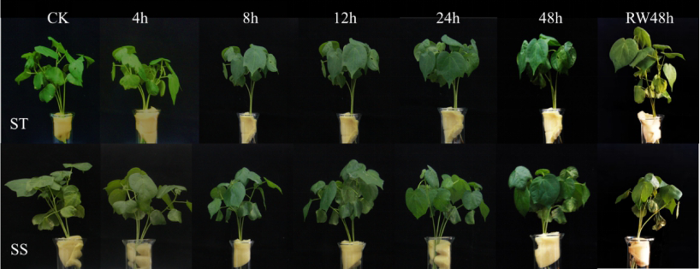
图1
盐胁迫下棉花幼苗不同时间段的生长变化
Fig.1
Changes of growth of cotton seedlings in response to salt stress at different time periods
2.2 棉花叶片对盐胁迫和复水后生理生化的响应
研究表明,NaCl 48 h处理下,ST型和SS型幼苗丙二醛浓度显著升高,叶绿素含量、超氧化物歧化酶活性和过氧化物酶活性均降低,盐胁迫影响了棉株正常的生长发育。ST型和SS型的丙二醛浓度分别较 0 h (CK)升高36.07%和64.61%,复水48 h后ST型幼苗丙二醛浓度较CK变化不明显,而SS型幼苗丙二醛浓度较CK升高11.54%。盐胁迫显著影响了细胞质膜过氧化水平,而复水对ST型的缓解效果优于SS型。ST型和SS型幼苗的叶绿素含量,盐胁迫下分别较CK降低10.29%和13.89%,复水后较CK分别降低5.23%和10.36%。盐胁迫显著抑制了棉花叶绿素合成,复水也显著改善了ST型和SS型的叶绿素合成。ST型的超氧化物歧化酶活性和过氧化物酶活性,在盐胁迫下分别降低3.06%和12.98%,复水后,分别较CK降低0.36%和12.51%。SS型的超氧化物歧化酶活性和过氧化物酶活性,在盐胁迫下分别显著降低27.31%和22.46%,复水后较CK显著降低39.79%和36.67%。盐胁迫下ST型活性氧清除能力强,SS型活性氧清除能力强,且复水并未改善SS型的活性氧清除能力。图2
图2
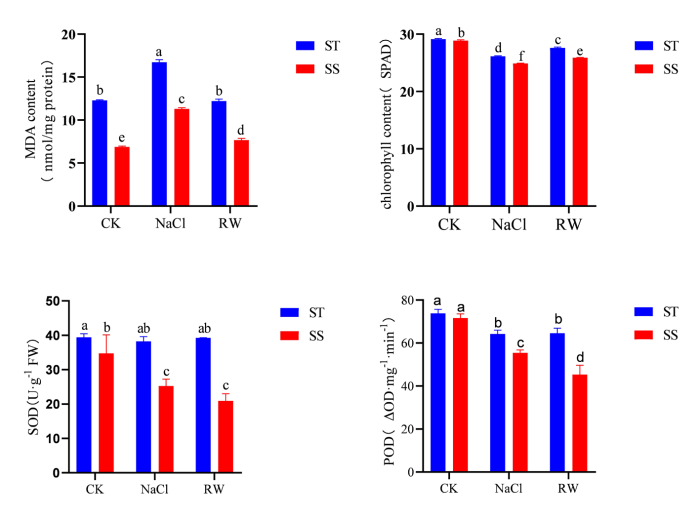
图2
棉花幼苗盐胁迫和复水后的生理响应
注:相同的字母表示处理间差异不显著,字母相同表示差异显著(P<0.05,LSD 法)
Fig.2
Physiological response of cotton seedlings to salt stress and re-watering
Note: The same letter means no significant difference between treatments, and the same letter means significant difference (P< 0.05, LSD method)
2.3 盐胁迫和复水后棉花叶片显微结构
研究表明,正常条件下ST型和SS型幼苗切片染色较深,显微结构排列较紧密,泡状细胞形如单层不规则的四边形,并紧密排列;盐胁迫下泡状细胞呈卵圆形,栅栏组织和海绵组织细胞排列较松散,叶片变得软化。复水后泡状细胞形如长卵形,叶片较平展,逐渐恢复正常生长。图3
图3
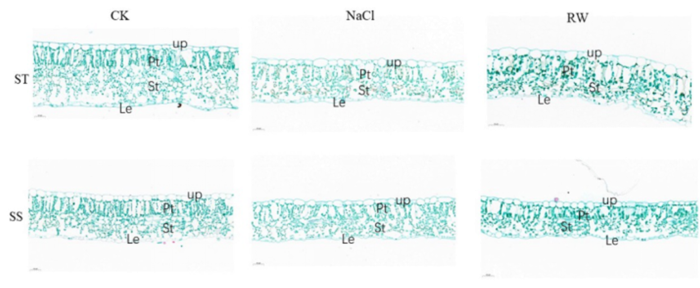
图3
盐胁迫和复水后的棉花叶片显微结构
注:Up:上表皮;Pt:栅栏组织;ST型:海绵组织;Le:下表皮
Fig.3
Cotton leaf micro structure after salt stress and re-watering
Notes:Up: Upper epidermis; Pt: Palisade tissue; st: Spongy tissue; Le: Lower epidermis
在正常条件下,ST型和SS型棉花幼苗的叶表皮结构差异不显著;NaCl胁迫条件下,ST型和SS型的叶片厚度、栅栏组织厚度和海绵组织厚度均下降,在复水后有所恢复。ST型棉花幼苗经过NaCl处理后,叶片厚度、栅栏组织厚度和海绵组织厚度较对照分别降低16.17%、13.92%和18.46%;SS型的叶片厚度、栅栏组织厚度和海绵组织厚度较对照分别显著降低32.43%、30.13%和41.10%。与对照差异显著。表1
表1 盐胁迫下及复水后棉花幼苗叶表皮结构变化
Tab.1
| 品种 Varieties | 处理 Treatments | 叶片厚度 Thickness of leaf (μm) | 栅栏组织厚度 Thickness of palisade tissue (μm) | 海绵组织厚度 Thickness of spongy tissue (μm) | 上表皮厚度 Thickness of upper epidermis (μm) | 下表皮厚度 Thickness of lower epidermis (μm) |
|---|---|---|---|---|---|---|
| ST型 ST Type | CK | 246.38±4.07a | 86.00±2.94a | 108.99±2.94ab | 28.54±4.06ab | 21.87±2.71a |
| NaCl | 206.54±25.05ab | 88.87±12.92ab | 88.87±12.92abc | 25.77±2.18a | 18.62±1.74abc | |
| RW | 248.67±56.35a | 112.71±37.92a | 112.71±37.92a | 29.19±2.04a | 16.21±2.90c | |
| SS型 SS Type | CK | 247.17±23.64a | 111.30±15.61a | 111.30±15.61a | 25.19±4.31b | 20.66±1.24ab |
| NaCl | 167.01±31.27b | 65.55±11.22b | 65.55±11.22bc | 25.58±1.06ab | 18.27±2.12abc | |
| RW | 176.47±11.23b | 75.09±6.78b | 75.09±6.78c | 25.60±7,77ab | 16.66±1.94bc |
3 讨论
3.1
盐通过限制植物对水分的吸收而渗透损害,并导致植物细胞中积累过高离子含量胁迫[32]。棉花亦进化出一系列应对盐度和其他环境压力的反应,包括形态、生理、生化和分子过程来应对环境胁迫,可避免胁迫后恢复,使植物能够在非生物胁迫下生存[33]。耐盐材料与盐敏感材料的区别可能就在于耐盐材料在遇到外部高盐胁迫的时候,相对盐敏感材料有一个快速适应、生理间和耐受力[34]。NaCl 48h处理下,棉花幼苗叶片受损伤严重,ST型和SS型幼苗叶片的丙二醛浓度显著升高,叶绿素含量和超氧化物歧化酶活性均显著降低。经过复水处理后,ST型和SS型得到一定的恢复,丙二醛浓度降低,叶绿素含量、超氧化物歧化酶活性和过氧化物酶活性均升高。与袁雨豪[34]的研究结果相类似,耐盐型材料比敏感型材料表现出更大的耐盐性和复水后更快的恢复。
3.2
盐分不仅改变植物的代谢机制, 而且影响植物的正常生长, 尤其是植物的形态学和解剖学[35],叶片是高等植物光合作用的中心,在遭受逆境胁迫时,植物叶片的表型、生理、解剖结构等性状均能及时响应[36]。棉花Na+区隔化研究表明,陆地棉叶片腺毛泌盐是棉花耐盐的具体表现之一[37]。叶片的显微结构特征是植物适应盐碱胁迫的一个重要方面,在NaCl胁迫下, 棉花叶片各组成细胞失水收缩,叶片横切面厚度变薄,栅栏组织等细胞形态受到影响[28]。研究中正常条件下棉花叶片显微结构排列较紧密,泡状细胞形如单层不规则的四边形,并紧密排列;盐胁迫下泡状细胞呈卵圆形,栅栏组织和海绵组织细胞排列较松散,叶片变得软化。复水后泡状细胞形如长卵形,叶片较平展,逐渐恢复正常生长。在正常条件下,ST型和SS型棉花幼苗的叶表皮结构差异不显著;NaCl胁迫条件下,ST型和SS型的叶片厚度、栅栏组织厚度和海绵组织厚度均下降,在复水后ST型得到了更好的恢复。
4 结论
NaCl处理下,棉花叶片丙二醛浓度显著升高,叶绿素含量和超氧化物歧化酶活性均显著降低。经复水处理,耐盐型和敏感型均得到一定的恢复,丙二醛浓度降低,叶绿素含量、超氧化物歧化酶活性和过氧化物酶活性均升高。盐胁迫不仅对棉花的生理生化水平有影响,还诱导细胞和组织发生结构性的改变,复水可有效缓解盐胁迫下棉花的生理生化水平。耐盐型材料比敏感型材料表现出更大的耐盐性和复水后更快的恢复。
参考文献
Analysis of widely targeted metabolites of the euhalophyte Suaeda salsa under saline conditions provides new insights into salt tolerance and nutritional value in halophytic species
[J].
Transcriptomic and metabolomic analysis reveals the role of CoA in the salt tolerance of Zygophyllum spp
[J].
Zygophyllum is an important medicinal plant, with notable properties such as resistance to salt, alkali, and drought, as well as tolerance of poor soils and shifting sand. However, the response mechanism of Zygophyllum spp. to abiotic stess were rarely studied.Here, we aimed to explore the salt-tolerance genes of Zygophyllum plants by transcriptomic and metabolic approaches. We chose Z. brachypterum, Z. obliquum and Z. fabago to screen for salt tolerant and sensitive species. Cytological observation showed that both the stem and leaf of Z. brachypterum were significantly thicker than those of Z. fabago. Then, we treated these three species with different concentrations of NaCl, and found that Z. brachypterum exhibited the highest salt tolerance (ST), while Z. fabago was the most sensitive to salt (SS). With the increase of salt concentration, the CAT, SOD and POD activity, as well as proline and chlorophyll content in SS decreased significantly more than in ST. After salt treatment, the proportion of open stomata in ST decreased significantly more than in SS, although there was no significant difference in stomatal number between the two species. Transcriptomic analysis identified a total of 11 overlapping differentially expressed genes (DEGs) in the leaves and roots of the ST and SS species after salt stress. Two branched-chain-amino-acid aminotransferase (BCAT) genes among the 11 DEGs, which were significantly enriched in pantothenate and CoA biosynthesis, as well as the valine, leucine and isoleucine biosynthesis pathways, were confirmed to be significantly induced by salt stress through qRT-PCR. Furthermore, overlapping differentially abundant metabolites showed that the pantothenate and CoA biosynthesis pathways were significantly enriched after salt stress, which was consistent with the KEGG pathways enriched according to transcriptomics.In our study, transcriptomic and metabolomic analysis revealed that BCAT genes may affect the pantothenate and CoA biosynthesis pathway to regulate the salt tolerance of Zygophyllum species, which may constitute a newly identified signaling pathway through which plants respond to salt stress.
QTL mapping and candidate gene analysis for alkali tolerance in japonica rice at the bud stage based on linkage mapping and genome-wide association study
[J].Salinity-alkalinity stress is one of the major factors limiting rice production. Damage caused by alkaline salt stress is more severe than that caused by neutral salt stress. Alkali tolerance at the bud stage in rice directly affects seedling survival and final yield when using the direct seeding cultivation model. However, genetic resources (QTLs and genes) for rice breeders to improve alkali tolerance are limited. In this study, we combined linkage mapping and a genome-wide association study (GWAS) to analyze the genetic structure of this trait in japonica rice at the bud stage.A population of 184 recombinant inbred lines (RILs) was utilized to map quantitative trait loci (QTLs) for the root length under control condition (RL), alkaline stress (ARL) and relative root length (RRL) at the bud stage. A major QTL related to alkali tolerance at the rice bud stage, qAT11, was detected on chromosome 11. Interestingly, a GWAS identified a lead SNP (Chr_21,999,659) in qAT11 that was significantly associated with alkaline tolerance. After filtering by linkage disequilibrium (LD), haplotype analysis, quantitative real-time PCR, we obtained three candidate genes (LOC_Os11g37300, LOC_Os11g37320 and LOC_Os11g37390). In addition, we performed phenotype verification on the CRISPR/Cas9 mutant of LOC_Os11g37390.Based on these results, LOC_Os11g37300, LOC_Os11g37320 and LOC_Os11g37390 were the candidate genes contributing to alkaline tolerance in japonica rice. This study provides resources for breeding aimed at improving rice responses to alkalinity stress.
土壤盐渍化成因危害及恢复
[J].
Causes, harm and recovery of soil salinization
[J].
新疆土壤盐渍化成因及其防治对策
[J].
Causes of soil salinization in Xinjiang and its control countermeasures
[J].
Physicochemical properties and salinization characteristics of soils in coastal land reclamation areas: a case study of China-Singapore Tianjin Eco-City
[J].
Salt tolerance mechanisms of plants
[J].Crop loss due to soil salinization is an increasing threat to agriculture worldwide. This review provides an overview of cellular and physiological mechanisms in plant responses to salt. We place cellular responses in a time- and tissue-dependent context in order to link them to observed phases in growth rate that occur in response to stress. Recent advances in phenotyping can now functionally or genetically link cellular signaling responses, ion transport, water management, and gene expression to growth, development, and survival. Halophytes, which are naturally salt-tolerant plants, are highlighted as success stories to learn from. We emphasize that () filling the major knowledge gaps in salt-induced signaling pathways, () increasing the spatial and temporal resolution of our knowledge of salt stress responses, () discovering and considering crop-specific responses, and () including halophytes in our comparative studies are all essential in order to take our approaches to increasing crop yields in saline soils to the next level.
Transcriptome analysis of Gossypium hirsutum L. reveals different mechanisms among NaCl, NaOH and Na2CO3 stress tolerance
[J].
Comparative effects of salt and alkali stresses on organic acid accumulation and ionic balance of seabuckthorn (Hippophae rhamnoides L.)
[J].
Root cell wall solutions for crop plants in saline soils
[J].The root growth of most crop plants is inhibited by soil salinity. Roots respond by modulating metabolism, gene expression and protein activity, which results in changes in cell wall composition, transport processes, cell size and shape, and root architecture. Here, we focus on the effects of salt stress on cell wall modifying enzymes, cellulose microfibril orientation and non-cellulosic polysaccharide deposition in root elongation zones, as important determinants of inhibition of root elongation, and highlight cell wall changes linked to tolerance to salt stressed and water limited roots. Salt stress induces changes in the wall composition of specific root cell types, including the increased deposition of lignin and suberin in endodermal and exodermal cells. These changes can benefit the plant by preventing water loss and altering ion transport pathways. We suggest that binding of Na ions to cell wall components might influence the passage of Na and that Na can influence the binding of other ions and hinder the function of pectin during cell growth. Naturally occurring differences in cell wall structure may provide new resources for breeding crops that are more salt tolerant.Copyright © 2018 The Authors. Published by Elsevier B.V. All rights reserved.
Physiological and transcriptome analysis of sugar beet reveals different mechanisms of response to neutral salt and alkaline salt stresses
[J].
中国棉花产业发展现状及展望
[J].棉花是中国种植业生产中产业链最长的大田经济作物,其商品率高达95%以上,但棉花产业尚存在许多不足之处,需要涉棉企业、棉农、科技人员、学者进一步关注,如自主种业、品牌培育、清洁生产、统防统治、贸易依存度、产业安全、规模经济、产业组织等因素影响中国棉花的产业竞争力和可持续发展。中国棉花种植以新疆、黄河流域、长江流域为主,其中新疆棉花产量占全国产量的67%,已形成规模化和机械化种植,而长江、黄河流域仍以小规模种植为主,没有充分发挥新型经营主体的带动作用,无法形成规模化种植和机械化生产,且缺乏集棉花生产、加工、销售为一体的综合数据平台,在棉花的专业化服务、全程服务和托管式服务方面仅有数家。中国棉花产业未来发展方向和目标应是提升棉田生产规模化、机械化、智能化、信息化、服务社会化水平,研发轻简化生产技术使棉农有尊严快乐植棉,降低生产成本,解决谁来种地的问题,掌控棉花产业链条的主动权。文中从棉花产业链的供求角度出发,阐述了中国棉花种植面积和总产量大幅减少、产业布局上新疆一枝独秀、国内消费有所降低但供求形势有所好转、进口量长期大于出口量和纺织业优势递减的发展现状,分析了中国棉花产业在生产环节、产业布局、组织管理、平台建设等方面存在的问题,借鉴美国和澳大利亚在棉花品种、生产技术、机械化和国家政策的种植经验和发展优势,结合中国供给侧结构改革的政策背景,从培育棉花新品种、研发轻简化和机械化新技术、投入农机设备、优化品种品质和区域布局、科学防治病虫害提高棉花质量、制定棉花目标价格制度、提高棉花生产保险额度、加大对棉农、棉商、农机制造商、纺织企业、出口商等的补贴力度和政策保障力度、发挥产学研优势和棉花协会功能、构建产供销一体化平台、完善棉花供需调控体系、建设现代植棉业服务体系、借助“一带一路”契机带动棉花和纺织业走出国门等多个层面提出相应的对策建议,从而刺激国内有效供给,尽快实现中国棉花产业供需平衡。最后,对中国棉花产业进行展望,将“三去一降一补”应用于棉花产业,并顺应全球棉花去库存的格局,未来两年棉价将有所上涨。
The present situation and prospects of cotton industry development in China
[J].Cotton is the longest chain of field commercial crops of China’s planting industry, which the commodity rate is as high as more than 95%, but still exists many shortcomings of the cotton industry which require further attention from cotton enterprises, cotton farmers, scientific and technical personnel, and scholars, such as independent seed industry, brand cultivation, cleaner production, unified management and pest control, dependence on foreign trade, industrial security and economies of scale, industrial organization and other factors that influence China's cotton industry competitiveness and sustainable development. The major production areas of cotton in China are Xinjiang, the Yellow River basin and the Yangtze river basin, for example, Xinjiang cotton production accounts for 67% of the national output and has formed scale and mechanization planting, but the Yangtze river basin and the Yellow River basin still practice the small scale economy, not full play the leading role of the new type of management main body, the scale planting and mechanized production, is lack of the integrated data platform of cotton production can not be formed, and processing and marketing, and only several departments are engaged in professional service, one-on-one full service and hosted service. The development direction and goal of cotton production in China should be improved the level of cotton production scale, mechanization, intelligence, informationization, socialization service, development of light-simplified production technology that makes cotton farmers to grow cotton more happily and with more dignity, reduce production cost, solve the problem who is going to a tiller of the ground, control tightly cotton industry chain. From the Angle of the cotton industry chain of supply and demand, this paper expounded the present situation of development of cotton industry that the Chinese cotton planting area and output decreased, the industrial layout in Xinjiang outshines others, the domestic consumption has decreased, but the supply and demand situation has been improved, the imports are greater than the exports over a long period of time and the advantages of textile industry decreased gradually, and so on. A series of problems about Chinese cotton industry in the production process, the industrial layout, organization and management, and platform construction were analyzed. Based on the practice of the growing experience and development advantages of the United States and Australia in cotton varieties, production technology, mechanization and national policy, combining with the policy background of China's reform of structure of the supply side, the corresponding countermeasures and suggestions were put forward including cultivating new cotton varieties, researching new technology of light-simplified and mechanized production, the input of agricultural machinery equipment, optimization of varieties, quality and area layout, scientifically preventing and controlling plant diseases and insect pests to improve the quality of cotton, develop cotton price target system, improve the insurance amount of cotton production, increase subsidies and policy support dynamics of cotton farmers, cotton business, agricultural machinery manufacturers, textile companies, exporters and so on, giving play to the advantages of production and cotton association function, building platforms of production-supply-sales integration, perfecting the regulation system of cotton supply and demand, construction of the modern cotton industry service system, driving the cotton and textile industry abroad with the help of One Belt And One Road, and so on, in order to stimulate domestic effective supply, achieve the equilibrium of supply and demand of China's cotton industry as soon as possible. Finally, the prospects for China's cotton industry were presented, the three cuts-one reduction-one subsidy (cut overcapacity, cut stores, cut levers-one-reduction-one subsidy) should be used in cotton industry and conform to the pattern of global cotton to get rid of the inventory, and cotton prices will be higher in the coming two years.
丝绸之路经济带农牧业合作的空间、潜力与中国农业“走出去” 策略
[J].
Space and potential for husbandry cooperation in silk road economic belt and “going out” strategy of Chinese agriculture
[J].
棉花耐盐性鉴定方法探讨
[J].
Strategies for evaluation the salt tolerance in cotton
[J].
棉花耐盐性研究进展
[J].
Recent progresses in studies on salinity tolerence in cotton
[J].
An overview of salinity stress, mechanism of salinity tolerance and strategies for its management in cotton
[J].
植物耐盐生理生化研究进展
[J].
Advances in physiological and biochemical research of salt tolerance in plant
[J].
Nitric oxide-induced saltstress tolerance in plants: ROS metabolism, signaling, and molecular interactions
[J].
高等植物K+吸收及转运的分子机制研究进展
[J].K<sup>+</sup>是植物生长必需的营养元素。K<sup>+</sup>被植物根系吸收后,有效地向地上部转运,在跨膜转运的过程中主要由次级K<sup>+</sup>转运蛋白和K<sup>+</sup>通道介导。KT/HAK/KUP和HKT家族是参与植物体内K<sup>+</sup>吸收及转运的两类主要K<sup>+</sup>转运蛋白,其中HKT家族参与K<sup>+</sup>转运的成员仅存在于单子叶植物中,它们在植物生长发育、渗透调节等过程中均发挥重要作用。Shaker家族是K<sup>+</sup>通道中最早发现且研究最为深入的一类电压门控型通道,是植物K<sup>+</sup>吸收的重要途径之一。本研究从结构特征、定位和组织表达、功能调控等方面对植物KT/HAK/KUP家族、HKT家族和Shaker通道进行综述,最后对未来的主要研究方向做了展望。
Advances in understanding molecular mechanisms of K+ uptake and transport in higher plants
[J].As one of the major nutrients, potassium (K<sup>+</sup>) is essential for plant growth and development. Large amounts of K<sup>+</sup> need to be taken up from the soil and transported throughout the plant. The K<sup>+</sup> transporters and the K<sup>+</sup> channels mainly mediate K<sup>+</sup> transport across the plasma membrane and the tonoplast membrane in plants. The HAK/KUP/KT family and the HKT family are two main groups of proteins which have been widely associated with K<sup>+</sup> uptake and transport, and they fulfill diverse roles in plant growth processes, salt tolerance and osmotic potential regulation. K<sup>+</sup>-permeable members of HKT family seem to be present in monocots only. The Shaker family, comprising voltage-gated channels, dominate the plasma membrane conductance of K<sup>+</sup> in most environmental conditions. This review summarizes recent research and progress in understanding of the structure, localization, expression, function and regulation of three main K<sup>+</sup> transport families. We also propose research hotspots and directions for future K<sup>+</sup> research.
A conserved primary salt tolerance mechanism mediated by HKT transporters: a mechanism for sodium exclusion and maintenance of high K(+)/Na(+) ratio in leaves during salinity stress
[J].
盐胁迫对无芒雀麦幼苗叶片形态及解剖结构的影响
[J].为了探究盐胁迫下无芒雀麦(Bromus inermis)幼苗叶片形态及解剖结构的适应性变化,本研究以‘乌苏一号’无芒雀麦(Bromus inermis Leyss.‘Wusu No.1’)为材料,分别采用NaCl:Na<sub>2</sub>SO<sub>4</sub>:Na<sub>2</sub>CO<sub>3</sub>=4:1:0(A盐),NaCl:Na<sub>2</sub>SO<sub>4</sub>:Na<sub>2</sub>CO<sub>3</sub>=1:4:0(B盐)和NaCl:Na<sub>2</sub>SO<sub>4</sub>:Na<sub>2</sub>CO<sub>3</sub>=1:1:8(C盐)3种混合盐进行胁迫处理,其中A,B盐为中性盐,C为碱性盐,每种混合盐均设置四个不同的电导率(Electrical conductivity,EC)梯度5,10,15,20 ms·cm<sup>-1</sup>,以浇灌自来水为对照组(CK)。试验结果表明,当C盐EC值为15 ms·cm<sup>-1</sup>,A和B盐EC值均为20 ms·cm<sup>-1</sup>时,各处理下幼苗的生长受到明显抑制;3种混合盐处理下,随着EC的增加,中脉厚度、主脉维管束直径、上下表皮细胞厚度、木质部面积变化均呈显著下降趋势,而上角质层厚度、韧皮部面积则表现出先增后降的变化趋势。总之,EC值-1</sup>时,碱性盐比中性盐更促进无芒雀麦叶片各项指标的增长,当EC值>10 ms·cm<sup>-1</sup>时,碱性盐对幼苗的抑制作用显著大于中性盐。
Effects of salt stress on leaf morphology and anatomical structure of Bromus inermis seedlings
[J].In order to investigate the adaptive changes of leaf morphology and anatomical structure of <i>Bromus inermis</i> seedlings under salt stress,the <i>Bromus inermis</i> Leyss.‘Wusu No.1’ was taken as test material,three mixed salts,NaCl:Na<sub>2</sub>SO<sub>4</sub>:Na<sub>2</sub>CO<sub>3</sub>=4:1:0(A salt),NaCl:Na<sub>2</sub>SO<sub>4</sub>:Na<sub>2</sub>CO<sub>3</sub>=1:4:0(B salt) and NaCl:Na<sub>2</sub>SO<sub>4</sub>:Na<sub>2</sub>CO<sub>3</sub>=1:1:8(C salt) were conducted.Salt A and B are neutral salts,Salt C is an alkaline salt,Four different Electrical conductivity(EC) gradients(5,10,15,20 ms·cm<sup>-1</sup>) were set for each mixed salt,and the control group(CK) was irrigated tap water. The results showed that seedlings' growth was significantly inhibited when the EC of C salt was 15 ms·cm<sup>-1</sup> and of A and B salt was 20 ms·cm<sup>-1</sup>. With the increase of EC,the thickness of midrib,the diameter of vascular bundle,the thickness of upper and lower epidermis cells,and the area of xylem decreased significantly,while the thickness of the upper cuticle and the area of phloem increased first and then decreased. In conclusion,when EC value <10 ms·cm<sup>-1</sup>,alkaline salt promoted the growth of various indexes of Bromus inermis leaves more than neutral salt. When EC value > 10 ms·cm<sup>-1</sup>,the inhibitory effect of alkaline salt on seedlings was significantly greater than that of neutral salt.
不同盐碱胁迫对棉花离子组稳态及Na+相关基因表达影响
[J].【目的】 维持细胞内离子稳态是作物重要的耐盐机制之一。研究不同盐碱胁迫下棉花离子组响应特征和耐盐基因表达的差异,为深入认识棉花耐盐机理和提高棉花耐盐性提供依据。【方法】 以鲁棉研24号为试验材料,在盆栽控制条件下设置3种盐碱胁迫类型(盐胁迫、碱胁迫和复合盐碱胁迫)和2个梯度水平(低盐碱和高盐碱),并以无盐碱胁迫处理为对照。测定棉花植株干物质质量以及根系形态指标根长、根表面积和根体积。采用电感耦合等离子体原子发射光谱仪(ICP-AES)测定棉花各器官P、Na、K、Ca、Mg等13种元素含量,并采用实时荧光定量聚合酶链式反应技术测定了耐盐相关基因GhDFR1、GhSOS1、GhNHX1和GhAKT1的相对表达量。【结果】 1)不同盐碱胁迫显著抑制棉花生长,复合盐碱胁迫棉花生长抑制率(48.7%~57.9%)显著高于盐胁迫(27.6%~49.9%)和碱胁迫(21.2%~35.5%)。盐胁迫和复合盐碱胁迫下,棉花地上部和根系生长均显著受抑制,地上部干物质质量、根长、根表面积和根体积显著降低;而碱胁迫对根系的抑制作用相对较小。2)3种盐碱胁迫下,棉花体内Na含量显著增加;各器官Mo含量也均显著增加,叶片和根系N含量降低。3)盐胁迫下,棉花Ca、Mg、Fe、Mn、Zn吸收受抑制,通过促进这些离子以及P、K的转运,维持体内离子平衡。4)碱胁迫下,除Ca、Mg、Fe、Mn、Zn以外,P的吸收也受到抑制,但K的吸收以及P、K、Ca、Mg、Fe、Mn、Zn向地上部转运受到促进。5)复合盐碱胁迫尤其是高盐和pH值环境下,主要营养元素吸收均受抑制,Ca、Mg、Zn、Mn、Fe转运能力降低。6)盐胁迫下,GhSOS1和GhAKT1基因相对表达量显著增加,在碱胁迫和复合盐碱胁迫下呈先增后降趋势;3种盐碱胁迫下,表现为碱>盐>复合盐碱胁迫。GhNHX1基因相对表达量随土壤盐碱度增加先增后降,表现为盐>碱>复合盐碱。【结论】 复合盐碱胁迫由于高盐度和pH叠加效应显著抑制棉花生长和离子吸收,制约P、K、Ca、Mg、Zn、Mn、Fe向地上部转运,使棉花K、Na离子调控能力下降导致离子失衡。
Ionic homeostasis and expression of Na+ related genes of cotton under different salt and alkali stresses
[J].
Anatomical adaptations to salinity in cogon grass[Imperata cylindrica (L.) Raeuschel]from the Salt Range, Pakistan
[J].
海岛棉苗期盐胁迫下形态学和生理学指标变化
[J].【目的】在300 mmol·L<sup>-1</sup> NaCl 胁迫下,观察并测定海岛棉耐盐性强的品系越海9号和耐盐性弱的品系PS-7叶片、茎细胞解剖结构和生理学指标,从形态学和生理学两个水平研究海岛棉苗期响应盐胁迫的应答机制,为棉花耐盐材料的筛选提供理论依据和技术方案。【方法】采用水培方法,待棉苗生长至3叶期时,开始进行300 mmol·L<sup>-1</sup> NaCl胁迫处理。运用光学显微技术及生理学指标测定法,在不同NaCl胁迫处理时间下,对海岛棉耐盐性强的品系越海9号和耐盐性弱的品系PS-7进行形态学观察及生理学指标分析。【结果】2份海岛棉材料对 NaCl 胁迫的反应不同。随着300 mmol·L<sup>-1</sup> NaCl处理时间的延长,与对照相比,越海9号和PS-7的叶片和茎的横切面面积均显著变小,处理24 h时,分别变小14.10%、54.69%与45.30%、87.90%,PS-7的变化幅度大于越海9号;处理12 h时,PS-7维管束中木质部已经损害严重,越海9号维管束中木质部则没有明显变化;PS-7的栅栏组织细胞在处理24 h时由长圆柱形变为卵圆形,越海9号的栅栏组织细胞的形状则没有变化。生理学研究表明,越海9号叶片中的叶绿素含量、超氧化物歧化酶和过氧化物酶活性在整个处理过程中均高于PS-7,而其丙二醛含量却明显低于PS-7;在300 mmol·L<sup>-1</sup> NaCl处理8 h时,越海9号和PS-7中的丙二醛含量、叶绿素含量、超氧化物歧化酶和过氧化物酶活性均达到了显著性差异。【结论】叶片中栅栏组织和茎中木质部可能是海岛棉响应盐胁迫的最敏感部分,叶绿素、丙二醛、超氧化物歧化酶和过氧化物酶可作为鉴定耐盐棉花材料的生理学指标。
Morphological and physiological mechanism of salt tolerance in Gossypium barbadense to salt stress at seedling stage
[J].
Photosynthetic response of two okra cultivars under salt stress and re-watering
[J].
Evaluation and exploration of favorable QTL alleles for salt stress related traits in cotton cultivars (G. hirsutum L.)
[J].
外源物调节碱胁迫水稻生理特性及相关基因表达的效应
[J].
Effects of exogenous regulatory substances on physiological characteristics and gene expression of rice seedlings under alkali stress
[J].
Roles of phytohormones and their signaling pathways in leaf development and stress responses
[J].Phytohormones participate in various processes over the course of a plant's lifecycle. In addition to the five classical phytohormones (auxins, cytokinins, gibberellins, abscisic acid, and ethylene), phytohormones such as brassinosteroids, jasmonic acid, salicylic acid, strigolactones, and peptides also play important roles in plant growth and stress responses. Given the highly interconnected nature of phytohormones during plant development and stress responses, it is challenging to study the biological function of a single phytohormone in isolation. In the current Review, we describe the combined functions and signaling cascades (especially the shared points and pathways) of various phytohormones in leaf development, in particular, during leaf primordium initiation and the establishment of leaf polarity and leaf morphology as well as leaf development under various stress conditions. We propose a model incorporating the roles of multiple phytohormones in leaf development and stress responses to illustrate the underlying combinatorial signaling pathways. This model provides a reference for breeding stress-resistant crops.


