

0 引言
【研究意义】干播湿出技术是一项不需冬春灌,干地播种后滴水补墒出苗的节水增效新技术。近年来,新疆阿克苏地区棉花干播湿出技术应用规模较大。生产中,棉花干播湿出技术有正封土和侧封土两种播种模式,其在增温保墒、抵御风灾、抑制杂草、土壤板结方面各有优劣。确定适宜本地栽培的棉花干播湿出类型,对发展农艺节水、避灾减灾、实现增产增效具有重要意义。【前人研究进展】干播湿出棉田地温增加[1],有利于棉种提早发芽[2-3],生长发育提前、花铃期铃重提高、根系载铃量增加,虽有增产潜力,但根系具有根量较少、须根量较多、根冠比较小、根系入土浅[4]。干播湿出在适量高频滴出苗水的前提下,表层土壤板结度降低[5],出苗率增加,苗期株高、茎粗增加,蕾期前干物质累积较快,提高籽棉产量和收获密度[6]。干播湿出棉田水盐分布呈现出土壤含水率膜内高于膜间,土壤盐分含量总体表现为膜间>宽行>窄行,土壤盐分纵向上主要积累在0~30 cm、横向上膜间盐分出现表聚现象的特点;窄行电导率、窄行含水率和表层覆土板结度与出苗率呈负相关,土壤含水率和窄行电导率与株高、茎粗亦具有负相关关系[5,7]。干播湿出棉田增施土壤改良剂,有助于种穴形成脱盐区、土壤紧实度降低、出苗率提高、产量增加[8]。【本研究切入点】前人关于棉花干播湿出的研究主要集中于出苗水滴水量、滴水频率和土壤盐碱改良剂,而在正封土和侧封土播种模式上鲜有报道。需立足阿克苏地区土壤盐碱较重、冬季干燥降水量少的客观实际,分析适宜阿克苏地区土壤类型和光热条件的干播湿出封土方式。【拟解决的关键问题】对比研究干播湿出棉田正封土、侧封土效果,探索不同封土方式对土壤温湿度、土壤水盐分布、出苗率、苗期生长发育以及产量的影响,分析适宜干播湿出封土方式,为棉花干播湿出技术在阿克苏地区更大面积的推广应用提供依据。
1 材料与方法
1.1 材料
播种机械:棉花干播湿出正封土、侧封土专用播种机。
盐碱改良剂:禾康、克碱王。
1.2 方法
1.2.1 试验设计
试验于2023年在新疆阿克苏地区阿克苏市柳源农场进行,土壤质地为黏土,膜宽 2.05 m,采用1膜3管6行种植模式,行距配置模式为10 cm+66 cm+10 cm+66 cm+10 cm,膜间宽度为66 cm,株距为10 cm,覆膜方式为单膜。滴灌带的滴头流量为2.7 L/h,滴头间距为30 cm,滴灌带在宽行之间距棉行间距10 cm处。4月18日播种,覆土厚度为1~2 cm,播种深度为3 cm。试验采取完全随机区组设计,种穴覆土模式设为正封土、侧封土2个处理,每个处理各占地10 hm2。
1.2.2 指标测定
1.2.2.1 土壤温湿度、湿度
在棉花苗期,采用土壤温湿度检测仪(S21A),在每个处理膜上中行相邻2株棉株间实时监测土壤温度和湿度日变化值,导出每日土壤温度和湿度的平均值。
1.2.2.2 出苗率
5月7日调查棉花的出苗状况,共测58个点,其中正封土27个点、侧封土31个点,每个点边行、次边行和中行共数100穴棉苗,统计棉花的出苗数与空穴数。
1.2.2.3 苗期地上部单株干物质重
于5月17日、5月24日、5月31日,每处理选取有代表性的连续10株棉花,在近地面用小刀将棉株地上部割断,装袋后置于105 ℃烘箱中杀青30 min,调至80 ℃烘至恒重,采用百分之一电子天平称重。
1.2.2.4 株高、主茎茎粗
从每个处理中选取有代表性的3个点,每个点分边行、次边行、中行各10株连续棉株,用卷尺、游标卡尺,分别于5月17日、5月24日、5月31日和6月6日量株高,于5月24日、5月31日和6月6日测主茎茎粗。
1.2.2.5 土壤含水量、含盐量
滴出苗水的前1 d、后1 d,在各处理膜间、窄行(滴灌带下)、种穴、宽行处使用土钻取土,取样深度为10和20 cm。委托新疆维吾尔自治区地质矿产勘查开发局第八地质大队检测土壤含水量、土壤含盐量。用脱盐率衡量脱盐效果,脱盐率大于0时表示脱盐。
1.2.2.6 产量及其构成因子
9月13日,数取6.67 m2的株数和成铃数,折算单株成铃数和667m2成铃数。10月13日,取连续整株棉株吐絮铃100朵,测定单铃重的同时,轧花后称皮棉重,计算衣分;按6.67 m2实收棉花,称籽棉重,折算667m2籽棉产量。
1.2.3 模糊综合评价法
1.2.3.1 评价指标体系的建立
将各处理土壤温度、土壤湿度,出苗率、苗期地上部单株干物质重、苗期株高、苗期主茎茎粗,种穴在0~20 cm脱盐率,667m2籽棉产量、铃重、单株铃数、衣分11个指标作为衡量干播湿出棉田不同封土模式效果的评价体系。
1.2.3.2 基于熵权的模糊综合评价
(1)建立从优隶属度矩阵。土壤温度、土壤湿度,出苗率、苗期地上部单株干物质重、苗期株高、苗期主茎茎粗,种穴在0~20 cm脱盐率,667m2籽棉产量、铃重、单株铃数和衣分为越大越优型指标,隶属度
式中,
(2)确定变异系数权重。权重表示各个指标的重要程度。采用变异系数法进行权重赋值。对于
变异系数:
式中,
变异系数权重:
(3)计算模糊评价的综合指数。把各评价指标的权重
1.3 数据处理
采用 EXCEL2010 和 DPS7.05 数据处理软件统计分析试验数据,方差分析使用最小显著差异法(LSD)进行,皮尔逊相关分析、曲线回归及所有数据用OriginPro 2021作图。
2 结果与分析
2.1 棉花正封土、侧封土对土壤温度的影响
研究表明,棉花播种至出苗、苗期,干播湿出正封土土壤日平均温度整体上高于侧封土,其中正封土、侧封土土壤日平均温度分别为23.9、22.7℃,正封土土壤日平均温度较侧封土高1.2℃,正封土增温作用明显,主要原因可能是与侧封土种穴裸露相比,正封土种穴覆土,相对更加保温。图1
图1
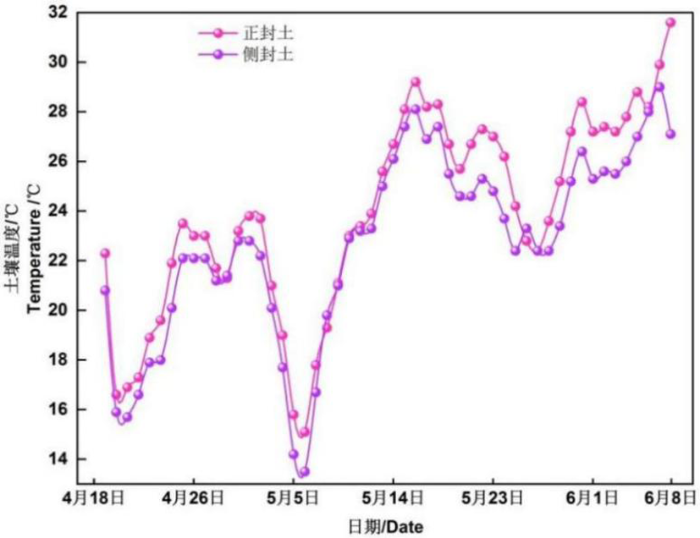
图1
正封土、侧封土方式下土壤温度的变化
Fig.1
Changes of soil temperature figure of top sealing soil and side sealing soil
2.2 不同封土方式对土壤湿度的影响
研究表明,在棉花播种至出苗、苗期,干播湿出正封土土壤湿度高于侧封土,其中正封土土壤日平均湿度自始至终均保持在100%,而侧封土土壤日平均湿度变化幅度在99.1%~100%,表现为滴出苗水后土壤湿度立即增至100%,随着时间的推移、土壤中的水分蒸发,土壤含水量逐渐降低,正封土在保墒上优于侧封土,正封土种穴覆土,较种穴裸露的侧封土更加保墒。图2
图2
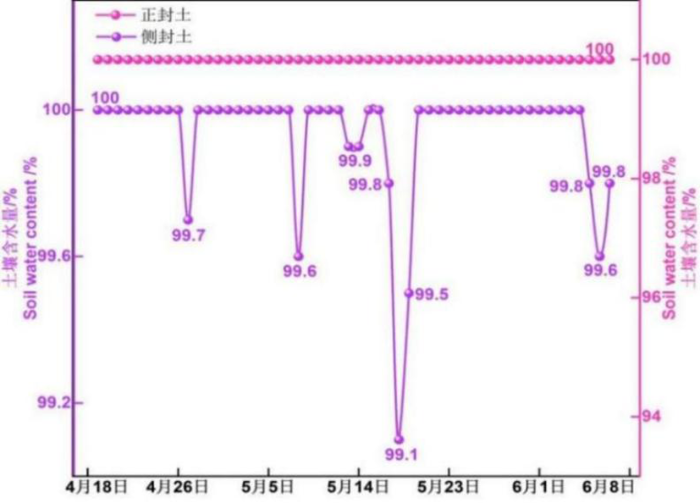
图2
正封土、侧封土方式下土壤湿度的变化
Fig.2
Changes of soil humidity figure of top sealing soil and side sealing soil
2.3 不同封土方式对棉花出苗率的影响
研究表明,正封土的棉花出苗率极显著高于侧封土,其中正封土、侧封土出苗率分别为70.7%、57%,正封土的出苗率高出侧封土13.7个百分点。图3
图3
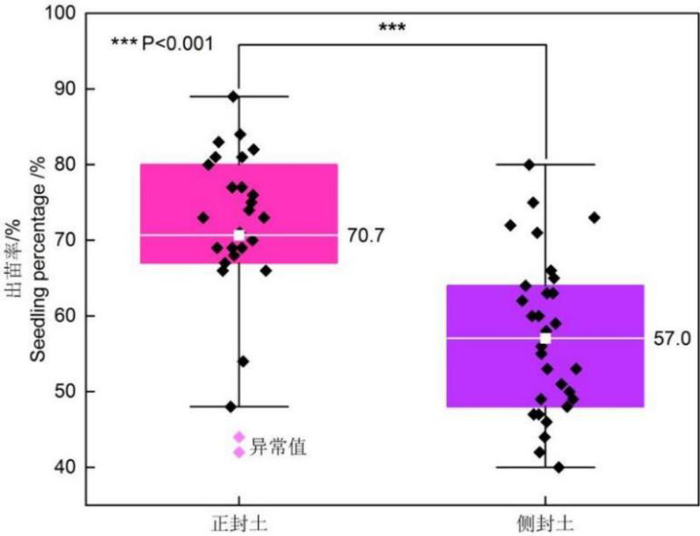
图3
正封土、侧封土方式下棉花出苗率的变化
Fig.3
Changes of cotton seedling emergence rate figure of top sealing soil and side sealing soil
2.4 不同转土方式对棉花苗期生长发育的影响
2.4.1 地上部单株干物质重
研究表明,在棉花苗期,正封土的地上部单株干物质重高于侧封土。与侧封土相比,5月17日、5月24日和5月31日,正封土的地上部单株干物质重分别增加93.4%、66.1%和12.1%,随着时间的后移,正封土干物质积累趋于减缓,而侧封土干物质积累趋于加快,正封土和侧封土在干物质积累上的差异在逐步减小。图4
图4
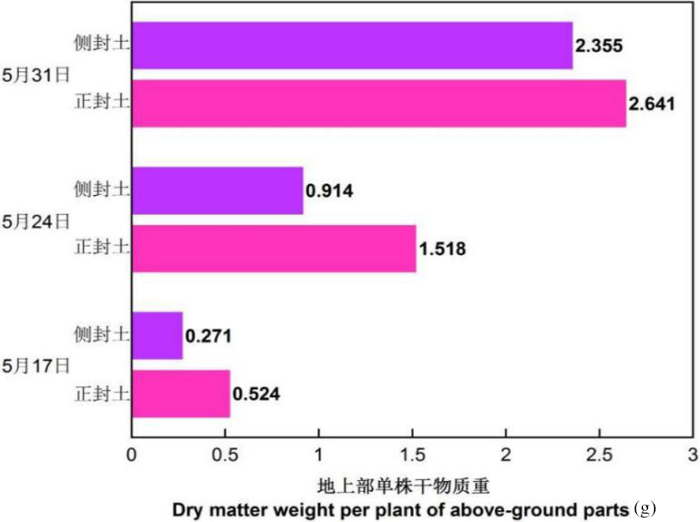
图4
正封土、侧封土方式下土地上部棉花单株干物质重的变化
Fig.4
Changes of cotton dry matter weight per plant of above-ground parts figure of top sealing soil and side sealing soil
2.4.2 正封土、侧封土方式下棉花株高的变化
研究表明,在苗期,正封土的株高极显著高于侧封土,5月17日、5月24日、5月31日和6月6日,正封土的株高较侧封土分别高1.8、2.3、2.8和2.5 cm,株高增长量呈先增加后减小的态势。图5
图5
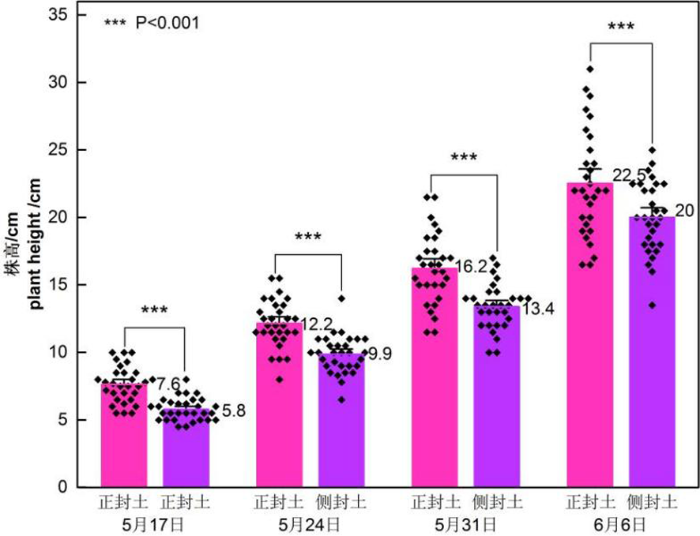
图5
正封土、侧封土方式下棉花株高的变化
Fig.5
Changes of cotton plant height figure of top sealing soil and side sealing soil
2.4.3 正封土、侧封土方式下棉花主茎茎粗的变化
研究表明,在棉花苗期,正封土的主茎茎粗极显著高于侧封土。与侧封土相比,5月24日、5月31日和6月6日,正封土的主茎茎粗分别增加0.71、0.96和0.88 cm,主茎茎粗呈先增加后减小的趋势。图6
图6
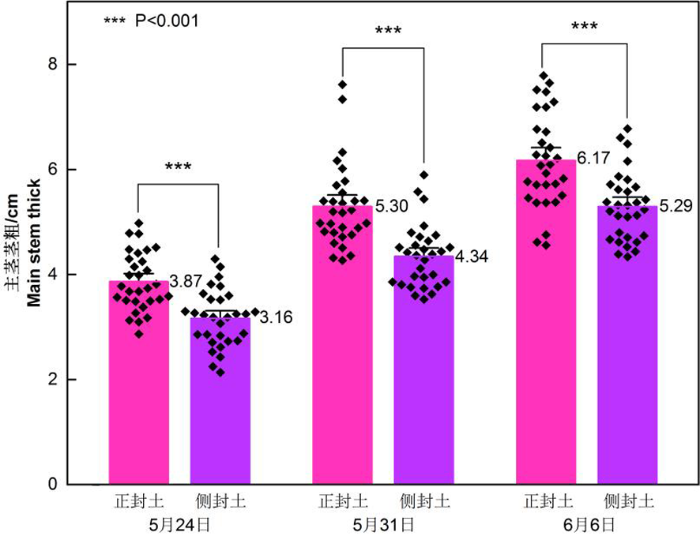
图6
正封土、侧封土方式下棉花主茎茎粗的变化
Fig.6
Changes of cotton main stem thick figure of top sealing soil and side sealing soil
2.5 不同封土方式对土壤总盐空间分布的影响
图7
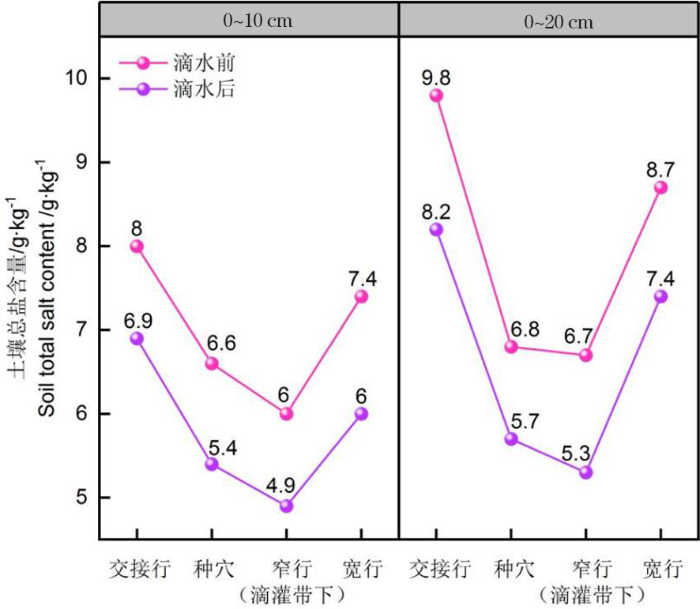
图7
侧封土方式下土壤总盐的空间分布
Fig.7
Spatial distribution of soil total salt figure for side sealing soil
图8
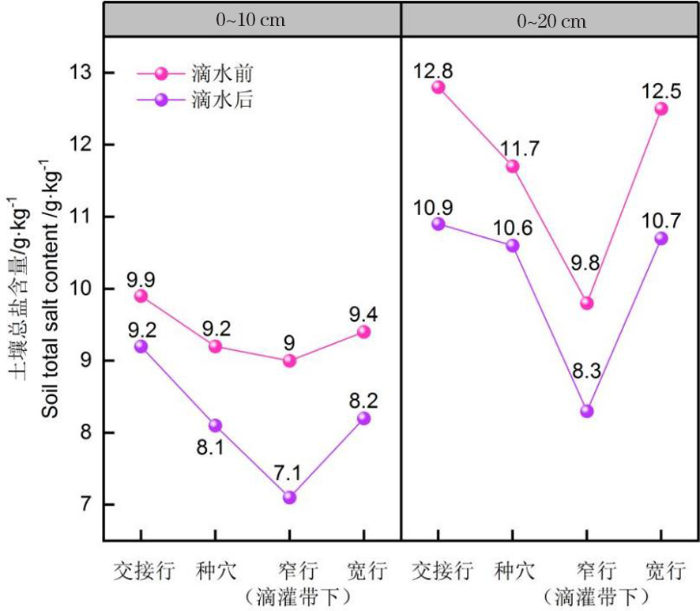
图8
正封土方式下土壤总盐的空间分布
Fig.8
Spatial distribution of soil total salt figure for top sealing soil
2.6 出苗率和膜间、种穴、窄行、宽行土壤含水率皮尔逊相关性
研究表明,出苗率与膜间、种穴、窄行(滴灌带下)、宽行的土壤含水率相关均不显著,但种穴与窄行(滴灌带下)、宽行的土壤含水率均呈显著正相关,相关系数分别为0.702、0.674;窄行(滴灌带下)与宽行的土壤含水率呈显著正相关,相关系数为0.742。图9
图9
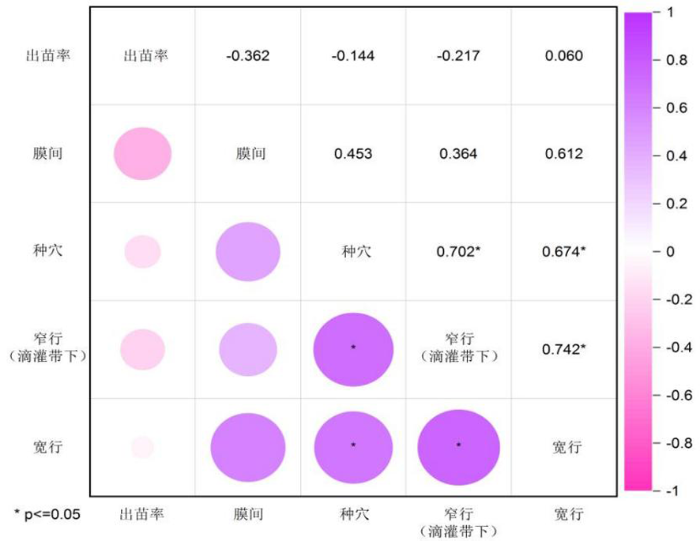
图9
棉花出苗率和土壤含水率相关性
Fig.9
Correlation analysis figure of cotton seedling percentage and soil water contents
2.7 出苗率和膜间、种穴、窄行、宽行土壤含盐率皮尔逊相关性
研究表明,出苗率与窄行(滴灌带下)的土壤含盐率呈显著负相关,相关系数为-0.841;但种穴与窄行(滴灌带下)、宽行的土壤含水率均呈显著正相关,相关系数分别为0.881、0.971;窄行(滴灌带下)与宽行的土壤含水率呈显著正相关,相关系数为0.893。图10
图10
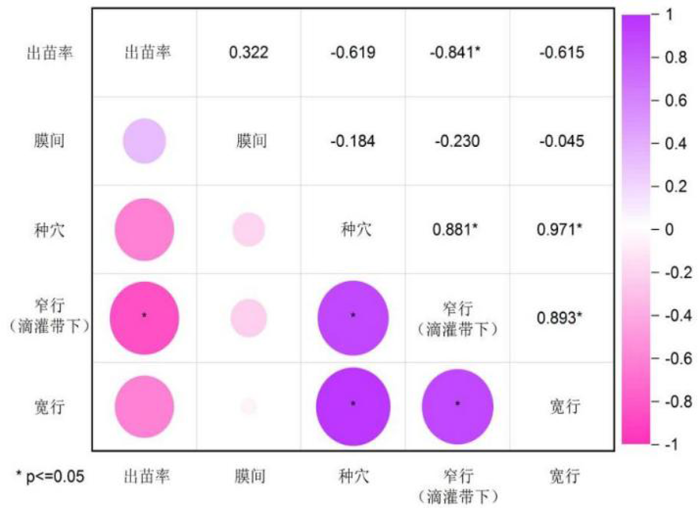
图10
棉花出苗率、土壤总盐含量相关性
Fig.10
Correlation analysis figure of cotton seedling percentage and soil total salt contents
2.8 出苗率与土壤含盐量曲线回归
图11
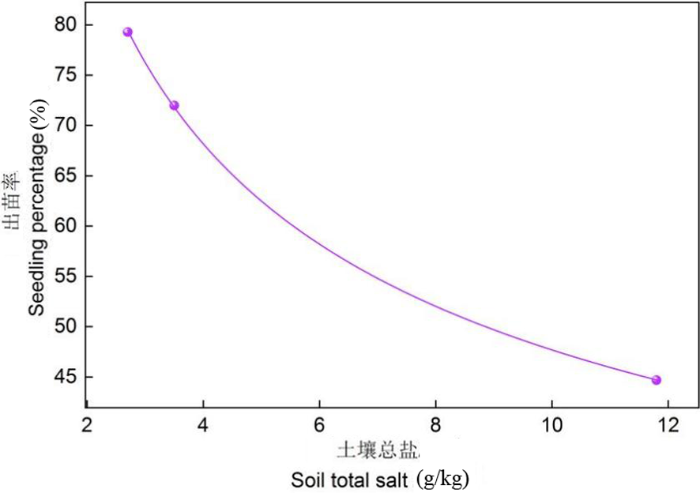
图11
正封土方式下棉花出苗率与土壤总盐含量曲线回归方程
Fig.11
Curve regression equation figure of seedling percentage and total salt contents for top sealing soil
图12
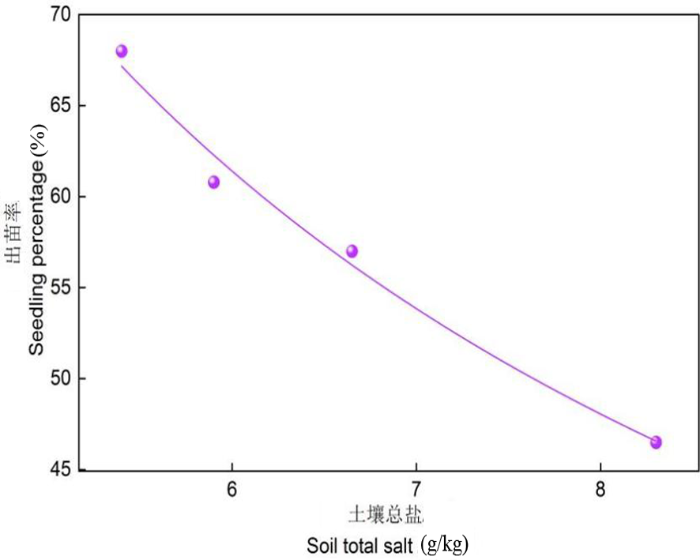
图12
侧封土方式下棉花出苗率与土壤总盐含量曲线回归方程
Fig.12
Curve regression equation figure of seedling percentage and total salt contents for side sealing soil
2.9 不同封土方式对产量及其构成因子的影响
研究表明,与侧封土相比,正封土下667m2籽棉产量高15.4 kg、单株铃数多1.58个/株、铃重轻0.1 g、衣分差别不大,但正封土与侧封土间产量及其构成因子差异均不显著。图13
图13
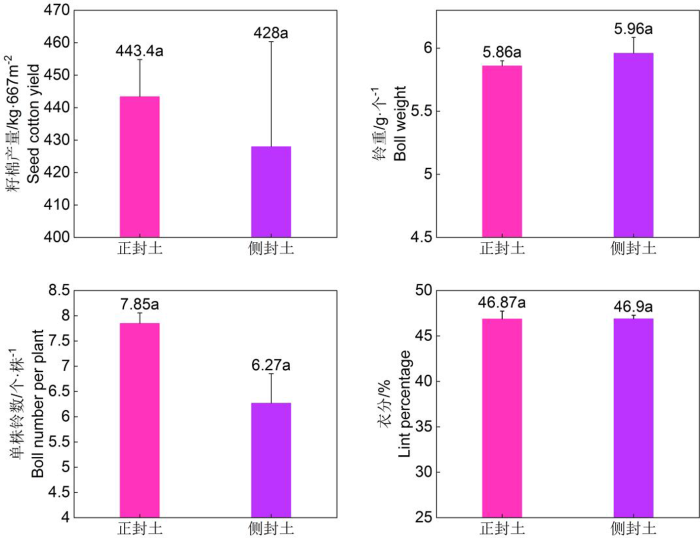
图13
正封土、侧封土方式下籽棉产量及其构成因子
Fig.13
Seed cotton yield and Component of top sealing soil and side sealing soil
2.10 综合评价
2.10.1 评价指标变异系数权重
研究表明,各指标的权重表现为种穴在0~20 cm脱盐率>单株铃数>出苗率>苗期主茎茎粗>苗期株高>苗期地上部单株干物质重>土壤温度>667m2籽棉产量>铃重>衣分>土壤湿度,其中,种穴在0~20 cm脱盐率、单株铃数和出苗率累计权重为64.82%,3个指标在干播湿出棉田不同封土方式评价指标体系中占有重要作用。此外,种穴在0~20 cm脱盐率的权重远远高于其余指标,在综合评价中影响较大。表1
表1 不同封土方式下评价指标变异系数权重的变化
Tab.1
| 评价指标 Evaluation indexes | 变异系数权重 Variation coefficient weight |
|---|---|
| 土壤温度 Soil temperature | 0.036 9 |
| 土壤湿度 Soil humidity | 0.000 4 |
| 出苗率 Seedling emergence rate | 0.153 8 |
| 苗期地上部单株干物质重 Dry matter weight per plant of above-ground parts at seedling stage | 0.082 1 |
| 苗期株高 Plant height at seedling stage | 0.084 3 |
| 苗期主茎茎粗 Main stem thick at seedling stage | 0.110 1 |
| 种穴在0~20 cm脱盐率 Desalination rate of seed hole in 0-20cm | 0.334 0 |
| 667m2籽棉产量Seed cotton yield | 0.025 3 |
| 铃重 Boll weight | 0.012 2 |
| 单株铃数 Bolls number per plant | 0.160 4 |
| 衣分 Lint percentage | 0.000 5 |
2.10.2 不同封土方式模糊评价综合指数
研究表明,用模糊综合评价法对干播湿出棉田不同封土方式的效果进行评价,由综合指数值的大小判断综合性状的优劣表现。综合指数越大、综合表现越优的原则,不同处理综合指数优劣排序为正封土>侧封土,综合考虑土壤温湿度、出苗率、脱盐率、苗期棉株主要农艺性状、产量及其构成因子11个性状,正封土的综合性状优于侧封土。表2
表2 不同封土方式下模糊综合指数的变化
Tab.2
| 评价指标 Evaluation indexes | 正封土 Top sealing soi | 侧封土 Side sealing soil |
|---|---|---|
| 土壤温度 Soil temperature | 0.036 9 | 0 |
| 土壤湿度 Soil humidity | 0.000 4 | 0 |
| 出苗率 Seedling emergence rate | 0.153 8 | 0 |
| 苗期地上部单株干物质重 Dry matter weight per plant of above-ground parts at seedling stage | 0.082 1 | 0 |
| 苗期株高 Plant height at seedling stage | 0.084 3 | 0 |
| 苗期主茎茎粗 Main stem thick at seedling stage | 0.110 1 | 0 |
| 种穴在0~20 cm脱盐率 Desalination rate of seed hole in 0-20 cm | 0 | 0.334 0 |
| 667m2籽棉产量 Seed cotton yield | 0.025 3 | 0 |
| 铃重 Boll weight | 0 | 0.012 2 |
| 单株铃数 Bolls number per plant | 0.160 4 | 0 |
| 衣分 Lint percentage | 0 | 0.000 5 |
| 综合指数 Complex index | 0.653 3 | 0.346 7 |
| 排序 Order | 1 | 2 |
3 讨论
3.1 温度对出苗率、苗期生长的影响
低温是棉花种子萌发的主要胁迫因子[9],播种出苗阶段出现5~12℃的低温,会导致种子萌发期延长、出苗率降低[10-11],长时间、高强度的低温,可能使种子质膜结构破坏、通透性增大,种子内可溶性糖、氨基酸等物质外渗,导致代谢紊乱,造成种子霉烂、发芽迟缓和发芽率低[12⇓⇓-15]。试验研究中,棉花播种-出苗期间即4月中下旬~5月上旬遭遇了历史罕见的较长时间低温天气,造成干播湿出条件下侧封土和正封土出苗率不高,分别为57%、70.7%。同时,土壤日平均温度对棉花出苗影响最大,土壤日平均温度高,有利于出苗和幼苗地上部生长,幼苗地上部干物质重较高[13,16⇓⇓-19]。试验研究中,棉花播种-出苗、苗期,正封土土壤日平均温度较侧封土高1.2℃,其出苗率高出侧封土13.7个百分点,地上部单株干物质重、株高、茎粗均高于侧封土。
3.2 不同封土方式对盐分空间分布的影响
干播湿出滴灌条件下,不管是正封土还是侧封土,土壤盐分均随水分运移到以滴头为中心向下的半椭球型湿润峰的边缘[20]。水平方向上,土壤盐分在水分对流和弥散的作用下,在距离滴头较近的窄行、种穴和部分宽行区域形成脱盐区,而在距离滴头较远的膜间交接行裸地表层区域形成积盐区,盐分呈现出膜内向膜间迁移的特性[20],使得膜间土层含盐量高于膜内窄行、种穴、宽行,出现盐分表聚现象。垂直方向上,滴水后,土壤表层盐分在重力作用下随水分从地表向下入渗,0~10 cm的土壤总盐含量小于10~20 cm;停止滴水后,土壤下层和湿润锋边缘的盐分在蒸发和棉花根系吸水及水分的弥散作用下从地下向上移动,滴水前的土壤总盐含量高于滴水后。
3.3 不同封土方式对脱盐率的影响
土壤脱盐率是衡量灌溉淋洗效果的主要指标之一[20],当脱盐率大于0时表示土壤脱盐,当脱盐率小于0时表示土壤积盐,当脱盐率等于0时表示盐分平衡[21]。试验研究中,不管是正封土还是侧封土,种穴的土壤脱盐率均大于0,表明干播湿出条件下正封土和侧封土对盐分均具有淋洗的作用,随着土壤中的部分盐分被排出种穴,种穴处于脱盐区,更有利于棉种在低盐环境下萌动、发芽。其中侧封土在0~10 cm、10~20 cm的种穴土壤脱盐率分别高于正封土6.2个百分点、6.8个百分点,说明侧封土的排盐效果好于正封土,主要原因可能是侧封土滴灌模式下滴灌带压力较高,滴头流量相对较大,湿润锋在水平和垂直方向上的运移距离增大[22],盐分随水分被转移到更大半径、更深深度的湿润锋边缘,土壤盐分含量在水平和垂直方向上随之降低,侧封土下种穴的土壤脱盐率增大。
4 结论
正封土在增温保墒上较侧封土效果佳,出苗率更高,苗期地上部单株干物质重、株高和主茎茎粗偏高,但产量及其构成因子差异不大,种穴在0~10 cm、10~20 cm的土壤脱盐率降低;正封土、侧封土的土壤总盐含量均表现为窄行(滴灌带下)<种穴<宽行<交接行,同一耕层深度下滴水后的土壤总盐含量小于滴水前,0~10 cm的土壤总盐含量小于10~20 cm;出苗率与窄行(滴灌带下)的土壤土壤总盐含量呈显著负相关;正封土、侧封土播种模式下,出苗率与窄行(滴灌带下)的土壤总盐含量X的曲线回归方程分别为Y=117.035 6X-389 8、Y=282.631 4X-0.852 1;正封土在土壤温湿度、出苗率、脱盐率、苗期棉株主要农艺性状、产量及其构成因子11个性状上的综合表现优于侧封土。
参考文献
干播湿出膜下滴灌棉花现蕾初期地温变化规律
[J].
Soil temperature variation in cotton budding pre-stage with drip irrigation under mulch with dry seeding and wet emergence method
[J].
图木舒克棉花干播湿出一播全苗栽培技术研究
[J].
Study on cultivation techniques of dry sowing, wet sowing and one sowing of cotton in Tumushuke
[J].
干播湿出棉田土壤温度及水分对出苗率的影响
[J].
在新疆南疆灌区棉花干播湿出种植方式下,通过田间试验研究土壤温度、水分变化及其对出苗率的影响。研究表明:各处理不同深度土壤温度在一天中表现为低-高-低的变化规律;表层5cm内土壤温度变幅最大,平均增幅63.5%-70%;随着深度增加土壤温度变化逐渐趋于平缓。各处理不同深度处下层土壤温度达到峰值的时间滞后于上层土壤,上层土壤降温速度高于下层土壤;土壤含水率越大地温变幅越小;600m3/hm2的干播湿出灌水定额可为棉花种子发育创造较好的湿热环境,利于棉花出苗。
Impacts of drip irrigation under mulch with dry sowing and wet seedling on soil temperature, water content and seedling emergence rate of cotton
[J].在新疆南疆灌区棉花干播湿出种植方式下,通过田间试验研究土壤温度、水分变化及其对出苗率的影响。研究表明:各处理不同深度土壤温度在一天中表现为低-高-低的变化规律;表层5cm内土壤温度变幅最大,平均增幅63.5%-70%;随着深度增加土壤温度变化逐渐趋于平缓。各处理不同深度处下层土壤温度达到峰值的时间滞后于上层土壤,上层土壤降温速度高于下层土壤;土壤含水率越大地温变幅越小;600m3/hm2的干播湿出灌水定额可为棉花种子发育创造较好的湿热环境,利于棉花出苗。
棉花膜下滴灌根系发育规律的研究
[J].
Study on cotton root development and spatial distribution under film mulch and drip irrigation
[J].
干播湿出灌水量和灌水频率对棉田土壤板结、水盐分布及出苗的影响
[J].
Effects of irrigation quantity and irrigation frequency of dry sowing and wet seedling on soil compaction, water-salt distribution and seedling emergence in cotton fields
[J].
干播湿出模式下不同出苗水对棉花生理性状及产量的影响
[J].针对新疆南疆地区干旱环境,常规冬春灌耗水严重,不利于南疆水资源的可持续发展,探索干播湿出环境下出苗期适宜的灌水方式。在南疆沙雅县开展大田试验,设置7个不同灌水量及频率处理(C1:675 m<sup>3</sup>/hm<sup>2</sup>,C2:900 m<sup>3</sup>/hm<sup>2</sup>,C3:1 125 m<sup>3</sup>/hm<sup>2</sup>,C4:675+225 m<sup>3</sup>/hm<sup>2</sup>,C5:675+450 m<sup>3</sup>/hm<sup>2</sup>,C6:675+300+150 m<sup>3</sup>/hm<sup>2</sup>,CK:冬灌2 700 m<sup>3</sup>/hm<sup>2</sup>),研究不同出苗水量和滴水频次对棉花株高、茎粗、出苗率、干物质累积量等生长指标、产量及其构成要素(单株铃数、收获密度)的影响。结果表明:CK处理出苗率最高,C1、C2、C3、C4、C5、C6出苗率分别为对照的81.48%,88.62%,67.35%,95.01%,73.66%与80.06%。在苗期,C1、C2、C3、C4、C5、C6处理株高分别对比CK减少10.63%,10.37%,36.33%,8.05%,22.45%,26.74%;茎粗分别对比CK减少2.14%,6.05%,31.67%,4.27%,12.81%,16.73%。冬灌棉单株铃重与籽棉产量的相关性最高(r=0.646),干播湿出棉收获密度与籽棉产量相关最密切(r=0.748)。CK处理在苗期出苗率、棉花生长指标以及后期产量及其构成要素要显著高于其他处理,C4处理在出苗率、收获密度以及籽棉产量均与CK处理处于同一水平。出苗水量大于675 m<sup>3</sup>/hm<sup>2</sup>时,同一滴水频次下,棉花出苗率随灌溉定额的减少而增加,C2处理棉花出苗率、苗期生长状况、后期产量及其构成要素高于C3处理,C4高于C5处理。同一灌水量下,棉花出苗率随滴灌次数的增加而升高,C4处理棉花出苗率、产量及其构成要素高于C2、C5处理,C6高于C3处理。综合各处理出苗、生长状况及产量情况,C4为最佳出苗水处理。
Effects of different seedling emergence water on physiological characters and yield of cotton under dry sowing and wet emergence mode
[J].In view of the arid environment in southern Xinjiang, the water consumption of conventional winter and spring irrigation mode is serious, which is not conducive to the sustainable development of water resources in southern Xinjiang. In this study, a field experiment was carried out in Shaya County, southern Xinjiang. Seven different irrigation treatments (C1 of 675 m3/hm2, C2 of 900 m3/hm2, C3 of 1 125 m3/hm2, C4 of 675+225 m3/hm2, C5 of 675+450 m3/hm2, C6 of 675+300+150 m3/hm2, CK of winter irrigation 180 m3/hm2) were set up to study the effects of different seedling emergence water and drip frequency on cotton flower height, stem diameter, seedling emergence rate, dry matter accumulation and other growth indicators, yield and its constituent elements (number of bolls per plant, harvest density). The results showed that the emergence rates of C1, C2, C3, C4, C5 and C6 were 81.48%, 88.62%, 67.35%, 95.01%, 73.66% and 80.06% of the control, respectively. At seedling stage, compared with CK, the plant height of C1, C2, C3, C4, C5 and C6 treatments decreased CK by 10.63%, 10.37%, 36.33%, 8.05%, 22.45% and 26.74% respectively, and the stem diameter decreased CK by 2.14%, 6.05%, 31.67%, 4.27%, 12.81% and 16.73% respectively. The correlation between Boll Weight per plant of winter irrigation cotton and seed cotton yield was the highest (r=0.646), and the harvest density of dry sowing wet cotton was the most closely related to seed cotton yield (r=0.748). The CK treatment was significantly higher than other treatments in seedling emergence rate, cotton growth index, late yield and its components. The C4 treatment was at the same level as CK treatment in seedling emergence rate, harvest density and seed cotton yield. When the emergence water amount was greater than 675 m3/hm2, under the same drip frequency, the cotton emergence rate increased with the decrease of irrigation quota. The cotton emergence rate, seedling growth status, late yield and its constituent elements of C2 treatment were higher than those of C3 treatment, and those of C4 treatment were higher than those of C5 treatment. Under the same irrigation amount, the emergence rate of cotton increased with the increase of drip irrigation times. The emergence rate, yield and components of cotton of C4 treatment were higher than those of C2 and C5 treatment, and those of C6 treatment was higher than those of C3 treatment. The seedling growth and emergence of C4 treatment were the best.
棉花膜下滴灌干播湿出土壤水盐变化与耗水规律试验研究
[J].新疆南疆每年冬春灌需要消耗大量水资源,为了探索棉花生育期节水控盐滴灌溉模,通过田间试验,对干播湿出膜下滴灌棉田在284mm、339mm、369mm和399mm灌溉定额下土壤水盐、CL-、棉花耗水规律和产量效应进行研究,研究表明:免冬春灌使棉田土壤盐分主要积累在0~30cm之间;284mm和339mm灌溉定额棉花出现水分胁迫,369mm和399mm的灌溉定额可满足棉花对水分的需求;土壤盐分和CL-含量具有相同的变化规律,在棉花生育期内284mm灌溉定额土壤处于积盐状态,339mm、369mm和399mm灌溉定额土壤处于脱盐状态;棉花生育期耗水峰值出现在7.30~8.20(播后93d~113d)之间。免冬春灌棉花滴灌定额369mm以上可获得较高籽棉产量。研究成果为干旱区棉田少、免冬春灌棉花膜下滴灌水盐调控技术提供参考。
Soil salt transfer law and water consumption characteristics for cotton with drip irrigation under mulch with dry sowing and wet seedling
[J].新疆南疆每年冬春灌需要消耗大量水资源,为了探索棉花生育期节水控盐滴灌溉模,通过田间试验,对干播湿出膜下滴灌棉田在284mm、339mm、369mm和399mm灌溉定额下土壤水盐、CL-、棉花耗水规律和产量效应进行研究,研究表明:免冬春灌使棉田土壤盐分主要积累在0~30cm之间;284mm和339mm灌溉定额棉花出现水分胁迫,369mm和399mm的灌溉定额可满足棉花对水分的需求;土壤盐分和CL-含量具有相同的变化规律,在棉花生育期内284mm灌溉定额土壤处于积盐状态,339mm、369mm和399mm灌溉定额土壤处于脱盐状态;棉花生育期耗水峰值出现在7.30~8.20(播后93d~113d)之间。免冬春灌棉花滴灌定额369mm以上可获得较高籽棉产量。研究成果为干旱区棉田少、免冬春灌棉花膜下滴灌水盐调控技术提供参考。
土壤改良剂对南疆棉田“干播湿出” 模式土壤性状和出苗率的影响研究
[J].以南疆棉田为研究对象,探索南疆棉田“干播湿出”条件下施用土壤改良剂促进棉种发芽出苗的方案。选用腐殖酸,微生物菌剂,蚯蚓酶氮素为土壤改良剂,共设8个试验处理,即腐殖酸(G1)微生物菌剂(G2)、蚯蚓酶氮素(G3)、腐殖酸+微生物菌剂(G4)、腐殖酸+蚯蚓酶氮素(G5)、微生物菌剂+蚯蚓酶氮素(G6)、腐殖酸+碳基酶微生物菌剂+蚯蚓酶氮素(G7)以及不施改良剂(CK)。试验通过“水肥一体技术”,在出苗水时施入不同配比组合的改良剂,研究不同处理对土壤温度、紧实度、含水率、含盐量以及出苗率的影响。试验结果表明:与对照处理相比,在0~20 cm土层盐分差异显著,各改良剂处理均有利于土壤的脱盐。在单施情况下,施腐殖酸的处理土壤含水率最高,水分动态变化最稳定;在配施情况下,G5和G6处理差异不明显,G7处理土壤含水率的整体效果最好。改良剂单施处理中施腐殖酸效果最好,较对照处理平均地温提高了2.9 ℃;配施情况下,以三种改良剂配施处理效果最好,其次是G4处理,G5和G6处理相差较小。各土壤改良剂处理土壤紧实度均小于对照,各处理差异性不显著(P>0.05)。出苗率越高,产量越高,土壤改良剂的施用均有利于棉花增产,综合分析,腐殖酸(75 kg/hm<sup>2</sup>)+碳基酶生物菌剂(75 kg/hm<sup>2</sup>)+蚯蚓酶氮素(225 kg /hm<sup>2</sup>)三者混合配施是改良土壤、促进棉种发芽出苗的最优方案。
Effects of soil amendments on soil properties and seedling emergence rate of dry sowing and wet emergence mode in cotton field in southern Xinjiang
[J].Taking the cotton field in southern Xinjiang as the research object, this paper explored the scheme of applying soil conditioner to promote the germination and emergence of cotton seeds under the condition of dry seeding and wet emergence in the cotton field in southern Xinjiang. In this study, humic acid, microbial agents and earthworm enzyme nitrogen were selected as soil modifiers. A total of 8 experimental treatments were set up, namely humic acid (G1), microbial agents (G2), earthworm enzyme nitrogen (G3), humic acid + microbial agents (G4), humic acid + earthworm enzyme nitrogen (G5), microbial agents+ earthworm enzyme nitrogen (G6), humic acid + microbial agents + earthworm enzyme nitrogen (G7) and no modifier (CK). Through the water and fertilizer integration technology, different combinations of modifiers were applied to the seedling emergence water to study the effects of different treatments on soil temperature, compactness, water content, salt content and seedling emergence rate. The results showed that compared with the control treatment, the soil salinity in 0~20 cm soil layer was significantly different and that each treatment was beneficial to soil sesaulting. Under the condition of single application, the treatment of humic acid had the highest soil moisture content and the most stable dynamic change of soil moisture. In the case of combined application, the difference between G5 and G6 treatment was not obvious, and the overall effect of G7 treatment on soil moisture content was the best. The effect of humic acid application was the best in the single application treatment of modifier, and the average ground temperature increased by 2.9 ℃ compared with the control treatment; In the case of combined application, the combined application of three modifiers had the best effect, followed by G4 treatment, and the difference between G5 and G6 treatment was small. The soil compactness of each soil conditioner treatment was lower than that of the control, but there was no significant difference among the treatments (P>0.05). The higher the emergence rate, the higher the yield, and the application of soil conditioner was beneficial to the increase of cotton yield. Comprehensive analysis showed that the mixed application of humic acid (75 kg/hm2) + biological agents (75 kg/hm2) + earthworm enzyme nitrogen (225 kg/hm2) was the best scheme to improve the soil and promote the germination and emergence of cotton seeds.
Chilling injury in plants
[J].
Hydropriming and hot water-induced heat shock increase cotton seed germination and seedling emergence at low temperature
[J].
Priming treatments for improvement of germination and emergence of cotton seeds at low temperature
[J].
棉花种子萌发和出苗温度指标研究
[J].研究不同温度环境下棉花萌发率和出苗率,探索棉花出苗适宜温度指标,为棉花高产栽培以及安全生产提供科学依据。结果表明:当温度达14 ℃及以上棉花种子萌发率、出苗率高且稳定;10 ℃处理时间越长,烂种率、烂芽率越高,出苗迟缓、出苗率越低。14 ℃是棉花种子萌发出苗的最适宜温度指标,12~14 ℃是棉花播种期适宜温度指标。
Study on the germination and emergence temperature of cotton seed
[J].研究不同温度环境下棉花萌发率和出苗率,探索棉花出苗适宜温度指标,为棉花高产栽培以及安全生产提供科学依据。结果表明:当温度达14 ℃及以上棉花种子萌发率、出苗率高且稳定;10 ℃处理时间越长,烂种率、烂芽率越高,出苗迟缓、出苗率越低。14 ℃是棉花种子萌发出苗的最适宜温度指标,12~14 ℃是棉花播种期适宜温度指标。
低温持续期与低温强度对棉花种子发芽率的影响
[J].
Effects of duration and intensity of low temperature on germination rate of cotton seeds
[J].
Physiological, biochemical and ultrastructural aspects of imbibitional chilling injury in seeds: a review of work carried out at the Beijing Botanical Garden
[J].
新疆阿拉尔垦区不同播期对棉花生长的影响
[J].【目的】研究不同播期对棉花生长影响,分析阿拉尔垦区适期早播与晚播对棉花生长造成的差异,为垦区棉花品种选择、促早栽培提供数据支持和理论依据。【方法】选用陆地棉品种J206-5,选择4月14日、4月17日、4月20日、4月23日、4月26日5个播种时间,研究播期对棉花出苗、棉苗生长、生育期、农艺性状、产量性状、干物质量及纤维品质的影响。【结果】随播期推迟,棉花出苗率增加,出苗时间缩短,苗期株高、主根长、节位、茎粗、各器官干物质量减少,生育进程减缓,生育期延长,产量降低,生殖器官进入快速积累期的时间提前,快速积累期缩短,马克隆值和成熟度下降。【结论】在阿拉尔垦区,适宜播期为4月上中旬,不宜超过4月20日;3 d膜下5 cm日平均地温≥12℃可作为棉花播种的适宜温度指标,在此条件下早播的棉花生长优势明显,易于形成产量,提高棉花纤维品质,宜采用中熟品种,晚播宜采用熟性较早的品种。
Effects of different sowing dates on cotton growth in Aral reclamation area, Xinjiang
[J].【Objective】 To clarify the differences between appropriately early-sowed and late sowing on cotton growth in Aral Reclamation area through the study of the effects of diffeent sowing dates on cotton growth in the hope of providing data support and theoretical basis for cotton variety selection and promoting early cultivation in Aral Reclamation Area. 【Methods】 In this project, J206-5 was taken as the material,five sowing dates were selected: April 14, April 17, April 20, April 23 and April 26, to study the effects of sowing date on emergence rate, seedling growth, growth duration, agronomic traits, yield characters, dry matter quality and fiber characteristics of cotton. 【Results】 With the delay of sowing date, the emergence rate of cotton was increased and the emergence time shortened, and the plant height, taproot length, node, stem diameter and dry matter quality of various organs were decreased, the growth process was slowed, the growth period was prolonged, the yield was decreased, the time of the reproductive organs to enter the rapid accumulation period was advanced, the rapid accumulation period was shortened, and the Micronaire value and maturity were decreased. 【Conclusion】 In Aral Reclamation Area, the suitable sowing date is in early and middle of April, earlier than April 20. The daily average ground temperature of 5 cm under film for 3 days ≥ 12 ℃ can be used as the appropriate temperature index for cotton sowing. Under these conditions, the early sowing cotton has obvious growth advantages, which is beneficial to formation of yield and improvement of fiber quality. Medium mature varieties should be selected for early sowing and early maturity varieties should be used for late sowing.
基于生理发育时间的棉花生育期模拟模型
[J].
Simulation model for cotton development stages based on physiological development time
[J].
棉花超高产理论与苗情诊断指标的初步研究
[J].
Preliminary study on the theory of super-high yield of cotton and the diagnostic index of seedling condition
[J].
播期温度对新疆膜下滴灌棉花出苗率及苗期生长的影响
[J].【目的】新疆膜下滴灌棉田普遍采用干土播种、滴水出苗技术,将棉花传统漫灌栽培条件下需要兼顾土壤墒情和气温状况转变为仅关注播期温度条件。论文根据棉花播种出苗对气温的要求,选择不同时期不同温度条件下播种,观测膜下滴灌棉花播种出苗及幼苗生长状况,分析播期温度变化对出苗率、苗期生长发育的影响及收获期产量的变化,为膜下滴灌棉花确定播种条件、实现一播全苗和培育壮苗提供理论依据。【方法】通过记载播种前气温及土壤温度的变化,以棉花种子发芽、出苗的生物学下限温度为最早播期,设置3—4个播期,调查不同播期下棉花出苗率,测定苗期株高、子叶节高度等形态指标和植株干物质累积量等,明确不同温度条件下播种对膜下滴灌棉花出苗和壮苗指标的影响。【结果】播前3 d膜下5 cm土壤温度18.7℃条件下棉花出苗速度快且出苗率最高;与温度较低条件下的早播相比,膜下5 cm土壤温度达24.7℃的晚播棉花出苗期至3叶期植株株高提高3.52%—8.64%、子叶节高度提高8.82%—20.59%、总根长增长1.79%—6.59%、比根长提高14.84%—25.93%;播前3 d膜下5 cm土壤温度9.5℃早播条件下,根干物质累积量较高、根冠比较大。【结论】棉花播前3 d平均气温稳定通过13.8℃—15.7℃,播后1周气温在16℃—18℃,出苗率可达90%以上;但平均气温在6.7℃—14.1℃、膜下5 cm平均地温9.5℃—17.6℃条件下播种,出苗至3叶期平均气温在18.5℃—19.5℃、有效积温在110℃— 120℃,棉花幼苗单位株高干物质累积量较高,根系生长量大,幼苗健壮,单株结铃多,铃重较高。因此,适温早播为棉花产量形成奠定良好基础。
Effects of different sowing dates on emergence rates and seedling growth of cotton under mulched drip irrigation in Xinjiang
[J].【Objective】Dry soil seeding with drip irrigation are widely used in field cotton in Xinjiang. And only seedling temperature has to be considered under dry soil seedling with drip irrigation. In this paper, according to the temperature requirement of cotton seedling, cotton was sown under different temperature conditions and different sowing dates. The emergence rate, seedling growth condition and yield of cotton under mulched drip irrigation were observed. The effects of sowing conditions on emergence rate, growth states and development of yield in harvest period were analyzed to provide theoretical basis for cultivating strong seedlings of cotton under mulched drip irrigation.【Method】According to the changes of air temperature and soil temperature, 3-4 sowing dates were set up. The earliest sowing date was based on the biological low temperature for cotton seeds germination and emergence. The morphological indexes, such as emergence rate, seedling height, cotyledon node height and total dry weight, were determined to demonstrate the effects of sowing under different temperature conditions on seedling indexes in cotton.【Result】Under “5 cm deep-18.7℃-3 days before sowing” condition, the germinate rate and emergence rate were the highest. Compared with early sowing at lower temperature treatment, the plant height under “5 cm deep-24.7℃-late sowing” condition was 3.52%-8.64% higher during seedling to three -leaf stage, the height of cotyledon section was 8.82%-20.59% higher, the total root length was 1.79%-6.59% longer, and the root length was 14.84%-25.93% greater. Under “5 cm deep-9.5℃-3 days before sowing” condition, the root dry matter accumulation was higher, and the ratio of root to shoot was the maximum.【Conclusion】Under “5 cm deep-3 days before sowing” condition steady passage 13.8℃-15.7℃, if the average temperature was in 16℃-18℃ after sowing 1 week, the cotton seedling emergence rate could be more than 90%. But if the air temperature was in 6.7℃-14.1℃ under “5 cm deep-9.5℃-17.6℃-3 days before sowing” condition, the average temperature was 18.5℃-19.5℃ and air accumulated temperature was in 110℃-120℃ during the emergence stage to trilobites stage, the unit of cotton seedling dry matter accumulation would be larger with stronger root and increasing boll number and single boll weight. Therefore, earlier sowing could support a good foundation for cotton yield.
微咸水灌溉下滴头流量及灌水量对压砂土壤入渗及水盐分布的影响
[J].
Effects of emitter discharge rate and water amount under brackish drip irrigation on water infiltration and distribution of soil moisture and salts with gravel-sand mulching
[J].


