

0 引言
【研究意义】乌拉尔甘草(Glycrrhiza uralensis Fisch)属于药食同源植物。甘草药理功效广泛,具有抗菌、抗炎、抑菌等生物活性。甘草中活性成分的生成与其内生菌有很大的关联[1]。植物内生菌是指生活的一定或全部阶段生存于健康植物组织及器官内部的真菌、细菌、放线菌[2]。内生菌与植株存在着共生关系,参与宿主植物的生理或代谢过程,直接或间接转化植物代谢物[3-4]。药用植物内生菌拥有完整且庞大的产酶体系,代谢产物可转化植物体内黄酮糖苷、皂苷等化合物,进而提高活性物质的含量,影响药用植物的药效[5-6]。β-葡萄糖苷酶(β-glucosidase,EC3.2.1.21),也称为纤维二糖酶,属于水解酶类,主要水解化合物末端的非还原性β-D-葡萄糖苷键,从而释放出β-D-葡萄糖和配基,是纤维素酶系中的三种组成成分之一,可协同降解纤维素为葡萄糖单元[7],其酶活力高低直接影响到纤维素酶的总体酶活力,且主要应用在木质纤维素材料水解及转化黄酮糖苷增加其生物活性等方面[8-9]。【前人研究进展】目前,利用微生物,尤其是植物内生菌对黄酮以及皂苷类化合物进行转化已成为研究的热点,β-葡萄糖苷酶通过水解化合物末端的非还原性β-D-葡萄糖苷键来产生苷元形式的活性成分。上官修蕾等[10]利用从茯茶样品中分离的“金花”菌所产的β-葡萄糖苷酶发酵豆粕转化大豆异黄酮苷元;于洁[11]从中药虎杖中分离的内生真菌Aspergillus aculeatusHZ001产生的β-葡萄糖苷酶将虎杖苷转化为白藜芦醇,有较高的转化率;Jxa等[12]以淫羊藿苷底物,利用菌株Ignitsphaera aggregans的β-葡萄糖苷酶转化制备生物活性更高的宝藿苷I;从人参中分离的252株内生细菌中,发现98株(38.88%)有β-葡萄糖苷酶活性,可以将人参皂苷转化为稀有人参皂苷[13]。【本研究切入点】β-葡萄糖苷酶来源广泛,在自然界中普遍存在于动物、植物、微生物中。其中β-葡萄糖苷酶主要来自霉菌、酵母菌和细菌等[14]。由于大多菌株存在产酶量少,活性低、特异性不强,限制了其在食品、化工以及生物医药方面的应用[15]。植物内生菌多样性丰富,是β-葡萄糖苷酶的良好来源。目前关于甘草内生菌产β-葡萄糖苷酶研究报道较少,需研究在分离与甘草生物相容性好的内生菌的基础上,筛选高产β-葡萄糖苷酶菌株,以期挖掘高效转化甘草活性成分的菌种资源。【拟解决的关键问题】分析乌拉尔甘草不同部位可培养内生菌的组成和数量及对产β-葡萄糖苷酶的内生菌进行初筛,研究甘草可培养内生菌在甘草不同部位分布规律以及产β-葡萄糖苷酶的菌株在甘草组织部位中的分布,为甘草内生菌的资源开发及在内生菌中筛选高产β-葡萄糖苷酶菌株提供参考。
1 材料与方法
1.1 材料
1.1.1 样品采集
新鲜健康的乌拉尔红皮甘草于2021年秋季采自新疆阿勒泰地区,放置采样袋中带回实验室,4℃条件下保存。
1.1.2 培养基
营养肉汤培养基NB(g/L):蛋白胨10.0、牛肉浸出粉3.0、氯化钠5.0;
营养琼脂培养基NA(g/L):蛋白胨10.0、牛肉浸出粉3.0、氯化钠5.0、琼脂20.0;
胰蛋白胨大豆肉汤TSB(g/L):胰蛋白胨17.0、大豆蛋白胨3.0、磷酸氢二钾3.0、氯化钠5.0、葡萄糖2.5;
胰蛋白胨大豆琼脂TSA(g/L):胰蛋白胨17.0、大豆蛋白胨3.0、磷酸氢二钾3.0、氯化钠5.0、葡萄糖2.5、琼脂20.0;
马铃薯葡萄糖水培养基PDB(g/L):马铃薯浸粉6.0、葡萄糖20.0、pH(5.6±0.2);
马铃薯葡萄糖琼脂培养基PDA(g/L):马铃薯浸粉6.0、葡萄糖20.0、琼脂20.0、pH(5.6±0.2);
七叶苷固体培养基(g/L):蛋白胨10.0、酵母粉3.0、Nacl 3.0、七叶苷1.0、柠檬酸铁0.5、琼脂粉20.0。
1.1.3 试剂与仪器
七叶苷、柠檬酸铁:上海源叶生物科技有限公司;细菌DNA提取试剂盒、真菌DNA提取试剂盒:新疆科递源生物科技有限公司;β-葡萄糖苷酶试剂盒(微量法):苏州科铭生物技术有限公司;96孔培养板:Corning Incorporated公司;恒温培养箱(ZWY型):上海福玛实验设备有限公司;摇床(BSD-YX3200型):上海博迅医疗生物仪器公司;离心机(Presoo17型):上海博迅医疗生物仪器公司;酶标仪、PCR扩增仪(TC-XP型):杭州博日科技有限公司;电泳仪:美国伯乐BIO-RAD公司;凝胶成像系统(GELDOC Go型):上海艾研生物科技有限公司。
1.2 方法
1.2.1 甘草内生菌的筛选
1.2.1.1 甘草表面消毒
取乌拉尔红皮甘草植株用自来水冲洗干净,切成适中的小段,在无菌操作台中进行表面消毒:无菌水冲洗3次,75%乙醇中浸泡3 min,无菌水冲洗1 min;5%次氯酸钠溶液中浸泡5 min,无菌水冲洗1 min;用75%乙醇漂洗30 s,无菌水冲洗1 min,备用[16]。取最后1次无菌水洗涤上清液100 μL,涂布于NA、TSA和PDA培养基,做3个空白对照,分别放入35和28℃培养1~5 d,若观察不到菌落生长则甘草表面消毒彻底。
1.2.1.2 甘草内生菌分离纯化
取消毒完毕的甘草主根、须根、茎、叶,分别用无菌破碎机匀浆,取组织匀浆液移入含10% NB、10%TSB、10% PDB培养基中,稀释2 000×、6 000×、18 000×后加入96孔培养板中,细菌35℃,真菌28℃培养[17],挑取长出的菌连续转接在NA、TSA、PDA培养基上直至得到纯化菌株。
1.2.1.3 甘草内生菌的鉴定
挑取纯化后的单菌落接种于营养肉汤液体培养基中,35℃、150 r/min摇床培养18 h。4℃、5 000 r/min离心5 min后取沉淀菌体,按照细菌DNA提取试剂盒操作步骤提取甘草内生细菌的DNA。采用16S rRNA通用引物27F(5'-AGAGTTTGATCMTGGCTCAG-3')和1492R(5'-TACGGYTACCTTGTACGACTT-3')分别作为正向和反向引物进行扩增。内生真菌接种在马铃薯葡萄糖水培养基中 28℃、150 r/min 摇床培养 5 d。4℃、8 000 r/min 离心5 min 后收集菌体,加入液氮迅速研磨成粉,按照真菌DNA提取试剂盒操作步骤提取甘草内生真菌的DNA。真菌通用引物ITS1(5'-TCCGTAGGTGAACCTGCGG-3') 和 ITS4(5'-TCCTCCGCTTATTGAATGC-3')进行扩增。PCR产物采用1.0%的琼脂糖凝胶电泳检验,将有条带的PCR产物送上海生工进行测序。将细菌和真菌的测序结果分别在EzBioCloud数据库(https://eztaxon-e.ezbiocloud.net)和NCBI数据库(https://blast.ncbi.nlm.nih.gov/Blast.cgi)与已知模式菌株序列比对,选择相似度较高的菌株序列,利用MEGA7.0软件邻接法(neighbor-joining method)构建系统发育树,校验值bootstrap设置为1 000,将构建好的进化树文件上传iTol网站(https://itol.embl.de)上完善进化树。
1.2.2 产β-葡萄糖苷酶内生菌的筛选
1.2.2.1 产β-葡萄糖苷酶内生菌的初筛
β-葡萄糖苷酶内生菌的筛选利用七叶苷显色原理,即七叶苷被β-葡萄糖苷酶水解后生成的6,7-二羟香豆素(也称七叶苷元),可以与铁离子反应,培养基上的菌落周围会生成黑褐色物质。将纯化后的甘草内生菌重新划线至七叶苷固体培养基上培养一段时间后观察颜色变化,菌株划线附近的培养基变黑,即该菌株能产β-葡萄糖苷酶[18]。
1.2.2.2 产β-葡萄糖苷酶内生菌的复筛
将在七叶苷培养基上出现颜色反应的细菌接种到营养肉汤培养基中35℃、180 r/min培养24 h,真菌接种到马铃薯葡萄糖水培养基中28℃、150 r/min培养5 d。将培养好的菌株发酵液于4℃、8 000 g离心10 min,取上清液即为粗酶液。按照β-葡萄糖苷酶活性检测试剂盒提供的方法测定菌株产酶活性。
β-葡萄糖苷酶的酶活定义:样本在37℃条件下每分钟产生1 nmol对硝基苯酚定义为一个酶活性单位U。
1.3 数据处理
采用Excel 2019对试验数据进行整理、分析与作图,采用SPSS 24.0进行统计软件进行单因素方差分析,多重比较采用最小显著差异法(LSD)。数据进行3 次重复试验,结果以“平均值±标准差(X±SD)”表示。
2 结果与分析
2.1 甘草不同组织部位可培养内生菌的分布
研究表明,从乌拉尔甘草主根、须根、茎、叶中分离到内生菌共48株,其中内生细菌33株,内生真菌15株。从甘草主根、茎两个部位中分离的内生细菌一样多,占比27.3%;定殖在须根和叶的比例分别为24.2%、21.2%。内生真菌在主根、须根、茎、叶中定殖的比例分别为53.3%、6.7%、26.7%、13.3%。内生细菌在主根和茎部密度最大,数量最多,其次是须根,叶中的内生细菌次之。内生真菌在主根中定殖的数量最多,与其他部位分离到的真菌菌株相比有显著差异,其次是茎部和叶部,须根中真菌数量最少。表1
表1 甘草不同部位内生菌分离结果
Tab.1
| 部位 Part | 内生细菌 Endophytic bacteria | 内生真菌 Endophytic fungi | ||
|---|---|---|---|---|
| 菌株数 Strain No.(个) | 百分率 Percentage(%) | 菌株数 Strain No.(个) | 百分率 Percentage(%) | |
| 主根 Taproot | 9 | 27.3 | 8 | 53.3 |
| 须根 Fibrous root | 8 | 24.2 | 1 | 6.7 |
| 茎 Stem | 9 | 27.3 | 4 | 26.7 |
| 叶 Leaf | 7 | 21.2 | 2 | 13.3 |
2.2 甘草可培养内生细菌的分离鉴定
研究表明,甘草内生细菌在主根部分离得到4个属,分别是芽孢杆菌属(Bacillus)、虚拟芽孢杆菌属(Fictibacillus)、不动杆菌属(Acinetobacter)、詹森杆菌属(Janthinobacterium);须根分离获得3个属,分别是芽孢杆菌属(Bacillus)、假单胞菌属(Pseudomonas)、农杆菌属(Agrobacterium);茎部分离到3个属,分别是芽孢杆菌属(Bacillus)、虚构芽胞杆菌属(Fictibacillus)、Metabacillus属;叶部分离到3个属,分别是芽孢杆菌属(Bacillus)、詹森杆菌属(Janthinobacterium)、Niallia属。甘草内生细菌在不同组织中多样性表现为主根>须根=茎=叶。表2
表2 甘草内生细菌的基因序列
Tab.2
| 菌株 Strains | 部位 Part | 同源性最高的菌株 Closest species | 同源性 Samilarity(%) | GenBank登录号 GenBank accession No. |
|---|---|---|---|---|
| A12 | 主根 | Bacillus velezensis CR-502 | 99.43 | OP435752 |
| A14 | 茎 | Fictibacillus nanhaiensis JSM 082006 | 99.16 | OP435753 |
| A15 | 茎 | Bacillus amyloliquefaciens DSM 7 | 99.79 | OP435754 |
| A17 | 叶 | Bacillus rugosus SPB7 | 99.52 | ON366397 |
| A22 | 叶 | Bacillus velezensis CR-502 | 99.71 | OP435755 |
| A23 | 须根 | Bacillus rugosus SPB7 | 97.38 | OP435756 |
| A28 | 主根 | Bacillus velezensis CR-502 | 99.50 | OP435757 |
| A29 | 主根 | Bacillus velezensis CR-502 | 99.43 | OP435758 |
| A30 | 主根 | Bacillus subtilis 3610 | 99.20 | OP435759 |
| A31 | 茎 | Bacillus cabrialesii TE3 | 99.11 | OP435760 |
| A33 | 茎 | Bacillus tequilensis KCTC 13622 | 97.06 | OP435761 |
| A34 | 茎 | Bacillus velezensis CR-502 | 99.29 | OP435762 |
| A36 | 叶 | Janthinobacterium svalbardensis JA-1 | 99.36 | OP435763 |
| A37 | 叶 | Bacillus tequilensis KCTC 13622 | 99.59 | OP435764 |
| A41 | 须根 | Pseudomonas piscicoa dhj-6 | 99.92 | OP435765 |
| A44 | 须根 | Bacillus tequilensis KCTC 13622 | 99.45 | OP435766 |
| A45 | 须根 | Agrobacterium radiobacter ATCC19358 | 99.04 | OP435767 |
| A62 | 主根 | Fictibacillus nanhaiensis JSM 082006 | 95.37 | OP435768 |
| A63 | 主根 | Acinetobacter oryzae B23 | 98.95 | OP435769 |
| A65 | 主根 | Bacillus subtilis 3610 | 99.14 | ON366398 |
| A71 | 茎 | Fictibacillus nanhaiensisJSM 082006 | 99.16 | OP435770 |
| A72 | 茎 | Bacillus cabrialesii TE3 | 99.31 | OP435771 |
| A73 | 茎 | Metabacillus litoralis SW-211 | 94.55 | OP435772 |
| A75 | 叶 | Niallia circulans ATCC 4513 | 99.24 | OP435773 |
| A78 | 须根 | Bacillus rugosus SPB7 | 99.38 | ON366399 |
| A79 | 主根 | Janthinobacterium svalbardensis JA-1 | 94.96 | OP435774 |
| A80 | 主根 | Bacillus tequilensis KCTC 13622 | 99.66 | OP435775 |
| A81 | 茎 | Bacillus tequilensis KCTC 13622 | 96.96 | OP435776 |
| A82 | 叶 | Bacillus cabrialesii TE3 | 99.31 | OP435777 |
| A83 | 叶 | Bacillus rugosus SPB7 | 99.31 | OP435778 |
| A84 | 须根 | Bacillus mobilis 0711P9-1 | 99.52 | OP435779 |
| A85 | 须根 | Bacillus tequilensis KCTC 13622 | 99.18 | OP435780 |
| A86 | 须根 | Bacillus rugosus SPB7 | 96.83 | OP435781 |
研究表明,33株甘草内生细菌隶属于8个属。Bacillus属菌株数量最多,共有23株,占比总数的69.7%,在各组织中都有分布;Fictibacillus属3株,占比9.1%、Janthinobacterium属2株,占比6.1%;Acinetobacter属1株,占比3.0%;Pseudomonas 属1株,占比3.0%;Agrobacterium属1株,占比3.0%;Metabacillus属1株,占比3.0%;Niallia属1株,占比3.0%。芽孢杆菌属是甘草内生细菌的优势菌群,且甘草主根部位的内生细菌多样性最高。图1
图1
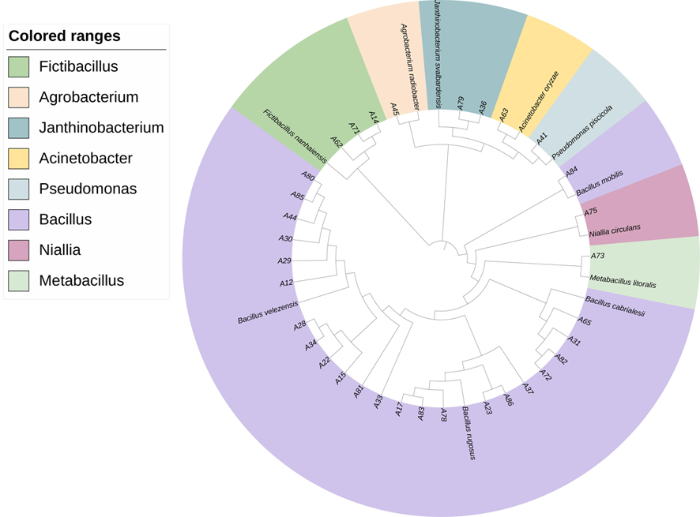
图1
甘草内生细菌的 16S rDNA 的系统进化
Fig.1
Phylogenetic analysis of 16S rDNA of endophytic bacteria in Glycyrrhiza uralensis Fisch
2.3 甘草可培养内生真菌的分离鉴定
研究表明,甘草主根部分离获得5个属真菌,分别是青霉属(Penicillium)、曲霉属(Aspergillus)、枝孢属(Cladosporium)、链格孢属(Alternaria)、聚端孢霉属(Trichothecium);茎部分离到4个属,分别是小脆柄菇属(Candolleomyces)、青霉属(Penicillium)、枝孢属(Cladosporium)、曲霉属(Aspergillus);叶部分离到2个属,分别是青霉属(Penicillium)、枝孢属(Cladosporium);须根分离得到1个属,为镰刀菌属(Fusarium)。甘草内生真菌在不同组织中多样性表现为主根>茎>叶>须根。表3
表3 甘草内生真菌的基因序列
Tab.3
| 菌株 Strains | 部位 Part | 同源性最高的菌株 Closest species | 同源性 Samilarity(%) | GenBank登录号 GenBank accession No. |
|---|---|---|---|---|
| p2 | 主根 | Penicillium sp. ST-PSB-J1 | 99.83 | OP681416 |
| p3 | 主根 | Aspergillus fumigatus C1946 | 99.83 | OP681417 |
| p4 | 主根 | Cladosporium cladosporioides 08SK030 | 92.03 | OP681418 |
| p6 | 主根 | Alternaria alternata JN10 | 99.81 | OP681419 |
| p9 | 茎 | Candolleomyces candolleanus NW550 | 99.42 | ON529501 |
| p10 | 茎 | Penicillium cyclopium CICC 4026 | 99.15 | OP681420 |
| p11 | 茎 | Cladosporium fusiforme a2 | 100.00 | OP681421 |
| p12 | 茎 | Aspergillus fumigatus MUST | 99.15 | OP681422 |
| p13 | 主根 | Cladosporium cladosporioides 08SK030 | 99.51 | OP681423 |
| p15 | 须根 | Fusarium oxysporum NDJ2 | 99.65 | OP681424 |
| p16 | 主根 | Aspergillus fumigatus MUST | 100.00 | OP681425 |
| p17 | 叶 | Cladosporium perangustum IA39 | 97.42 | OP681426 |
| p36 | 主根 | Trichothecium sp. 10731 | 99.42 | OP681427 |
| p38 | 主根 | Alternaria alstroemeriae | 96.85 | OP681428 |
| p44 | 叶 | Penicillium glabrum PM2 | 99.64 | OP681429 |
15株甘草内生真菌隶属于7个属。Cladosporium属4株,占比26.7%;Penicillium属3株,占比20.0%;Aspergillus属3株,占比20.0%;Alternaria属2株,占比13.3%;Trichothecium属1株,占比6.7%;Candolleomyces属1株,占比6.7%;Fusarium属1株,占比6.7%。枝孢属是甘草内生真菌的优势菌群,且甘草主根部位的内生真菌多样性最高。图2
图2
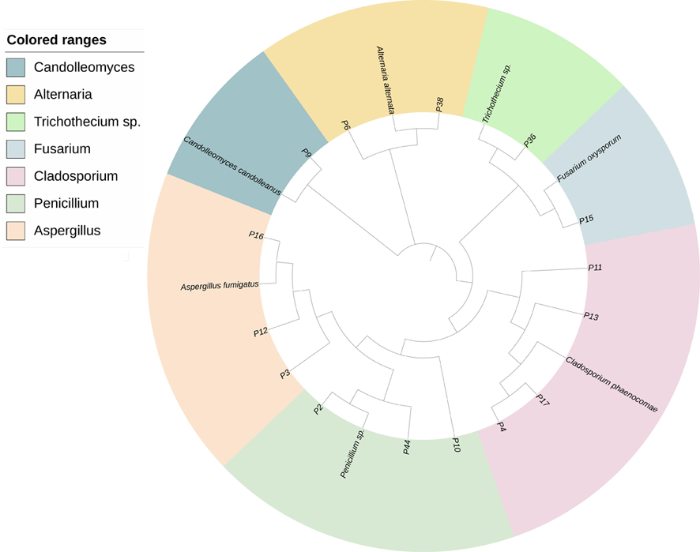
图2
甘草内生真菌的ITS- rDNA 的系统进化
Fig. 2
Phylogenetic analysis of ITS- rDNA of endophytic fungi in Glycyrrhiza uralensis Fisch
2.4 产β-葡萄糖苷酶内生菌的筛选
研究表明,有3株细菌和3株内生真菌的产酶黑色沉淀圈较为明显。8株内生细菌经过营养肉汤培养基发酵24 h、4株内生真菌经马铃薯葡萄糖水培养基发酵5 d后,取上清液对其进行酶活力测定。12株菌株经发酵后,A12、A15、A17、A29、A30、A31、A65、A78、P9、P11、P16、P17的酶活力平均值分别为0.53、3.51、0.48、1.29、0.85、1.51、3.69、5.64、4.01、1.23、2.84、2.69 U/mL。产黑色沉淀圈较大的6株内生菌的酶活力也较高,与另外6株菌株相比酶活力有显著差异。6株菌株酶活力较高的菌株经鉴定后3株内生细菌均为芽孢杆菌属,分别为A15(Bacillus amyloliquefaciens)、A65(Bacillus subtilis)、A78(Bacillus rugosus)。3株内生真菌分别为P9(Candolleomyces candolleanus)、P16(Aspergillus fumigatus)、P17(Cladosporium perangustum)。12株产β-葡萄糖苷酶菌株中分离自根部位的有5株,占比41.7%。分离自茎、叶、须的比例分别为33.3%、16.7%、8.3%,产酶的菌在根部位分布最多。图3,图4
图3
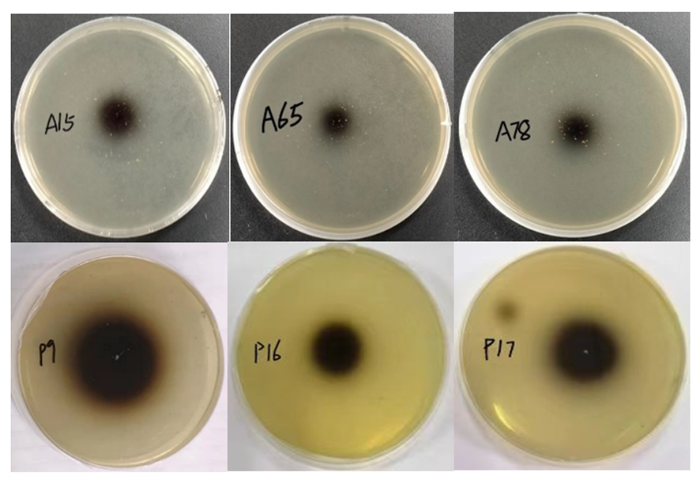
图3
七叶苷平板初筛产β-葡萄糖苷酶菌株
Fig.3
Preliminary screening of strains producing β-glucosidase on esculin agar plates
图 4
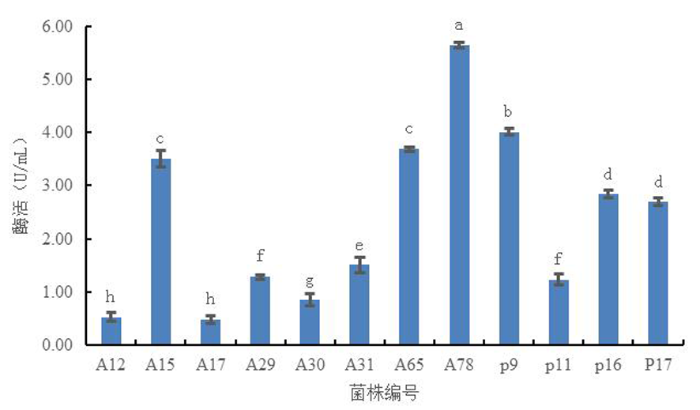
图 4
菌株发酵液的β-葡萄糖苷酶活
注:不同小写字母表示内生细菌或内生真菌的酶活有差异性显著(P<0.05)
Fig.4
The activity of β-glucosidase in fermentation broth of strains
Note:Different lowercase letters indicate that the enzyme activities of endophytic bacteria or endophytic fungi are significantly different(P<0.05)
3 讨论
3.1 近年来围绕甘草内生菌的相关研究逐步增多,甘草内生菌的研究来源主要是乌拉尔甘草、胀果甘草[19]。不同的品种、产地、生态环境、组织部位(根、茎、叶)等因素对甘草内生菌组成有很大的影响[20]。陈静等[21]从5个地区的129株乌拉尔甘草样品中共分离到 438 株内生真菌,结果显示不同产地甘草内生真菌群落组成也各不相同。甘肃、新疆和内蒙古都以镰孢属和曲霉属为优势菌属,而宁夏和北京是以镰孢属为优势菌属。张燃等[22]对宁夏野生和种植甘草的内生菌进行分离,结果表明野生甘草内生菌数量与多样性都明显高于种植甘草。Li等[23]从新疆3个不同地区的乌拉尔甘草中共分离116株内生细菌,隶属于20个属,根组织中14个属,高于茎12个属和叶组织6个属。内生菌的分布规律与宿主本身的特性及内生菌的种类相关,在植物的不同组织部位具有不同分布和结构[24],因为不同植物组织中的结构和营养不同,不同内生菌的营养需求也不相同,这影响了内生菌定植、生长和分布[25]。
3.2 张琴等[28]以新疆胀果甘草为材料,从甘草内生菌中分离的两株高产β-葡萄糖苷酶的菌株均来源根部位,经鉴定两株菌分别是泡盛曲霉和构巢曲霉,酶活力分别为18.63、18.04 U/mL,两株菌对甘草黄酮转化后的抗氧化活性均有显著增加;Huang等[29]从喜树种子中分离到一株产β-葡萄糖苷酶的新菌株花色曲霉,经响应面法优化发酵后的β-葡萄糖苷酶活性为812.86 U/mL,可高效降解纤维素;刘姜华[30]从槐角粉中分离纯化一株产β-葡萄糖苷酶的菌株为米根霉,经发酵后酶活力达到1.16 U/mL,该酶将槐角苷转化为染料木素的转化得率为80.2%;Tam等[31]从人参属植物的根、茎和叶中分离出27株β-葡萄糖苷酶试验阳性的菌株,4株酶活性较高的菌株,其中苍白杆菌Ochrobactrum sp.酶活最高为1.83U/L,用于进一步研究人参皂苷Rb1向人参皂苷Rd和Rg3的生物转化。目前植物内生菌中产β-葡萄糖苷酶的菌株多集中在真菌曲霉属和少部分的细菌,且普遍真菌酶活较高。与其他从药用植物中分离的内生细菌的报道一致[32-33]。试验获得的一株芽孢杆菌Bacillus rugosus A78,酶活优于其他真菌菌株,最高为5.64 U/mL。而且芽孢杆菌具有易培养、生长周期短的特点,后期通过优化菌株发酵条件提高产酶活性,可以进一步提升β-葡萄糖苷酶在工业上的应用潜力。
4 结论
共获得纯化内生菌48株,其中,内生细菌33株,内生真菌15株。内生细菌在主根和茎部分布最多,芽孢杆菌属是甘草组织中的优势细菌属,内生真菌在主根中定殖的数量最多,枝孢属是甘草内生真菌的优势菌属。根部可能是甘草内生菌寄生或共生的主要组织部位。筛选获得12株产β-葡萄糖苷酶的菌株,有6株酶活较高,其中Bacillus rugosus A78菌株酶活最高为5.64 U/mL。产β-葡萄糖苷酶的菌株在主根组织部位分布的最多,占比41.7%,是选育产酶菌株的优势部位。
参考文献
Community structure,spatial distribution,diversity and functional characterization of culturable endophytic fungi associated with Glycyrrhiza glabra L.
[J].
黄芪内生菌多样性及其次生代谢产物研究进展
[J].
Research progress on diversity and secondary metabolites of endophytic bacteria in Astragalus membranaceus
[J].
内生菌影响药用植物产生药理活性化合物的研究进展
[J].
药用植物自古以来就被应用于传统医学,是抗菌、抗病毒、抗肿瘤等天然药物的重要来源。广泛存在于植物健康组织中的内生微生物,是植物微生态系统的重要组成部分。已有研究表明,大量药用植物内生菌具有重要的生物学价值和经济意义,它们在漫长的进化过程中,与宿主植物之间建立了某些特殊的关系,对药用植物活性代谢产物的形成有重要作用,进而影响药用植物源药材的质量和产量。本文聚焦于内生菌与药用植物药效成分之间的相互关系,通过调查近年来已发表的药用植物内生菌研究数据,总结了存在于药用植物中的内生菌多样性、潜在药用价值、影响药理活性化合物生成的生物学机制问题。本综述旨在阐明内生菌在天然药物生产中的作用机制和重要地位,了解相关知识有助于科研工作者更有效的利用植物内生菌控制药材品质,或者从植物/内生菌资源中开发、生产更多更好的天然药物。
Impact of Endophytic Microorganisms on the Pharmaco-active Compounds Production in Medicinal Plants:A Review
[J].Medicinal plants have been used in traditional medicine since antiquity,and they represent a very important source of natural medicines such as antimicrobial,antiviral,and antitumor molecules. Endophytic microorganisms exist widely inside the healthy tissues of living plants,and are important components of plant micro-ecosystems. In fact,many studies have demonstrated the biological and economic importance of endophytes in medicinal plants. Over the long period of their evolution,these microbes have established some special relationships with their host plants,which can significantly influence the formation of bioactive metabolic products in hosts,then affect the quality and quantity of crude drugs derived from these medicinal plants. This paper focuses on the increasing knowledge of relationships between endophytes and pharmaco-active compounds in medicinal plants through reviewing of the published data of studying endophytes in medical plants in recent years. The analytical results summarize the studies on endophytes isolated from medicinal plants,including their biodiversity,pharmacological potential,and biosynthetic mechanism affecting the formation of pharmaco-active compounds. The aim of this review is to elucidate the role mechanism and importance of endophytes in the production of natural medicines. Understanding such knowledge can help researchers apply them more effectively to improve the quality of medicinal plants,or exploit more and better natural medicines from plants or endophytes resources.
Quorum quenching is an antivirulence strategy employed by endophytic bacteria
[J].Bacteria predominantly use quorum sensing to regulate a plethora of physiological activities such as cell-cell crosstalk, mutualism, virulence, competence, biofilm formation, and antibiotic resistance. In this study, we investigated how certain potent endophytic bacteria harbored in Cannabis sativa L. plants use quorum quenching as an antivirulence strategy to disrupt the cell-to-cell quorum sensing signals in the biosensor strain, Chromobacterium violaceum. We used a combination of high-performance liquid chromatography high-resolution mass spectrometry (HPLC-ESI-HRMS(n)) and matrix-assisted laser desorption ionization imaging high-resolution mass spectrometry (MALDI-imaging-HRMS) to first quantify and visualize the spatial distribution of the quorum sensing molecules in the biosensor strain, C. violaceum. We then showed, both quantitatively and visually in high spatial resolution, how selected endophytic bacteria of C. sativa can selectively and differentially quench the quorum sensing molecules of C. violaceum. This study provides fundamental insights into the antivirulence strategies used by endophytes in order to survive in their ecological niches. Such defense mechanisms are evolved in order to thwart the plethora of pathogens invading associated host plants in a manner that prevents the pathogens from developing resistance against the plant/endophyte bioactive secondary metabolites. This work also provides evidence towards utilizing endophytes as tools for biological control of bacterial phytopathogens. In continuation, such insights would even afford new concepts and strategies in the future for combating drug resistant bacteria by quorum-inhibiting clinical therapies.
微生物发酵技术在中药苷类生物转化中的应用进展
[J].
Microbial fermentation technology in traditional Chinese medicine glycosides application progress in biotransformation
[J].
内生真菌Eupenicillium javanicum R57水解京尼平苷β-葡萄糖苷酶的分离纯化及其酶学性质
[J].从10株东乡野生稻内生真菌中筛选到7株可转化京尼平苷合成京尼平的菌株,其中菌株R57的转化效率最高,最大转化率可达98.7%。通过菌体形态结合ITS rDNA、18S rDNA及28S rDNA序列分析,将该菌鉴定为爪哇正青霉Eupenicillium javanicum R57。菌株R57的粗酶液经硫酸铵沉淀、透析、超滤、EzFast DEAE FF阴离子交换层析及Sephadex G-150凝胶柱层析,获得电泳纯的β-葡萄糖苷酶,其相对分子质量约为81kDa。该β-葡萄糖苷酶对京尼平苷和4-硝基苯基-β-D-吡南葡萄糖苷(PNPG)均有催化作用,但对京尼平苷的K<sub>m</sub>值最小,为0.153mmol/L,且催化效率更高;该β-葡萄糖苷酶具有较强耐酸性和耐热性,最适pH 4.6,最适温度60℃。该酶活性受K<sup>+</sup>、Co<sup>2+</sup>、Zn<sup>2+</sup>、Mn<sup>2+</sup>、Al<sup>3+</sup>及尿素的激活,但受Cu<sup>2+</sup>、Fe<sup>2+</sup>、Mo<sup>3+</sup>、Pb<sup>2+</sup>及SDS不同程度的抑制。
Purification and characterization of geniposide- hydrolyzing β-glucosidase from endophytic Eupenicillium javanicum R57 harboring in Dongxiang wild rice
[J].In this study, seven out of ten endophytic fungal strains from Dongxiang wild rice were screened for producing β-glucosidase. The strain R57 has the highest conversion efficiency, and the biotransformation rate was 98.7% from geniposide to genipin. The strain R57 was identified as Eupenicillium javanicum R57 by morphological characteristics, microscopic observation and ITS rDNA, 18S rDNA, 28S rDNA sequence analysis. Using the combination of ammonium sulfate precipitation, dialysis, ultrafiltration, EzFast DEAE FF anion exchange chromatography and Sephadex G-150 gel column chromatography, β-glucosidase was purified. Molecular weight of β-glucosidase was determined to be 81kDa by SDS-PAGE. The β-glucosidase can hydrolyze p-nitrophenyl-β-D-galactopyranoside (PNPG) and geniposide, however, the efficiencies of hydrolyzing geniposide were higher than that of PNPG. The Km value of β-glucosidase to geniposide was 0.153mmol/L. β-glucosidase showed high pH stability and heat resistance, the highest reaction velocity was acheived at 60°C, pH 4.6. The hydrolysis activity of the β-glucosidase was activated by K+, Co2+, Zn2+, Mn2+, Al3+ and urea, while inhibited by Cu2+, Fe2+, Mo3+, Pb2+ and SDS.
里氏木霉及其纤维素酶高产菌株的研究进展
[J].
Research development of trichoderma reesei and its cellulase hyperproduction strains
[J].
Positive role of non-catalytic proteins on mitigating inhibitory effects of lignin and enhancing cellulase activity in enzymatic hydrolysis:Application,mechanism and prospective
[J].
Microbial β-Glucosidases:Screening,Characterization,Cloning and Applications
[J].
产β-葡萄糖苷酶芽孢杆菌的筛选及水解大豆异黄酮糖苷研究
[J].为获得能高效水解大豆异黄酮糖苷的芽孢杆菌,利用七叶苷平板分离法从动物的新鲜粪便中筛选产β-葡萄糖苷酶的芽孢杆菌菌株,然后对酶活最高的菌株进行种属鉴定和水解大豆异黄酮糖苷的研究.结果显示:筛选到1株酶活力较高的芽孢杆菌R2-2,经鉴定为解淀粉芽孢杆菌(Bacillus amyloliquefaciens);该菌株有较高的糖苷水解能力,黄豆苷水解率最高达到53.65%,染料木苷为48.80%.
Screening of bacillus strains producing β-Glucosidase and study on hydrolysis of soybean isoflavone glycosides
[J].
Characterization of a novel thermostable glucose-tolerant GH1 β-glucosidase from the hyperthermophile Ignisphaera aggregans and its application in the efficient production of baohuoside I from icariin and total epimedium flavonoids
[J].
diversity and bioactivity of culturable bacterial endophytes in mountain-cultivated ginseng in Korea
[J].Plants harbor diverse communities of bacterial species in their internal compartments. Here we isolated and identified bacterial endophytes from mountain-cultivated ginseng (MCG, Panax ginseng Meyer) to make working collection of endophytes and exploit their potentially beneficial properties toward plants and human being. A total of 1,886 bacteria were isolated from root, stem and leaf of MCGs grown in 24 different sites across the nation, using culture-dependent approach. Sequencing of 16S rDNA allowed us to classify them into 252 distinct groups. Taxonomic binning of them resulted in 117 operational taxonomic units (OTUs). Analysis of diversity indices across sampling sites and tissues suggested that composition of bacterial endophyte community within ginseng could differ substantially from one site to the next as well as from one host compartment to another. Assessment of 252 bacterial isolates for their beneficial traits to host plants showed that some bacteria possesses the ability to promote plant growth and produce ß-glucosidase, indicating their potential roles in plant growth promotion and bio-transformation. Taken together, our work provides not only valuable resources for utilization of bacterial endophytes in ginseng but also insights into bacterial communities inside a plant of medicinal importance.
Microbial β-Glucosidase:Sources,Production and Applications
[J].
微生物来源的β-葡萄糖苷酶在食品工业中应用进展
[J].
Progress on the β-Glucosidase from Microganisms and Its Applications in Food Industry
[J].
High-throughput cultivation and identification of bacteria from the plant root microbiota
[J].Cultivating native bacteria from roots of plants grown in a given environment is essential for dissecting the functions of the root microbiota for plant growth and health with strain-specific resolution. In this study, we established a straightforward protocol for high-throughput bacterial isolation from fresh root samples using limiting dilution to ensure that most cultured bacteria originated from only one microorganism. This is followed by strain characterization using a two-sided barcode polymerase chain reaction system to identify pure and heterogeneous bacterial cultures. Our approach overcomes multiple difficulties of traditional bacterial isolation and identification methods, such as obtaining bacteria with diverse growth rates while greatly increasing throughput. To facilitate data processing, we developed an easy-to-use bioinformatic pipeline called 'Culturome' ( https://github.com/YongxinLiu/Culturome ) and a graphical user interface web server ( http://bailab.genetics.ac.cn/culturome/ ). This protocol allows any research group (two or three lab members without expertise in bioinformatics) to systematically cultivate root-associated bacteria within 8-9 weeks.
产β-葡萄糖苷酶菌株的筛选及产酶条件优化
[J].
Screening of β-glucosidase producing strains and optimization of enzyme production conditions
[J].
甘草内生菌研究概况
[J].甘草内生菌能够产生与宿主植物相同、相似或全新的活性代谢物。采用内生菌发酵法生产甘草次生代谢物对可持续利用甘草资源及筛选新型活性代谢产物具有重要意义。在过去的几十年,尽管人们对甘草内生菌多样性、分离和鉴定、药理作用、次生代谢产物等方面进行了研究,并取得了一定的成果,但还远远不能满足生产的需要,甘草内生菌作为微生物资源是天然产物的重要来源。本研究综述了甘草内生菌及其次生代谢产物的相关研究,归纳出甘草内生菌可产甘草苷、甘草次酸、甘草素等次生代谢产物,并针对甘草内生菌次生代谢产物研究中存在的问题进行了展望,为合理利用甘草内生菌及进一步开发应用提供参考。
Research Progress on Endophytes from Glycyrrhiza uralensis
[J].Endophytes isolated from Glycyrrhiza uralensis have the potential to produce the same, similar or new active metabolites as the host plants. Secondary metabolites of Glycyrrhiza uralensis produced by fermentation with endophytes are not only important for sustainable utilization of Glycyrrhiza uralensis resources but also significant for screening new metabolites. In the past several decades, although the diversity, isolation and identification, pharmacological action, secondary metabolites and other aspects of endophytes from Glycyrrhiza uralensis have been studied and some achievements have been obtained, it is far from meeting the needs of production. As a microbial resource, endophytes from Glycyrrhiza uralensis are an important source of natural products. The study reviewed the research on endophytes from Glycyrrhiza uralensis and their metabolites, and summarized that endophytes from Glycyrrhiza uralensis could produce liquiritin, glycyrrhetinic acid, liquiritigenin and other secondary metabolites. Meanwhile, according to the problems in the research on secondary metabolites of endophytes from Glycyrrhiza uralensis, the study discussed the prospect and provided certain reference for the rational utilization of endophytes from Glycyrrhiza uralensis.
甘草内生菌的鉴定与药理作用和活性成分研究进展
[J].
Research progress of identification,pharmacological action and active ingredients of endophytes isolated from Glycyrrhiza uralensis
[J].
不同产地甘草内生真菌多样性及分离条件研究
[J].
Diversity and isolation parameters of endophytes from Glycyrrhiza uralensis of different habitats
[J].
宁夏野生甘草和种植甘草内生菌的分离和初鉴定
[J].
Isolation and preliminary identification of endophyte of wild and cultivated Glycyrrhiza uralensis in Ningxia
[J].
Synergistic plant-microbe interactions between endophytic bacterial communities and the medicinal plant Glycyrrhiza uralensis F.
[J].
麻花秦艽不同组织部位可培养内生菌群结构及其与龙胆苦苷含量的相关性
[J].
Community Structure of Cultivable Endophytes in Different Organs of Gentiana straminea Maxim and Its Correlation with the Content of Gentiopicrin
[J].
The Effect of Bagging Branches on Levels of Endophytic Fungal Infection in Japanese Beech Leaves
[J].
Comparative Study on Population Ecological Distribution and Extracellular Enzyme Activities of Endophytic Fungi in Artemisia annua
[J].
产β-葡萄糖苷酶甘草内生菌的筛选及对甘草黄酮转化的研究
[J].对甘草内生菌进行分离,并从中进行高产β-葡萄糖苷酶菌株的筛选,以利用微生物转化法将甘草黄酮糖苷水解成苷元,提高其抗氧化活性。结果从分离纯化出的47株甘草内生菌中筛选得到GF10和GF19两株高β-葡萄糖苷酶活性真菌,两株菌对甘草黄酮的转化实验结果表明:转化后黄酮的抗氧化活性均有显著增加,GF10、GF19对DPPH自由基的清除率分别达到71.67%、65.94%,比未经转化黄酮的清除率(20.68%)分别提高了246.57%、218.86%。对甘草黄酮主要成分的HPLC法检测结果表明,经微生物转化后,甘草苷与异甘草苷的质量浓度均有不同程度的降低,而甘草素和异甘草素的质量浓度则显著增加。其中GF19转化的处理,甘草素在4种黄酮物质中所占的比例最高,为29.18%,比转化前(10.38%)提高了181.12%;异甘草素比例最高的处理是GF10,为8.64%,比转化前(4.27%)高出102.34%。
Isolation of β-Glucosidase-Producing Endophytes from Glycyrrhiza inflate and Their Effects on Flavonoid Transformation
[J].Forty-seven endophytes were isolated from different parts (root, stem and leaf) of Glycyrrhiza inflate and potent 2 β-glucosidase-producing strains, designated as GF10 and GF19, were screened out of them. GF10 and GF19 were comparatively evaluated for their effectiveness in microbial transformation of flavonoid glucosides in Glycyrrhiza inflate into aglycones to obtain higher antioxidant activity. Both strains could increase the antioxidant activity of flavonoids, and the DPPH radical scavenging rates after fermentation with them were 71.67% and 65.94%, respectively, which were 246.57% and 218.86% higher than before fermentation (20.68%). HPLC analysis showed that the concentrations of liquiritin and isoliquiritin decreased to different extents after microbial transformation, whereas the concentrations of liquiritigenin and isoliquiritigenin significantly increased. Liquiritigenin was the most abundant among four flavonoids with a percentage of 29.18% after GF19 transformation, which was 181.12% higher than the original level (10.38%), while GF10 transformation made isoliquiritigenin the most dominant flavonoid and its percentage was increased from its original level (4.27%) to 8.64% by 102.34%.
Production,immobilization and characterization of beta-glucosidase for application in cellulose degradation from a novel Aspergillus versicolor
[J].
Isolation and screening of endophytic bacteria from Ngoc Linh ginseng(Panax vietnamensis Ha et Grushv) for biosynthesis β-glucosidase
[J].
Culturable endophytic bacteria associated with medicinal plant Ferula songorica:molecular phylogeny,distribution and screening for industrially important traits[J]. 3 Biotech


